
498A FIR vs Private Complaint in Delhi: Which Route Should You Take?
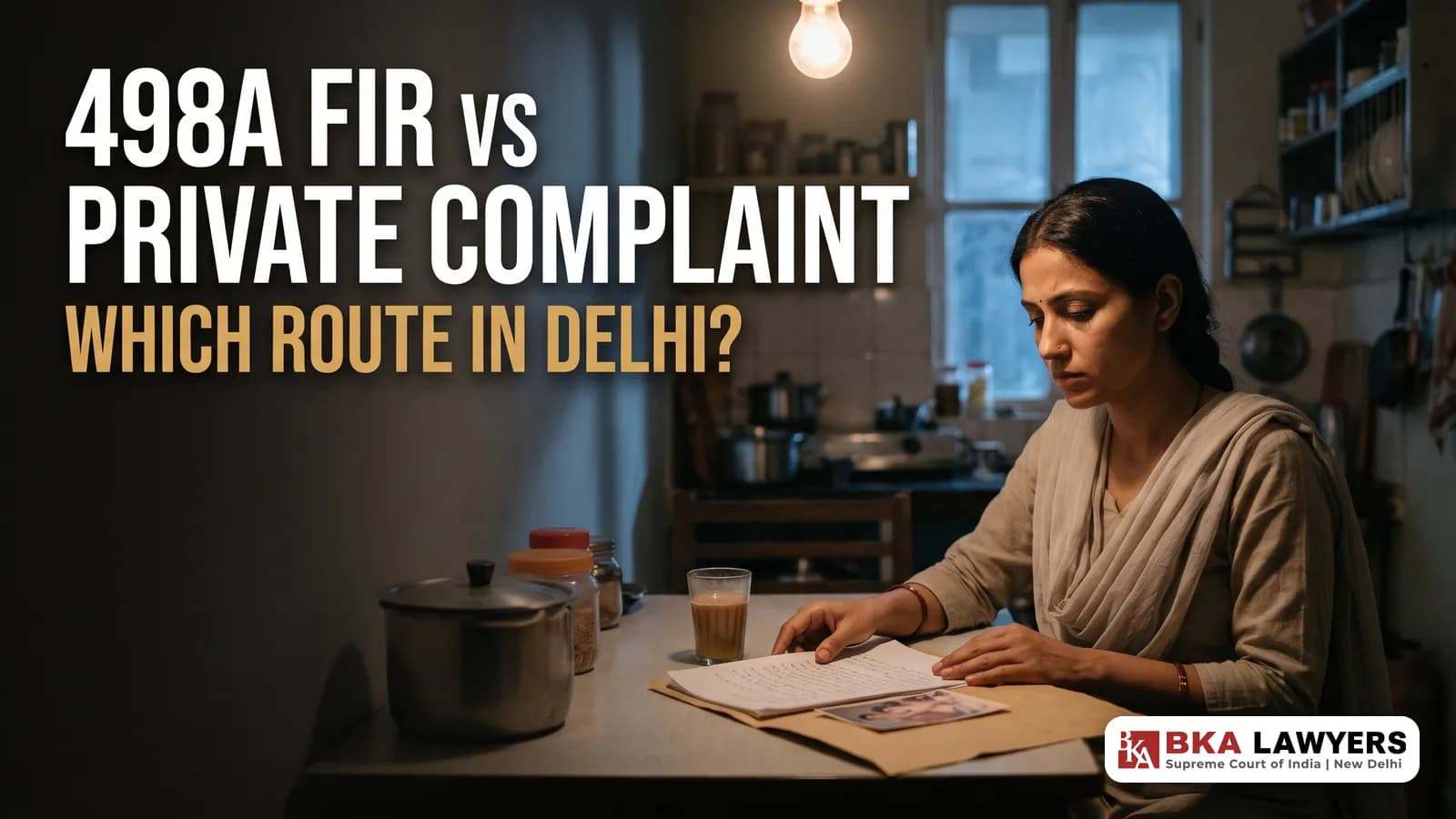
A woman in Delhi who says she has been subjected to cruelty by her husband or in-laws has two legal doors to knock on. She can go to the police and ask for an FIR (First Information Report — the formal police record that starts a criminal investigation). Or she can file a private complaint before a Magistrate, who then decides whether the police should investigate at all. The choice shapes how fast the case moves, how much control she keeps, and how easily the other side can challenge it.
The offence is cruelty by husband or his relatives, earlier Section 498A of the Indian Penal Code (IPC) and now Section 85 of the Bharatiya Nyaya Sanhita (BNS) for acts after 1 July 2024. The procedure follows the Bharatiya Nagarik Suraksha Sanhita (BNSS) for conduct after that date, and the old CrPC for anything earlier. Two routes exist under both regimes.
Route 1: Go to the police and seek an FIR
This is the route most people picture first. The complainant approaches the local police station, or the women's help desk at the station, or the Special Cell for Women in Delhi, and gives a written complaint. If the police register an FIR, the machinery of the State begins.
- When it fits. Immediate danger, ongoing threats, recent violence, or evidence that could disappear. The police can act quickly, record statements, and, where needed, arrest. If you are unsure which police station has jurisdiction, Delhi police generally register a Zero FIR at any station and then transfer the papers to the correct one.
- What it involves. The police record the complaint, investigate, and file a charge sheet (the formal report listing the accused and the evidence) before the Magistrate. The complainant does not run the case; the State does.
- The main risk. Delay or refusal at the police station is common enough that the law provides a remedy. If the police do not register an FIR, the complainant can approach the Superintendent of Police under Section 173(4) of the BNSS, or move the Magistrate under Section 175(3) of the BNSS (earlier Section 156(3) CrPC), asking that the police be directed to investigate.
A second risk is credibility. In practice, courts in Delhi look closely at whether the allegations are specific — dates, incidents, who said or did what — or a general narrative of family friction. A Delhi High Court line of decisions has repeatedly held that ordinary matrimonial discord, mere taunts, or a child staying with the husband after separation cannot by themselves be dressed up as Section 498A cruelty. A vague FIR invites a quashing petition under Section 528 of the BNSS (earlier Section 482 CrPC) before the Delhi High Court. A careful, fact-specific complaint survives that scrutiny better than a long one built on adjectives.
Route 2: File a private complaint before the Magistrate
Here the complainant, through a lawyer, files a complaint before the Judicial Magistrate having jurisdiction over the area where the cruelty took place. The Magistrate examines the complainant on oath.
- When it fits. You want a court to look at the material before the police are directed to act; the police have already declined to register an FIR and you prefer the judicial route to the SP route; or the allegations are older and you need to explain delay with documents.
- What it involves. The Magistrate may dismiss the complaint if there is no sufficient ground to proceed, or may direct an investigation by the police under Section 175(3) of the BNSS (earlier Section 156(3) CrPC), or take cognisance and issue process to the accused under Section 223 of the BNSS (earlier Section 204 CrPC). If the Magistrate takes cognisance directly, the complainant's side must prove the case, though the State may still assist. The complainant carries a heavier practical burden than in an FIR case.
- The main risk. A private complaint is a slower route to any coercive step against the accused. It can be dismissed at the threshold, and that dismissal is itself a setback. There is also a limitation to watch: the law prescribes a period within which a complaint must be filed, and there is a real risk if you sit on old incidents. If you are close to that line, treat the date as urgent, not as a detail to sort out later.
How to decide
- If there is a present threat, recent violence, or you fear evidence will vanish, prefer the police route. Speed matters more than control. Use the Zero FIR facility if the jurisdiction is unclear, and keep the SP and Magistrate remedies in reserve if the police stall.
- If the police have already refused to register an FIR, prefer the judicial route under Section 175(3) BNSS. A Magistrate's direction to investigate is often more effective than arguing with a station officer.
- If the allegations are older and need documentary context, a private complaint can be the better fit — but check the limitation position first.
- If what you really want is protection, maintenance and a residence order, neither route is the main vehicle. Those come under the Protection of Women from Domestic Violence Act, 2005; a 498A case is a criminal proceeding with a different purpose. The two often run together, but they are not substitutes.
What judges weigh in practice is specificity. A complaint that says the husband and mother-in-law demanded a particular thing on a particular occasion, with names and dates attached, reads very differently from one that says "they harassed me constantly." The first survives a quashing petition; the second often does not.
Before taking either route, gather the marriage certificate, any medical records, messages and call records, bank or transfer records where dowry is alleged, and a dated written account of the incidents in your own words. Note the date of the last alleged act — limitation, where it applies, can decide the fate of a good case. A short chronological note prepared calmly before any complaint is filed is worth more than a long narrative prepared in distress.
Facing a similar situation? Talk to a BKA advocate before you act.
Chat on WhatsAppNeed help with this?
Our Family Law services
Frequently Asked Questions
Can I file a 498A case directly in court in Delhi without going to the police first?
Yes. A private complaint can be filed before the Judicial Magistrate having jurisdiction, who will examine you on oath. The Magistrate may dismiss it, direct a police investigation under Section 175(3) of the BNSS, or take cognisance directly. Going straight to court is slower than an FIR but gives a judicial officer the first look at your material.
Police FIR nahi likh rahi, kya karun? (The police are refusing to register my FIR — what should I do?)
Write to the Superintendent of Police under Section 173(4 of the BNSS, setting out the complaint and the refusal. If that does not produce action, move the Magistrate under Section 175(3) BNSS asking for a direction to the police to investigate. Keep copies of every written complaint and any acknowledgement you receive.
Is 498A still a valid section after the new criminal laws?
Section 498A IPC continues to apply to conduct before 1 July 2024. For acts on or after that date, the equivalent offence is Section 85 of the Bharatiya Nyaya Sanhita, and the procedure follows the BNSS. The substance of the offence — cruelty by the husband or his relatives — remains broadly the same.
Can a 498A FIR be quashed if the allegations are general?
Yes. The Delhi High Court has repeatedly held that ordinary matrimonial discord, taunts, or a child staying with the husband after separation do not amount to cruelty under Section 498A. A quashing petition lies under Section 528 BNSS. This is why a complaint built on specific dates and incidents is far more durable than a general narrative.
Related Articles

7 Alimony Myths That Could Cost You Dearly in an Indian Divorce
Alimony and maintenance in India are governed by fact-specific rules. We debunk seven myths that can cost you money or rights in divorce.
Grandparents' Visitation Rights in India: What the Law Actually Says (and Doesn't)
Indian law gives grandparents no automatic right to see their grandchildren. Courts weigh the child's welfare above all. Here are the myths, and the facts that matter.

Daughter as Coparcener: How the 2005 Hindu Succession Amendment Changed Women's Property Rights Forever
The Hindu Succession (Amendment) Act, 2005 made daughters coparceners by birth in joint Hindu family property. This explainer covers who it applies to, how the Supreme Court's 2020 ruling on fathers who died before 2005 works, and the practical steps to enforce the right.