
Arrest Without Written Grounds: Why the Supreme Court Says the Officer Must Face a Departmental Inquiry
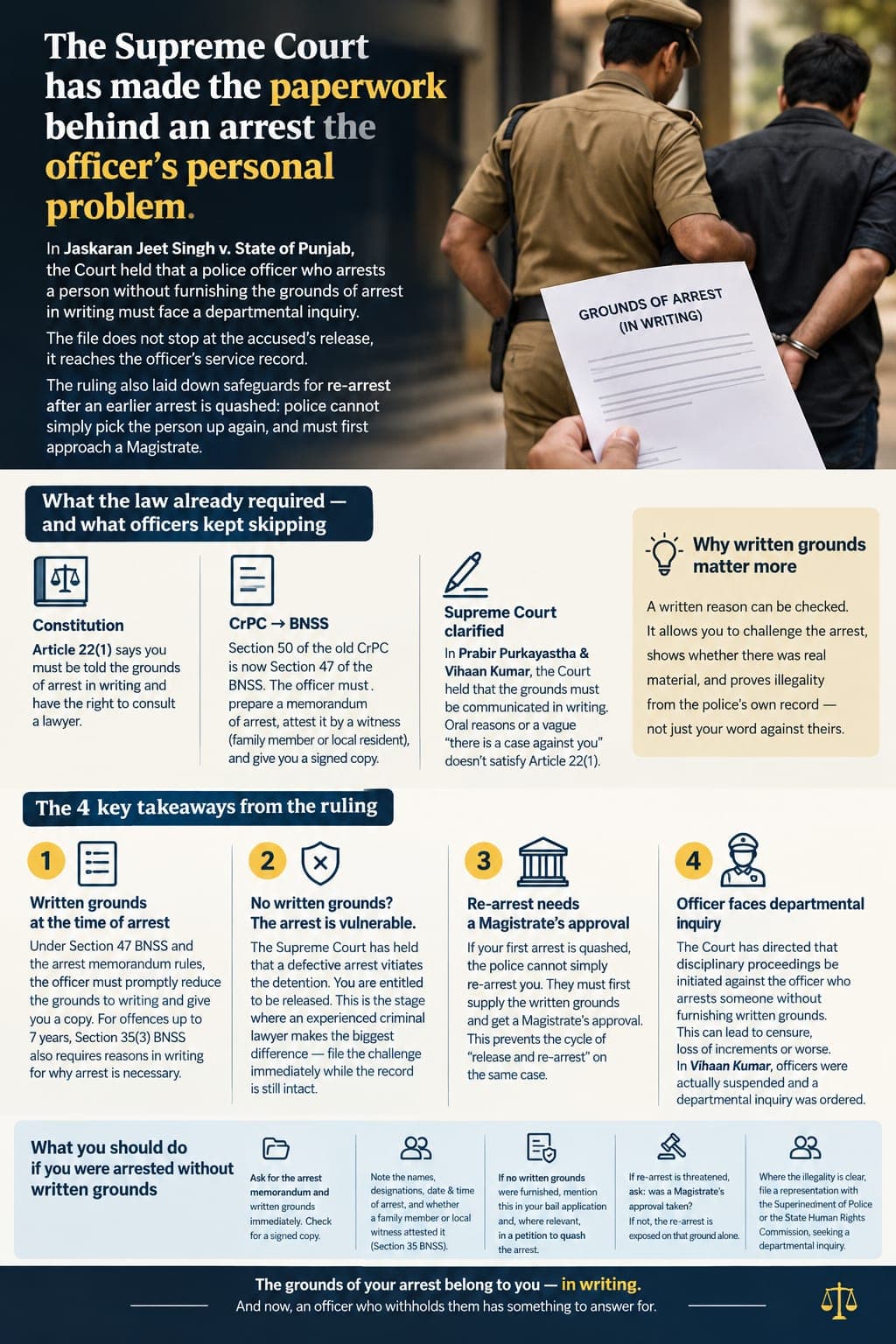
The Supreme Court has now made the paperwork behind an arrest the officer's personal problem. In Jaskaran Jeet Singh v. State of Punjab, the Court held that a police officer who arrests a person without furnishing the grounds of arrest in writing must face a departmental inquiry — the file does not stop at the accused's release, it reaches the officer's service record. The ruling also laid down safeguards for re-arrest after an earlier arrest is quashed: police cannot simply pick the person up again, and must first approach a Magistrate.
For anyone who has been detained, or has watched a family member taken away, this changes the practical arithmetic of an illegal arrest. It is no longer only about getting bail.
What the law already required — and what officers kept skipping
The right to be told why you are being arrested is not new. Article 22(1) of the Constitution says a person who is arrested cannot be detained without being informed, as soon as possible, of the grounds of arrest, and cannot be denied the right to consult a lawyer. Section 50 of the old CrPC mirrored this, and after the criminal law overhaul the same obligation sits in Section 47 of the Bharatiya Nagarik Suraksha Sanhita, 2023 (BNSS), read with the documentation and production requirements in Sections 35 and 58 BNSS — the arresting officer must prepare a memorandum of arrest, have it attested by a witness (a family member or a respectable local resident), and give the person a signed copy.
What the Supreme Court added in earlier decisions — Prabir Purkayastha v. State (NCT of Delhi) and Vihaan Kumar v. State of Haryana — was the word "writing." Telling someone orally, or vaguely saying "there is a case against you," does not satisfy Article 22(1). The grounds must be communicated in writing, and the Court described that requirement as one it "reiterates" with no hesitation.
Why written grounds matter more than officers admit
An oral reason cannot be checked. A written one can be. That is the whole point.
Once the grounds are on paper, three things become possible. First, you can challenge the arrest — either through bail or by asking the High Court to quash it under Article 226 or Section 528 BNSS (the successor to Section 482 CrPC). Second, the trial court can see whether the arrest was made on material or on suspicion dressed up as material. Third, if the arrest was unlawful, the illegality is provable from the police's own record rather than your word against theirs.
This is why the Court in Vihaan Kumar refused to treat a defective arrest as a technical slip. It is the difference between a detention that has a stated legal basis and one that simply happens.
Step 1: Officers must furnish written grounds at the time of arrest
Under Section 47 BNSS and the arrest memorandum rules, the arresting officer must promptly reduce the grounds of arrest to writing and serve a copy on the arrested person. In practice that means a signed document, not a verbal explanation at the police station.
If the arrest is made for an offence carrying up to seven years, Section 35(3) BNSS is also engaged — the officer must record reasons in writing for why the arrest is necessary, and the officer must be able to justify those reasons later before the Magistrate.
Step 2: If arrested without written grounds, the arrest itself becomes vulnerable
The Supreme Court has repeatedly held that failure to communicate grounds in writing vitiates the arrest. The remedy is not symbolic. The detention can be declared illegal, and the accused is entitled to be released.
This is the stage where an experienced criminal lawyer matters most: the challenge is filed immediately, while the illegality is fresh and the record is still intact. Courts look at what is on the file, not at what an officer later claims was said.
Step 3: Re-arrest after a quashed arrest needs a Magistrate's approval
The same ruling extends the logic forward. If your first arrest is quashed because the grounds were not furnished, the police cannot simply re-arrest you and repeat the process. The Supreme Court has mandated that before a re-arrest, the investigating agency must supply the written grounds and secure the approval of a Magistrate.
Practically, this prevents the loop that many accused persons face: get released on a technical defect, get picked up again the next week on the same case.
Step 4: The officer now faces a departmental inquiry
This is the genuinely new part. The Court held that disciplinary or departmental proceedings should be initiated against the officer who arrested a person without furnishing written grounds. A departmental inquiry is not a criminal prosecution — it is an internal service action that can lead to censure, loss of increments, or worse for the officer's career.
That consequence is what turns an arrest safeguard from advice into pressure. Officers are now on notice that an improper arrest will follow them into their service record. In Vihaan Kumar, officers who mishandled the appellant's escort and medical examination were actually suspended and a departmental inquiry was ordered against them by the Deputy Commissioner of Police — so this is not a paper threat.
What you should do if you were arrested without written grounds
Do not wait for the charge sheet. Get the record while it still exists.
Ask for the arrest memorandum and the written grounds immediately, and note whether you were given a signed copy. Record the names and designations of the arresting officers, the date and time of arrest, and whether a family member or local witness attested the memorandum under Section 35 BNSS. If no written grounds were furnished, that fact itself should be stated in your bail application and, where relevant, in a petition seeking to quash the arrest.
Where re-arrest is threatened after a quashed arrest, the first question to ask is simple: was a Magistrate's approval taken? If not, the re-arrest is exposed on that ground alone.
And where the illegality is clear, a representation to the Superintendent of Police or the State Human Rights Commission, asking for a departmental inquiry against the erring officer, is a legitimate step — the Supreme Court has now expressly endorsed that consequence.
None of this requires you to know the Criminal Procedure Code by heart. It requires you to know that the grounds of your arrest belong to you in writing, and that an officer who withholds them has something to answer for.
Facing a similar situation? Talk to a BKA advocate before you act.
Chat on WhatsAppNeed help with this?
Our Civil Law services
Frequently Asked Questions
What exactly counts as 'written grounds of arrest' that the police must give me?
It means a written document setting out why you are being arrested — the offence, the basis for suspicion, and the reasons the officer believes your arrest is necessary. An oral explanation at the police station, or being told 'there is a case against you', does not satisfy Article 22(1) of the Constitution or Section 47 BNSS. Under Section 35 BNSS the arresting officer must also prepare an arrest memorandum, have it attested by a family member or respectable local witness, and give you a signed copy.
If my arrest was quashed for not giving written grounds, can the police simply arrest me again?
No. The Supreme Court has specifically addressed this loop. Before re-arresting you after an arrest has been quashed for defective grounds, the police must supply the written grounds and obtain the approval of a Magistrate. If they pick you up again without that approval, the re-arrest is vulnerable to challenge on that ground alone.
What is a departmental inquiry against a police officer, and does it actually happen?
A departmental inquiry is an internal disciplinary proceeding against the officer, separate from any criminal prosecution. It can result in censure, withholding of increments, suspension, or heavier service penalties. It is not theoretical — in the Vihaan Kumar matter, officers who mishandled an arrested person's escort and medical examination were suspended and a departmental inquiry was ordered against them by the Deputy Commissioner of Police.
Can I ask for a departmental inquiry against the officer who arrested me illegally?
Yes. You can make a representation to the Superintendent of Police or the senior officer of the concerned station, setting out the facts and asking for disciplinary action. You can also approach the State Human Rights Commission. The Supreme Court's ruling now expressly endorses a departmental inquiry as the consequence of failing to furnish written grounds, which strengthens such a request considerably.
Should I raise the missing written grounds in my bail application or file a separate petition?
Raise it in the bail application first — an arrest that violates Article 22(1) and Section 47 BNSS is itself a ground for release, and courts examine what is on the record. If the arrest is being used to justify continued custody, a separate petition to quash the arrest under Article 226 or Section 528 BNSS is also available. Practically, both are stronger when filed early, while the arrest record is still intact.
What should I collect immediately after an arrest made without written grounds?
Note the names and designations of the arresting officers, the date and time of arrest, the police station, and whether any family member or local witness attested the arrest memorandum. Ask in writing for the grounds of arrest and the arrest memorandum, and keep proof of that request. This record is what proves the defect later, and it is far easier to gather in the first few days than months afterwards.

About the author
Ujjwal Agrawal
Advocate · Commercial & Money Recovery Cases
Ujjwal Agrawal focuses on commercial litigation and money recovery, including cheque bounce cases under the Negotiable Instruments Act and recovery suits for individuals and businesses.
More about our team →Related Articles

Hiding a Live-In Relationship or a Child From a Prospective Bride: What the Kerala High Court Has Now Said
The Kerala High Court has held that concealing a live-in relationship or an existing child from a prospective bride can amount to obtaining consent to sex by deceitful means. Here is what the ruling means, in plain English, and what both sides should know before a marriage is arranged.
Arbitration and Settlement in India: A Practical Guide
Understand how arbitration works in India under the Arbitration and Conciliation Act, 1996, including settlement options, enforceability, and practical steps for resolving disputes outside court.
Anti-Paper Leak Law Gets Stronger: How the 2026 Amendment Builds on the 2024 Act
In-depth analysis of the 2026 amendment to India's anti-paper leak law, explaining its key provisions and how it enhances the earlier 2024 Act.