
Delhi High Court Orders Son and Daughter-in-Law to Vacate an 85-Year-Old Father's Own House: What This Means for Parents and Adult Children
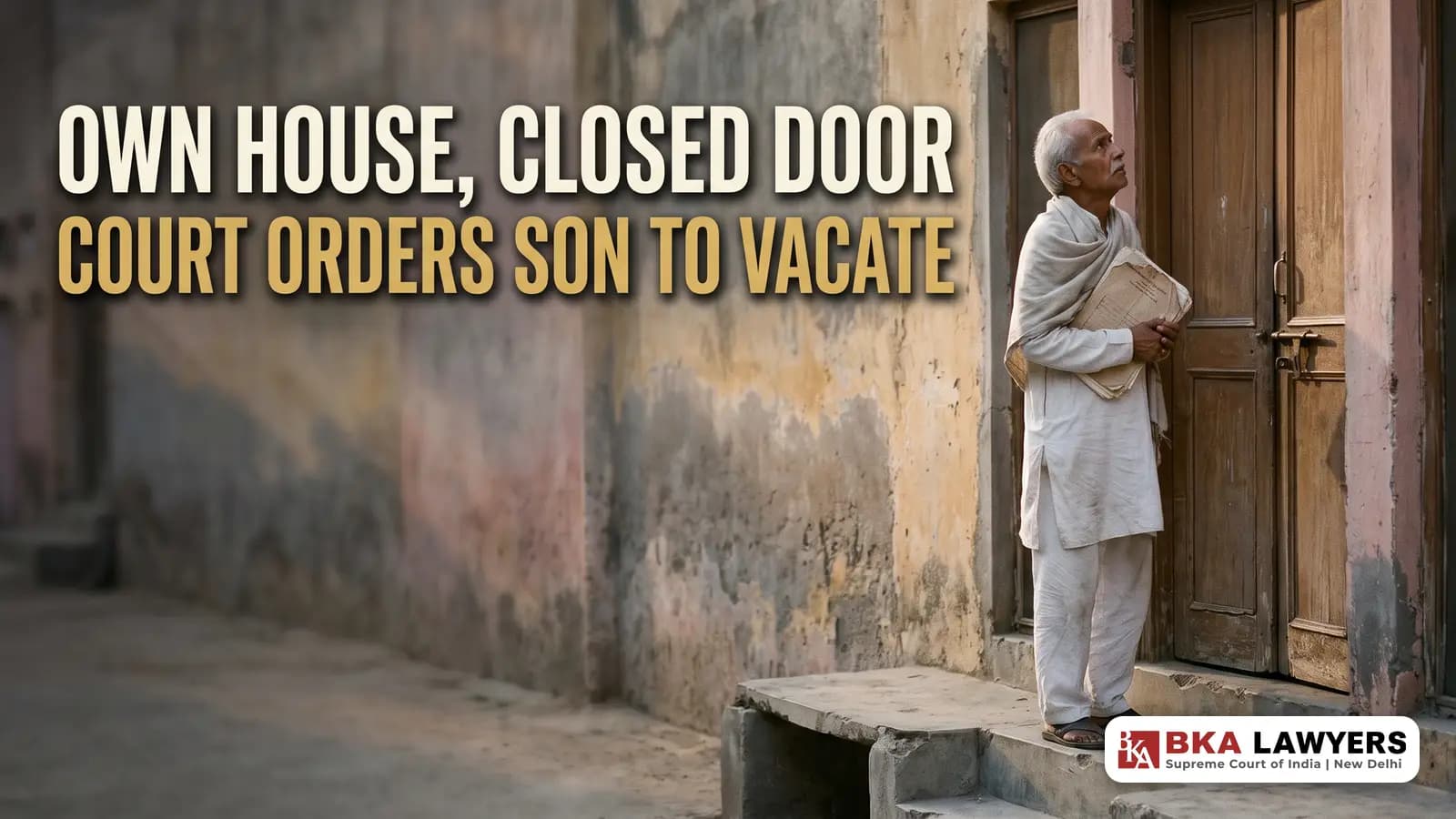
A house that belongs to the father is not, in law, the family's common property merely because the son lives in it. That is the heart of a recent Delhi High Court ruling reported in November 2026, in which the Court directed a son and his wife to vacate the self-owned house of an 85-year-old man.
What changed
The decision is not a new statute. It is a judgment applying settled law — but it restates an important point with unusual clarity. In Indian law, ownership and occupation are separate questions. A person who owns a property (name on the title documents, sale deed, or a registered will bequest) has the right to possession. A relative living there is, in most cases, a licensee — someone permitted to occupy the property as a guest of sorts, not a co-owner — unless there is a legal right to stay.
The Court's order reflects three principles that Indian courts have applied consistently:
- A parent's home is not the joint family's property unless it is genuinely ancestral (Hindu Undivided Family) property. A self-acquired house remains the owner's alone, whatever the family relationships inside it.
- Adult children have no automatic right of residence in a parent's self-owned home. Any permission given is a licence, not a right, and can be withdrawn.
- The Maintenance and Welfare of Parents and Senior Citizens Act, 2007 gives parents an additional route — a quick remedy before the Maintenance Tribunal — where children refuse to maintain them or treat them with cruelty. That route was not always the one used here, but the outcome is aligned with its spirit.
The date this ruling applies from should be treated as the date of the judgment itself. Because it applies settled legal principles, it does not change the law for litigants in other states — but it is a useful signal of how Delhi courts will now look at similar disputes.
Who it affects
Parents who own their own home and find adult children (and their spouses) unwilling to leave face this most often. But the ruling's logic runs both ways, and any family in which an adult child, a widow, a relative or a married daughter has been allowed to live in a house owned by someone else should understand it.
It also matters for the following groups:
- Senior citizens seeking quiet eviction of an adult child from their own house without a full civil suit.
- Adult sons and daughters who assume that because they have lived in the house for years, they have a right to remain. Long occupation does not, by itself, create ownership or tenancy.
- Daughters-in-law, whose position is the most fact-specific. After a marital dispute, a daughter-in-law may have a claim to residence under the Protection of Women from Domestic Violence Act, 2005, but that right is not absolute and is weighed against the owner's rights. Courts have sometimes refused to disturb a daughter-in-law's occupation for a limited period and allowed it in other cases. The outcome usually depends on her need, the marital status of the relationship and the owner's own circumstances.
- Sons and daughters who have contributed money to a parent's house. This is the situation that turns contested. Without documentary evidence of an agreement or a share in title, a payment can be treated as a loan or a gift, not as a purchase.
A common mistake clients make: assuming a parent's house becomes the children's property once they are married and living there. Until title changes — by registered sale, gift, or inheritance on the owner's death — it does not.
What to do now
For parents:
- Check the paperwork first. What matters is the registered title (sale deed, gift deed, partition deed or will). Keep the latest property tax receipts and electricity bills in your own name.
- Keep a written record. If a child has lived in the house with your permission, that permission should be documented in writing. A polite letter that records when occupation began and the conditions of permission helps enormously if the matter goes to court.
- Consider the forum. For senior citizens whose children refuse to leave or refuse to maintain them, the Maintenance Tribunal under the 2007 Act (each district has one) can be far quicker than civil courts. For an ordinary owner who is not a senior citizen, a civil suit for possession and, if necessary, mesne profits (compensation for use and occupation) is the usual route.
- A suit takes time. Possession suits in Delhi can run for years. That is precisely why the 2007 Act route is often preferred where it fits.
For adult children who have been asked to leave:
- Do not ignore a legal notice. Silence does not protect occupation — it strengthens the owner's case that occupation is not really disputed.
- Assemble your documents. Any proof of a financial contribution, any written promise, any documentary fact that shows a share in the property or an agreement to live there indefinitely — these matter.
- Understand what you are defending. If you claim a share in title, that is a different case from claiming only a right to reside for now. Mixing the two weakens both.
For anyone whose family member lives in a house owned by another:
- Put the arrangement in writing. In leases, licence agreements or family arrangements, written terms make a future dispute cheap and short. Oral arrangements are where cases become expensive.
A short checklist I would suggest before any action is taken:
- The registered title deed or will establishing ownership.
- Proof of sole ownership — e.g. self-acquisition by purchase or inheritance in a single name.
- Any written permission given for occupation.
- Proof of age and status if a Maintenance Tribunal remedy is being considered.
- A realistic assessment of time and cost before filing in civil court.
In short: the Delhi High Court's order is a restatement, not a revolution. A parent's own house does not become the children's house because they live in it. At the same time, a daughter-in-law's position under the Domestic Violence Act is a live question in many such disputes and depends heavily on the facts. Legal advice before the first notice is sent is usually what prevents an expensive and painful fight.
Facing a similar situation? Talk to a BKA advocate before you act.
Chat on WhatsAppNeed help with this?
Our Civil Law services
Frequently Asked Questions
If my son and daughter-in-law live in my own house and refuse to leave, can I get them removed?
Yes, in most cases. If the house is your self-acquired property and title is in your name, you are the owner and they are generally licensees whose permission you can withdraw. You can either file a civil suit for possession or, if you are a senior citizen, approach the district Maintenance Tribunal under the Maintenance and Welfare of Parents and Senior Citizens Act, 2007. The Tribunal route is usually faster.
Son aur bahu ghar khaali nahi kar rahe, kya kar sakta hoon? (My son and daughter-in-law are not vacating the house — what can I do?)
If the house is in your name and you are a senior citizen, you can file an application before the district Maintenance Tribunal under the 2007 Act. If you are not a senior citizen, a civil suit for possession is the usual route. In either case, keep your title documents, property tax receipts and any written record of the permission you gave them.
Does a daughter-in-law have a right to stay in her father-in-law's house after a marital dispute?
This is fact-specific. She may claim a right of residence under the Protection of Women from Domestic Violence Act, 2005, but courts weigh that against the owner's rights, her financial need and the status of the marriage. Courts have sometimes allowed her to remain for a limited period and in other cases have refused. The outcome depends on the specific facts.
Does living in a parent's house for many years give an adult child any ownership right?
No. Long occupation does not by itself create ownership or tenancy. Title changes only through a registered sale, gift or partition deed, or by inheritance on the owner's death. A written agreement or proof of a share in title is needed for a child to claim an interest in the property.
Related Articles
Bail Refused for NRI In-Laws Who Skipped Investigation: What Ignoring a Dowry Case Notice Actually Costs
A Chandigarh court refused bail to Canada-based in-laws in a dowry case because they did not join the investigation despite notices. Here is what legally follows when an accused ignores summons in a dowry complaint.

Mother Has the Stronger Prima Facie Custody Claim for a Child of Unwed Parents: Supreme Court
The Supreme Court has held that where a child is born to unwed parents, the mother has the better prima facie claim to custody. What this means for custody disputes, the welfare principle, and what parents should do now.

Can a live-in partner claim a share in the apartment after a long relationship ends?
Whether a woman in a long live-in relationship can claim a share in her partner's property depends on what the Supreme Court has said and the proof she holds.