
How to Prove Medical Negligence in India: 12 Documents to Collect Before Filing
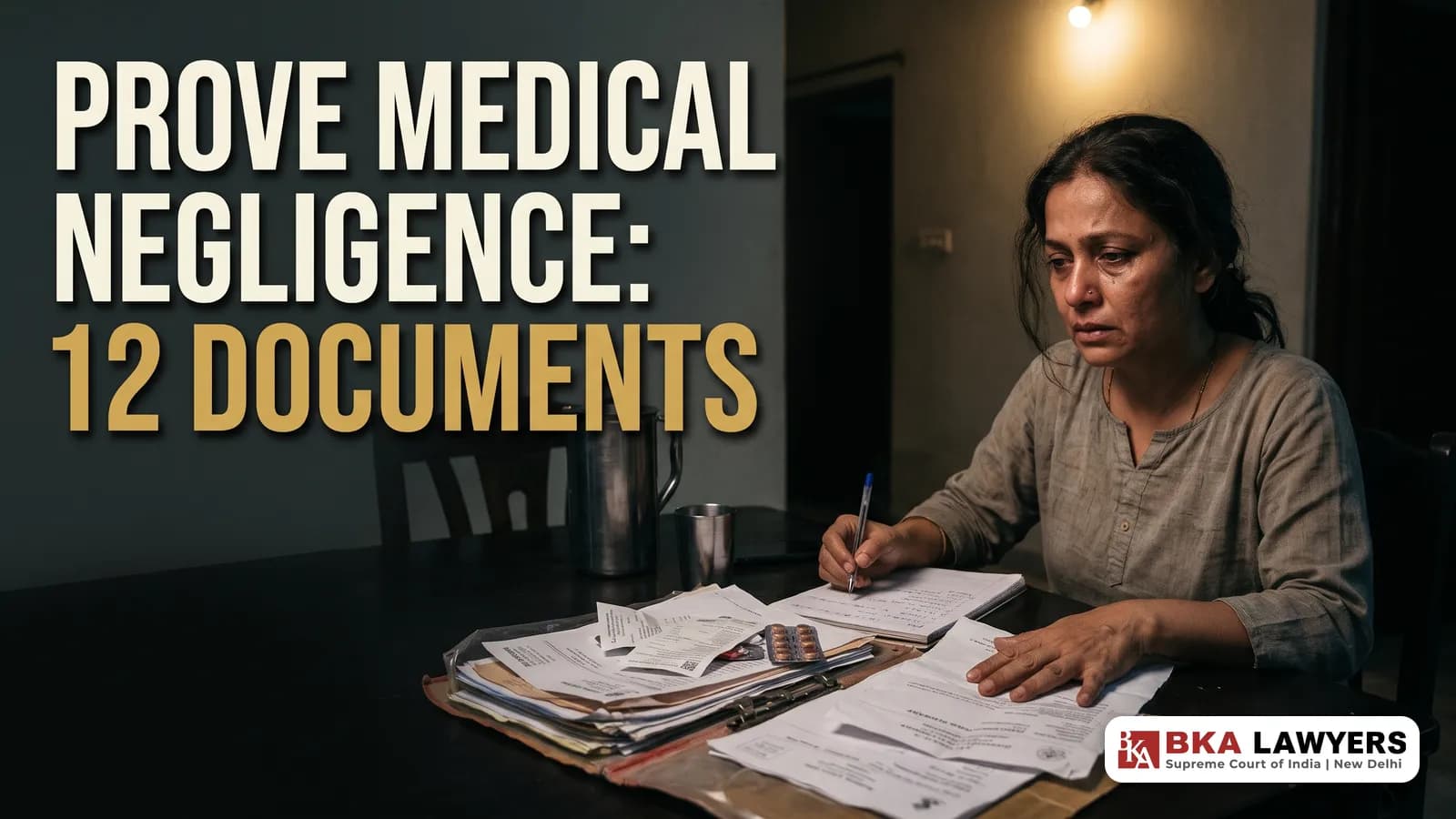
Medical negligence cases are won or lost on documents. The burden of proof lies on the patient or family, and the standard is high: you must show that the doctor or hospital failed to exercise reasonable care, and that this failure caused harm. Before you file a complaint, gather these 12 documents. They form the backbone of your case, whether you go before a consumer commission, a civil court, or (in rare cases) a criminal court.
Core Medical Records
- Complete in-patient case file. This includes admission notes, progress notes, doctor's orders, nursing notes, and discharge summary. It shows what was done and when. Under the Clinical Establishments (Central Government) Rules, 2012, hospitals are required to maintain these records. You have a right to a copy.
- All investigation reports. Blood tests, imaging (X-rays, CT scans, MRIs), biopsy reports, and their films or digital files. These are objective evidence of the patient's condition.
- Operation notes and consent forms. If surgery was performed, the operative note details what was done. The consent form shows what risks were disclosed. Missing or altered consent forms can be telling.
- Prescription slips and medication charts. These reveal what drugs were prescribed, in what dose, and who prescribed them. Errors in medication are a common ground for negligence.
- Referral letters and transfer summaries. If the patient was referred to another doctor or hospital, these documents show what information was shared and whether timely action was taken.
Proof of Negligence and Causation
- Expert medical opinion. A written opinion from a qualified doctor in the same specialty, stating that the standard of care was not met and that this caused harm. This is often the most crucial document. Without it, courts are reluctant to second-guess medical judgment.
- Medical literature and guidelines. Copies of standard textbooks, journal articles, or clinical guidelines (e.g., from ICMR or WHO) that establish the accepted standard of care for the condition. These support the expert's opinion.
- Timeline of events. A chronological summary of what happened, prepared by you, cross-referenced with the medical records. This helps the court see the sequence and identify gaps or contradictions.
Financial and Personal Impact
- Bills and receipts. Hospital bills, pharmacy receipts, consultation fees, and costs of future treatment. These prove the financial loss suffered.
- Proof of income. Salary slips, income tax returns, or business accounts of the patient (or dependents, in case of death). This is needed to claim loss of earnings.
- Travel and incidental expenses. Bills for travel to hospitals, stay for attendants, and other out-of-pocket costs.
- Photographs and videos. If there are visible injuries, disfigurement, or the condition of the patient, visual evidence can be powerful. Also, photographs of the hospital premises or equipment if relevant (e.g., unsterile conditions).
Common Mistakes to Avoid
- Not requesting records early. Hospitals may be slow or evasive. Send a written request under the Right to Information Act (for government hospitals) or the hospital's own policy for private ones, and keep proof of the request.
- Relying on oral assurances. Do not accept verbal explanations without obtaining them in writing. If a doctor admits a mistake orally, try to get it documented or witnessed.
- Delay in obtaining expert opinion. Experts may be hesitant to criticize colleagues, so approach academic institutions or retired doctors. Do not wait until the last minute.
- Filing without a complete set. A case filed with missing documents gives the other side an opportunity to fill gaps in their favour.
What to Do Next
Start by sending a written request to the hospital for a complete copy of the medical records. Maintain a folder with all the documents listed above. If you face difficulty, consult a lawyer who handles medical negligence cases to guide you on the appropriate forum and limitation period. Time is of the essence: delays can cost you the right to compensation.
Facing a similar situation? Talk to a BKA advocate before you act.
Chat on WhatsAppNeed help with this?
Our Medical Negligence services
Frequently Asked Questions
Hospital medical records nahi de raha, kya karu? (Hospital is not providing medical records, what should I do?)
You can apply under the Right to Information Act for government hospitals. For private hospitals, send a written request citing the Clinical Establishments Rules; if ignored, the consumer commission can direct production of records.
What documents are absolutely necessary to file a medical negligence case?
The complete in-patient case file, investigation reports, and an expert medical opinion are essential. Financial documents like bills and income proof support your compensation claim.
Can I file a medical negligence case without an expert opinion?
In most cases, an expert opinion is necessary to establish the standard of care. However, in clear cases like res ipsa loquitur (e.g., a foreign object left inside the body), courts may not require it.
Related Articles

Birth Injury Medical Negligence in India: A Step-by-Step Guide to Filing a Consumer Complaint
A birth injury claim in a consumer forum depends on picking the right forum, meeting the limitation period and holding the right medical evidence.
Medical Negligence: Before You Sign a Consent Form — What the Law Says About Informed Consent and When a Doctor Can Be Liable
Informed consent is more than a signature on a form. Understand what the law requires, when a doctor can be held liable for failing to obtain it, and the practical steps to protect your rights.

Marital Rape Before the Supreme Court: What the Pending Decision Means
The Supreme Court is hearing whether a husband can be prosecuted for rape under Indian law. Here is what is actually in dispute, who is affected, and what married couples should do meanwhile.