
Fired Without Notice in Delhi NCR: When Is Termination Actually Illegal?
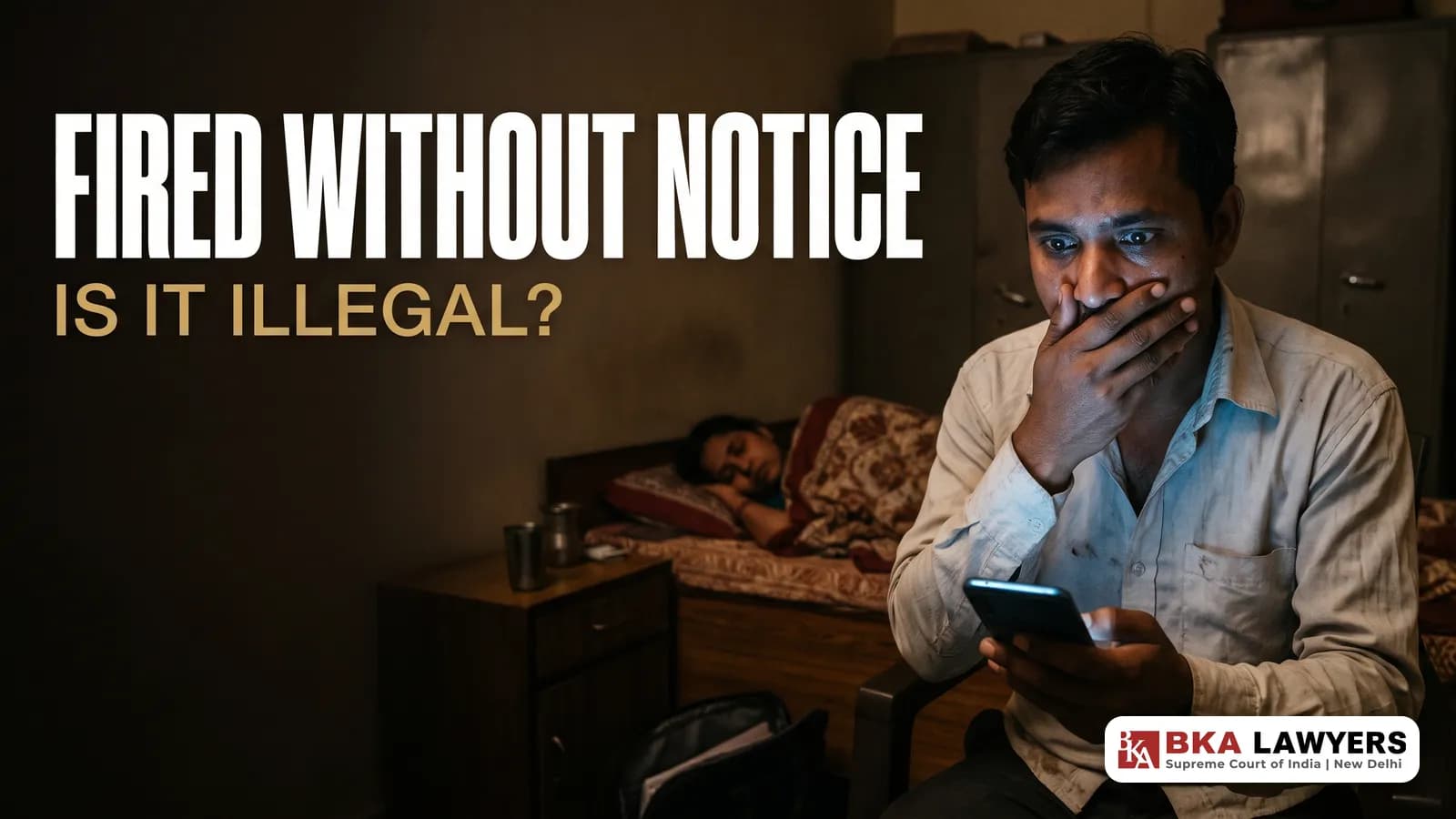
Most employees assume that a termination without notice is automatically illegal. It is not. In Indian law, whether your dismissal was lawful turns on three things: the terms of your employment contract, the standing orders or service rules that apply to your workplace, and whether the employer followed the procedure those rules require. A sudden dismissal may be perfectly legal. It may also be unlawful — and the difference is rarely obvious from the termination letter alone.
What is clear is that "we no longer require your services" is not the legal test. The test is whether the employer had the power to terminate in the way it did.
Two broad routes are open to an employee who believes the dismissal was unlawful. They lead to different forums, different relief and different timelines. Choosing between them is the first real decision you will make.
Route one: challenge the termination as illegal — reinstatement and back wages
This is the classic labour law remedy. It asks the forum to hold that the termination itself was invalid, to set it aside, and to put you back in your job.
When it fits
- You are a workman within the meaning of the Industrial Disputes Act, 1947 — broadly, someone doing manual, skilled, unskilled, technical, operational or clerical work. Supervisory staff above a certain pay threshold are generally outside this definition, so this is the first thing to check.
- Your employer is an "industry" — which the courts have read widely, and which covers most private companies, hospitals, educational institutions and service organisations.
- The employer failed to follow the retrenchment requirements: notice or wages in lieu, retrenchment compensation, and the procedure for the affected employee. Retrenchment means termination for reasons other than misconduct, and the statute attaches conditions to it.
- There was no domestic enquiry, or the enquiry was conducted in a way that denied you a fair hearing — no charge sheet, no chance to respond, no opportunity to cross-examine witnesses.
What it involves: a claim before the labour authority, conciliation, and then reference to the Labour Court or Industrial Tribunal. The central question is not whether the employer disliked you, but whether the procedure was followed and whether the punishment was proportionate.
Main risk: time. These proceedings move slowly, and reinstatement is not guaranteed even where the termination is found bad. Courts often substitute compensation for reinstatement where the relationship has broken down irretrievably or the employer has lost confidence in the employee. It is also common for reinstatement to be ordered without full back wages.
Route two: sue for breach of contract — damages instead of the job
A civil suit in the Delhi High Court or the relevant district court, depending on the value of the claim, treats the dismissal as a breach of your employment contract.
When it fits
- You are in a managerial or professional role and do not qualify as a workman.
- Your appointment letter fixes a notice period, a severance entitlement or a defined term, and the employer ignored it.
- You want money rather than your job back — salary for the notice period, unpaid dues, contractual severance, and in some cases damages.
- The employer has also withheld salary, refused a relieving letter, or made false allegations that harmed your reputation.
What it involves: pleadings that set out the contract, the breach and the loss. The court will read the appointment letter closely. Claims for damages must be pleaded with specificity — a bare assertion of "mental agony" is unlikely to carry much weight on its own.
Main risk: contract, not fairness. A civil court will enforce the bargain you signed; it will not ask whether the employer behaved decently. Many private sector appointment letters reserve the employer's right to terminate with immediate effect on payment of salary in lieu of notice — and if yours does, the "no notice" complaint largely disappears.
The third track people forget: statutory protection in specific sectors
Some categories of employees have a statutory layer of protection on top of their contract. Private school teachers in Delhi are a well-known example — the Delhi High Court has repeatedly held that a dismissal without the required approval of the Directorate of Education is ineffective. Similar protections exist in various forms for workers covered by establishment-specific statutes and for employees of entities such as statutory boards and public undertakings.
If you fall into one of these categories, a writ petition before the Delhi High Court may be available, and it is often faster than a labour reference. The threshold question is whether the employer is subject to a statutory obligation of that kind — worth checking before anything else.
How to decide
- If you are a workman-grade employee and the employer had no valid reason or enquiry, prefer Route one. The statute gives you a remedy the contract does not.
- If you are a manager or professional with a written contract and no standing orders apply, prefer Route two. The labour court is likely to find you outside its jurisdiction.
- If your sector carries statutory approval requirements for dismissal, check Route three first. A writ petition can be the cleanest and quickest path.
- If your dues are modest and the notice period is the main loss, look hard at practical settlement. The cost and delay of contested litigation often exceed what a court would award.
In practice, what judges look at is narrower than what employees expect. The question "was I treated unfairly?" rarely decides the case. "Was the procedure prescribed by law followed?" usually does. A termination that feels brutal may still be upheld; a termination that was polite may still fail because the enquiry was defective.
What to do next
Gather your appointment letter, any extensions or revisions, the employee handbook or service rules, all termination correspondence, and your salary records. Note the date of dismissal carefully — limitation periods for these claims are short, and a late challenge can fail on delay alone. If you plan to raise an industrial dispute, move promptly, since the reference itself depends on the dispute being alive.
Finally, read the termination letter for what it does not say. Silence about the reason, the absence of a charge sheet, and a refusal to state grounds are all facts a court will notice.
Facing a similar situation? Talk to a BKA advocate before you act.
Chat on WhatsAppNeed help with this?
Our Labour & Employment services
Frequently Asked Questions
Is termination without notice period legal in India?
It can be. If your appointment letter allows the employer to terminate on payment of salary in lieu of notice, the dismissal may be lawful even if it lands suddenly. The position changes if a statute or your service rules require a longer process — for example, a charge sheet and domestic enquiry for misconduct. The appointment letter is the starting point.
Mujhe bina notice nikaal diya, kya karun? (I was removed without notice — what should I do?)
Preserve everything before you do anything else: the appointment letter, the termination communication, salary slips and any emails about the decision. Note the exact date of dismissal, because limitation periods for employment claims run quickly. Then assess whether you qualify as a workman, since that determines whether the Labour Court or a civil court is the right forum.
What is the difference between wrongful termination and illegal termination?
People use them interchangeably, but legally they are not the same. Illegal termination means the employer had no power to dismiss in that manner — the statute or service rules were breached. Wrongful termination is broader: a dismissal that breaches the contract, for example by ignoring a contractual notice period. The remedy and the forum differ depending on which it is.
Can I claim reinstatement if I was fired without a domestic enquiry?
Where you are a workman and the employer dismissed you for misconduct without holding a proper enquiry, the Labour Court may set aside the dismissal. However, reinstatement with full back wages is not automatic. Courts sometimes award compensation instead, particularly where the employment relationship has broken down.
Related Articles
How to Prove Medical Negligence in India: 12 Documents to Collect Before Filing
A straightforward checklist of the 12 documents you must gather before filing a medical negligence case in India, explained by a senior advocate. Learn what to collect, why it matters, and the common mistakes to avoid.
Grandparents' Visitation Rights in India: What the Law Actually Says (and Doesn't)
Indian law gives grandparents no automatic right to see their grandchildren. Courts weigh the child's welfare above all. Here are the myths, and the facts that matter.
Supreme Court to Decide Whether Marital Rape Is a Crime: What the Pending Case Means
The Supreme Court is hearing whether the marital rape exception in Indian rape law should go. Here is what is actually before the Court, who it affects, and what to do meanwhile.