
Interim vs Permanent Maintenance: When Can a Husband Legally Reduce or Stop Payments?
A maintenance order is not a suggestion. It is a direction of a court, enforceable like any other. So the short answer to the question in the title is this: a husband cannot unilaterally stop or reduce maintenance, however genuine his financial difficulty may be. The only lawful route is to go back to the court that made the order and ask it to vary or cancel it.
This distinction — a lawful application for variation versus simply stopping the payment — is where a great many people get into trouble.
Interim and permanent maintenance are governed by different provisions
In matrimonial law, maintenance generally arises under Section 24 and Section 25 of the Hindu Marriage Act, 1955. Section 24 provides for interim (temporary) maintenance — payable while the divorce or other matrimonial proceeding is pending, to cover the spouse's support and the cost of running the case. Section 25 deals with permanent maintenance — an order made at the end of the case, and it may be a monthly sum or a lump sum.
Separately, a wife may claim maintenance under Section 144 of the Bharatiya Nagarik Suraksha Sanhita, 2023 (BNSS), which replaced Section 125 of the Code of Criminal Procedure, 1973. The BNSS provision covers a wife, children and parents, and is a criminal-court remedy: if an order is breached without cause, the court can enforce it. Note the difference in forum — the Hindu Marriage Act route is before the matrimonial court; the BNSS route is before a Magistrate.
A key point that many husbands miss: an order under the matrimonial law and an order under the BNSS route can both be in play, and the courts generally avoid duplication. If you are paying under one, say so, with evidence, rather than quietly stopping payment altogether.
Interim maintenance is set early, on affidavit evidence
Interim maintenance is assessed relatively early, often without a full trial. The court looks at the parties' prima facie position — their income, their standard of living, the wife's own earning capacity, and the needs of any children.
Because it is assessed on incomplete material, the figure is provisional. It can be revised upward or downward later. But it is still a binding order until changed. A common mistake is to assume that because the husband knows the figure is inflated and intends to challenge it at trial, he may withhold payment in the meantime. He may not. The order stands until it is varied.
Permanent maintenance is decided on the full evidence
Permanent maintenance comes at the end of the case. Here, the court has the benefit of the full record: both parties' incomes, assets, liabilities, the wife's qualifications and earning capacity, the duration of the marriage, and the children's welfare. The court may award a monthly sum, a lump sum, or a combination.
A settlement recorded in a divorce by mutual consent can also fix maintenance. Once such a consent term is part of a decree, it is binding in its terms, and reopening it requires showing a material change in circumstances, not mere regret at having agreed.
For how long must maintenance be paid?
The duration depends on the basis of the order and the facts. Broadly:
- Interim maintenance runs while the proceeding is pending. It ends when the proceeding concludes, unless it merges into the final order.
- Permanent maintenance is usually periodic, and courts often direct that it continue during the wife's lifetime or until she remarries. Some orders are time-limited — for example, to allow a spouse time to become self-sufficient — and then fall away.
- Children's maintenance generally ends when the child attains majority, though a court can extend it if the child remains dependent through education or disability.
- A lump-sum award is paid once and does not continue.
So the question “until when must I pay?” cannot be answered without reading the order itself. The order, not general expectations, decides.
When a husband can lawfully seek reduction or cancellation
The law does recognise change. The relevant applications are for variation of a maintenance order under the matrimonial statutes, and under Section 146 of the BNSS, which allows a Magistrate to cancel or alter an order on proof of a change in circumstances. The grounds that genuinely move a court include:
- Change in the husband's circumstances — genuine and documented loss of employment, a substantial fall in income, serious illness, or a liability the court accepts as unavoidable. Mere lifestyle choices that reduce income carry little weight.
- Change in the wife's circumstances — she has begun earning substantially, has received a significant inheritance or asset, or has remarried. Remarriage is a ground for cancellation, subject to the terms of the order.
- Concealment or misrepresentation — if the earlier order was obtained on suppressed or false material, that can support an application to revisit it.
- Conduct disentitling the claimant — for example, where the spouse is living in adultery or has converted to another religion in a manner that affects the statutory right, or where a consent term has been breached. The exact effect depends on the statute and the facts.
Note carefully: an EMI or a personal loan, by itself, is not a lawful ground to reduce maintenance. It is a choice about how one's income is allocated. A husband who took on a large loan after separation cannot argue that the loan should crowd out his wife's maintenance. That said, a court may consider pre-existing, unavoidable liabilities when assessing quantum. The distinction between the two is often decisive.
Non-payment without a court order is illegal
Here is the line. Stopping payment without an order permitting it is a breach of a court direction. The consequences can include:
- Execution proceedings to recover arrears, including attachment of property.
- In the BNSS route, the Magistrate may enforce the order as provided in that statute; wilful disobedience can attract coercive orders.
- In matrimonial proceedings, continuing default damages credibility and can influence costs and subsequent orders.
If a husband believes the order is wrong, his remedy is to apply — not to stop. That application can be made even while complying, and compliance is usually the strongest fact in his favour. A man who has paid consistently and seeks variation for a documented reason is in a far stronger position than one who has defaulted and then argues about it.
What the court actually looks at
Judges look for evidence, not assertions. Two things are examined closely:
Actual capacity, not claimed capacity. Income tax returns, bank statements, salary slips, Form 16, loan documents and asset records decide the question. A husband who claims reduced income but maintains an unchanged lifestyle, foreign travel or new purchases weakens his own case.
The wife's needs and standard of living. The court aims to prevent destitution, not to equalise wealth. It also weighs whether she has the means and the ability to maintain herself.
The court is generally unpersuaded by vague pleas of business losses without documents, by commitments taken on after separation, and by an unexplained refusal to disclose income. Non-disclosure often leads the court to draw an adverse inference — that is, to assume against the person who has withheld the information.
A short checklist before you apply
If you are considering an application to reduce or stop payments, gather:
- The order itself, and any subsequent orders, in full.
- Bank statements, ITRs, Form 16 and salary slips for the relevant period.
- Evidence of any change relied on — a termination letter, medical records, a business's audited accounts.
- Proof of all payments made so far, with dates and amounts.
- Evidence of the wife's earnings, assets or remarriage, if that is the ground.
- Any agreement or consent term setting out what was settled.
Also note the practical point on timing. Delay in filing a variation application, while payments continue to fall due, tends to harden the position. File the application as soon as the change occurs.
What to do next
The first step is to read the operative order and identify exactly what it says you must pay and until when. Then decide whether the lawful route is a variation application before the court that made the order, or a fresh position before the Magistrate in a BNSS proceeding. Gather the documents listed above before drafting anything. If payments are due, pay them while the application is pending; that fact alone often decides how the court views the request. Where a genuine change in income, health or the wife's circumstances is documented, the law provides a remedy. Where it is not, non-payment simply adds a fresh default to an existing order.
Facing a similar situation? Talk to a BKA advocate before you act.
Chat on WhatsAppNeed help with this?
Our Family Law services
Frequently Asked Questions
Can a husband stop paying interim maintenance if his income has dropped?
No. Interim maintenance is a court order and remains binding until the court modifies it. If income has genuinely fallen, the correct step is to file an application for variation before the same court, with documents such as salary slips, termination letters or audited accounts. Stopping payment on your own initiative is a default.
EMI aur loan ke basis par maintenance kam ho sakti hai? [Can maintenance be reduced on the basis of EMIs and loans?]
Not merely because you took on an EMI. A loan taken after separation is generally treated as a personal choice and does not reduce the obligation. However, a pre-existing, unavoidable liability may be considered by the court when deciding the quantum. The key is documentation and timing.
What are the legal grounds for cancelling permanent maintenance?
Common grounds include the wife's remarriage, a substantial change in the wife's income or assets, a genuine and documented fall in the husband's earning capacity, and concealment of material facts when the original order was passed. Under the BNSS, Section 146 allows a Magistrate to cancel or vary an order on proof of changed circumstances. Each case turns on its own record.
How long does a husband have to keep paying maintenance?
It depends on the order. Interim maintenance generally continues while the matrimonial case is pending. Permanent maintenance is often periodic and may continue during the wife's lifetime or until she remarries, unless the order fixes a different period. Children's maintenance usually ends at majority, though it can be extended if the child remains dependent. Always read the operative order.
Can maintenance be denied if the wife is earning?
Not automatically. The court considers the wife's actual income, her qualifications and her standard of living. If she earns enough to maintain herself comfortably, the court may reduce or decline maintenance, but mere employment does not end the obligation. The figure is assessed on evidence, not assumption.
What happens if a husband simply refuses to pay?
The wife can file for execution of the order, and the court may attach property or pass coercive orders to recover arrears. Under the BNSS, wilful non-compliance can attract enforcement by the Magistrate. Continuing default also damages the husband's credibility in any future application to reduce the amount.

About the author
Ujjwal Agrawal
Advocate · Commercial & Money Recovery Cases
Ujjwal Agrawal focuses on commercial litigation and money recovery, including cheque bounce cases under the Negotiable Instruments Act and recovery suits for individuals and businesses.
More about our team →Related Articles
Supreme Court and High Court Rulings on Maintenance When the Wife Has Her Own Income
A wife's salary, flat or car does not automatically shut down her maintenance claim. What the Supreme Court and High Courts have actually held on maintenance where the wife earns, and how the courts decide.
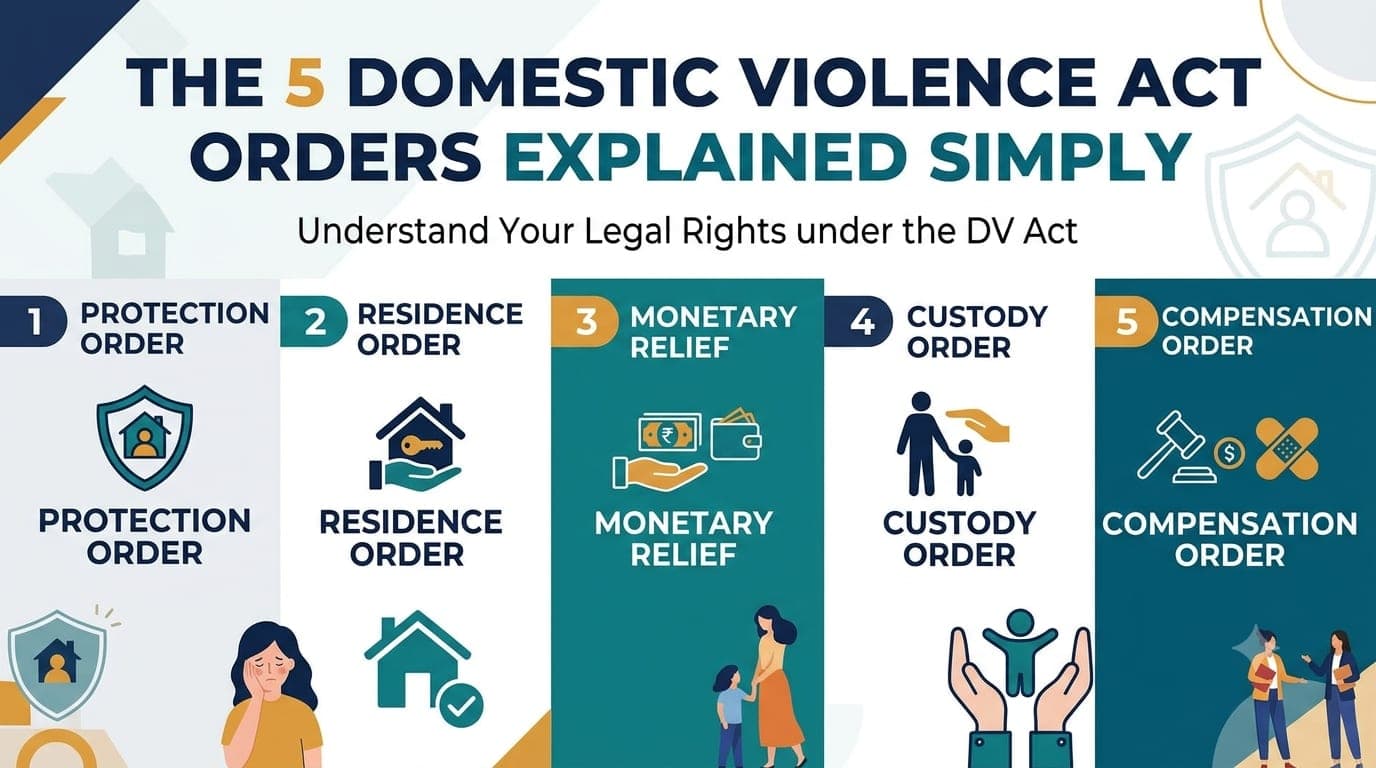
The 5 PWDVA Orders Explained Simply: Protection, Residence, Monetary Relief and More
A plain-English breakdown of the five orders a court can pass under the Protection of Women from Domestic Violence Act, 2005, and how they sit alongside Section 498A of the IPC (now Section 85 of the BNS).

Wife's Rights in a Matrimonial Dispute: Maintenance, Residence, Custody and Streedhan
A plain-English guide to a wife's core legal rights in a matrimonial dispute in India — maintenance under Section 144 BNSS and Section 125 CrPC, residence under the Domestic Violence Act, child custody, and ownership of streedhan.