
Supreme Court and High Court Rulings on Maintenance When the Wife Has Her Own Income
A wife owns a flat worth ₹1.7 crore and two luxury cars. The Madras High Court still declined to disturb an order of ₹1 lakh per month payable to her by her estranged husband. Lawyers who read only the headline conclude that maintenance is now payable regardless of the wife's own means. That is not quite what the judgment says, and the distinction matters if you are on either side of an application.
Ownership of an asset is not the same thing as income
A flat and a car are capital. Maintenance, whether interim or final, is assessed against income — what a person actually has available to spend each month. So the first question a court asks is not "what does she own?" but "what does she earn, and what did she earn during the marriage?"
In the Madras case, the value of the flat and cars did not translate into a monthly earning capacity that came close to the standard of living the marriage had supported. A model or self-employed professional may have had high earnings in some years and none in others. Courts read that volatility carefully. A single good year is not proof of a stable income.
This is the practical point that gets lost in the reporting. A woman can be asset-rich and income-poor. Conversely, a woman with a modest flat but a steady salary may not need much support at all.
What the law actually says about a wife who earns
The governing provision for a Hindu wife is Section 125 of the Code of Criminal Procedure, 1973, now re-enacted as Section 144 of the Bharatiya Nagarik Suraksha Sanhita, 2023. The provision requires a husband with sufficient means to maintain a wife who is unable to maintain herself. The important words are "unable to maintain herself" — not "owns nothing".
The Supreme Court has repeatedly held that the test is a comparison. The wife's inability is measured against the standard of living she enjoyed in her matrimonial home, not against bare survival. If she earns ₹40,000 a month but the household she left ran on ₹3 lakh a month, she may still be "unable" in the legal sense. That is where most maintenance litigation is actually fought.
Two other routes exist. A wife can claim maintenance under the Hindu Marriage Act, 1955 during pendency of proceedings, and under the Hindu Adoptions and Maintenance Act, 1956 as a separate civil right. The three regimes interact, and a court hearing one will often take note of orders passed under another.
Bombay: a job does not defeat an interim claim
The Bombay High Court has reaffirmed a similar proposition in a different fact pattern. Where the husband's income exceeded ₹1 lakh a month, the court did not interfere with an interim award of ₹15,000 a month, even though the wife held a job.
The principle behind that decision is worth understanding. Interim maintenance is meant to keep the litigation from becoming a weapon. If a working wife with a modest salary is forced to fund a years-long contest out of her own pocket while the husband's income remains intact, the proceeding becomes unequal before it has even been decided on merits. So at the interim stage, courts lean towards maintaining the parties where they were, not towards final findings on who needs what.
What a court actually looks at in practice
Having argued these matters before family courts and the High Court, the pattern is fairly consistent. Courts look at:
- The husband's net income — salary slips, income tax returns, Form 16, bank statements, and often the standard of living visible in the matrimonial home (house rent, school fees, household expenses).
- The wife's real income — not just the salary on paper, but whether it is secure, whether it was earned before or after separation, and whether it covers rent and basic living costs at her current location.
- The standard of living during the marriage — this is usually the deciding factor, and it is proved through evidence, not assertion.
- The wife's separate assets — these are relevant but rarely decisive on their own. A flat she cannot rent out or sell without losing her home does not produce income.
- The children — if children live with the wife, their expenses are folded into the calculation.
What judges tend to find unconvincing: a husband producing a share certificate or mutual fund statement to prove his wife is "rich" while his own ITR shows an income he has not disclosed. Equally, a wife claiming total destitution when her bank statements show regular credits. Courts notice both.
What this means for both sides
For a husband, the takedown is not the wife's assets. It is her income, and credible proof that it covers her reasonable needs. Documents showing her earning capacity, her employment history and any rental or business income matter far more than the value of a flat.
For a wife, the argument is not that she has nothing. It is that what she has does not meet the standard she lived at, or that her income is unstable, or that her assets are non-liquid. Bank statements, tax returns, evidence of the matrimonial household's spending, and proof of the children's expenses carry the case.
A common mistake on both sides is to treat maintenance as a moral contest. It is a documented arithmetic exercise. Parties who file affidavits of assets and income without supporting documents routinely lose ground, whichever side they are on.
Where and how to file
A claim under Section 144 of the BNSS lies before the Judicial Magistrate having jurisdiction where the wife resides or where the husband resides, or where the parties last resided together. It is a criminal-side proceeding but essentially civil in nature. A claim under the Hindu Marriage Act is filed as an interim application in the pending matrimonial petition. The Hindu Adoptions and Maintenance Act allows a separate civil suit before the Family Court.
Before filing, gather: last three years of income tax returns for both parties, salary slips or Form 16, bank and credit card statements, the marriage certificate, proof of the matrimonial residence and its monthly running cost, school fee receipts for children, and any earlier orders on maintenance. Interim applications can be moved quickly; final orders take longer because they require evidence.
Watch the enforcement side. A maintenance order can be enforced under Section 144 BNSS and, in the civil route, through execution. Non-payment also has consequences in the matrimonial petition itself, and courts increasingly ask for arrears to be cleared before hearing the main matter.
Facing a similar situation? Talk to a BKA advocate before you act.
Chat on WhatsAppNeed help with this?
Our Family Law services
Frequently Asked Questions
If the wife has a job and earns well, can she still claim maintenance?
Yes, in many cases. The law asks whether she is able to maintain the standard of living she had in the matrimonial home, not merely whether she earns. If her salary is far below that standard, or unstable, a court can still award maintenance. Much depends on the documents showing both parties' income.
Wife ke paas flat aur gaadi hai, phir bhi maintenance milega? [The wife has a flat and a car — will she still get maintenance?]
Ownership of a flat or car by itself is not a bar to maintenance. A court looks at whether the asset produces any income. A self-occupied flat generates nothing. If the flat is rented out or can be sold without leaving her homeless, the court may factor that in. The size of the award will usually reflect any actual income.
Wife ki income chhupa rahi hai toh kya karein? [What can a husband do if the wife is hiding her income?]
The husband can apply to the court for a direction that both parties file affidavits of assets and income with supporting documents. If she still does not disclose, the court can draw an adverse inference against her and also call for records from her employer or bank. Non-disclosure of income is treated seriously.
Can a maintenance order be increased or reduced later?
Yes. Maintenance orders are not final in that sense. If either party's financial position changes — a job loss, a large salary increase, or a serious medical expense — the affected party can apply to the same court for variation. The court will pass a fresh order based on the current facts.
How is maintenance calculated when the wife lives separately in another city?
The court looks at the actual cost of living where she resides, including rent, food, medical care and travel. A wife living in a metro with higher housing costs may reasonably need a larger amount than one living in her hometown. She should file rent agreements, utility bills and local expense proof.
Can interim maintenance be stopped because the wife owns assets?
Not automatically. At the interim stage, courts grant support based on a prima facie view of the husband's capacity and the wife's needs, and they are reluctant to revisit that in a revision petition. Ownership of assets is considered, but it usually does not by itself defeat an interim claim if the husband's income is substantial.

About the author
Ujjwal Agrawal
Advocate · Commercial & Money Recovery Cases
Ujjwal Agrawal focuses on commercial litigation and money recovery, including cheque bounce cases under the Negotiable Instruments Act and recovery suits for individuals and businesses.
More about our team →Related Articles
Interim vs Permanent Maintenance: When Can a Husband Legally Reduce or Stop Payments?
Maintenance cannot be stopped at will. This explainer sets out when a husband can lawfully seek reduction or cancellation, and when non-payment is simply illegal.
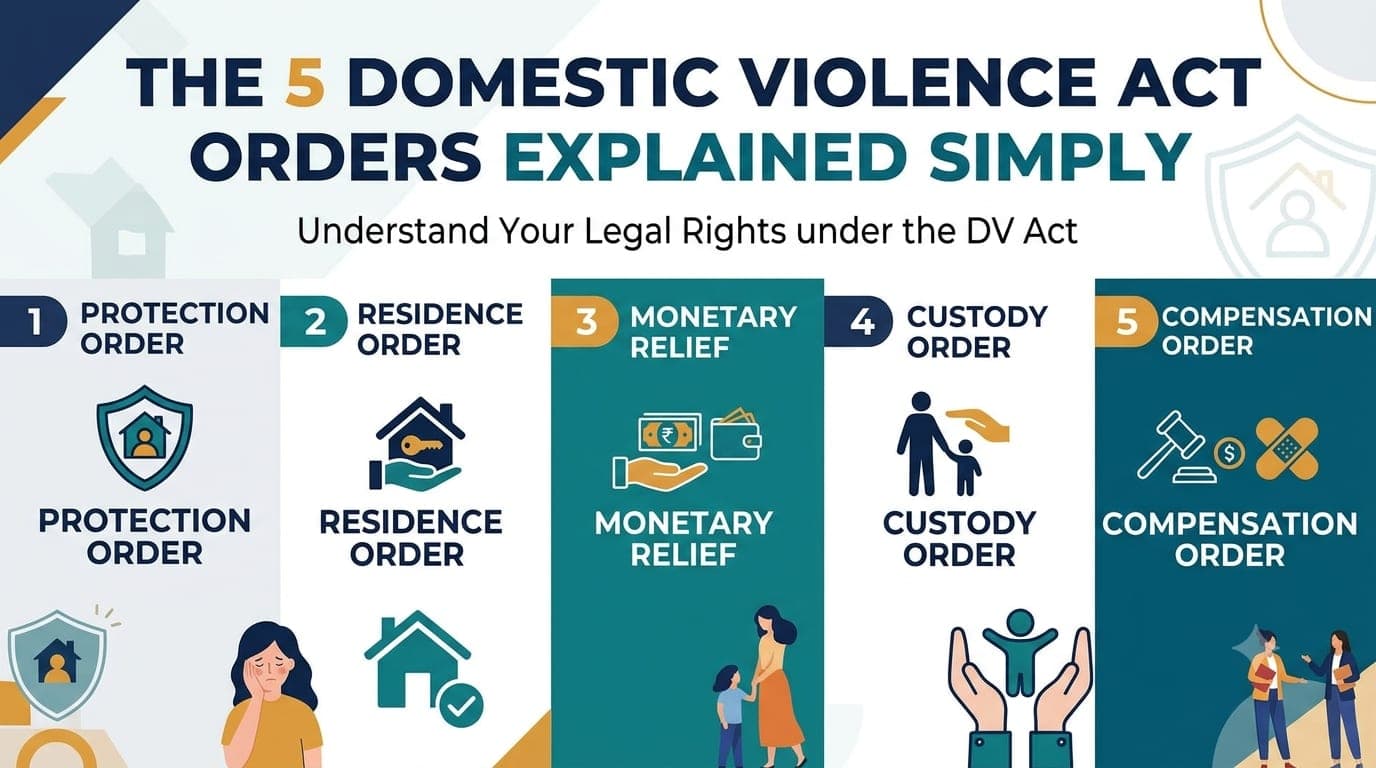
The 5 PWDVA Orders Explained Simply: Protection, Residence, Monetary Relief and More
A plain-English breakdown of the five orders a court can pass under the Protection of Women from Domestic Violence Act, 2005, and how they sit alongside Section 498A of the IPC (now Section 85 of the BNS).

Wife's Rights in a Matrimonial Dispute: Maintenance, Residence, Custody and Streedhan
A plain-English guide to a wife's core legal rights in a matrimonial dispute in India — maintenance under Section 144 BNSS and Section 125 CrPC, residence under the Domestic Violence Act, child custody, and ownership of streedhan.