
POCSO and Child Custody: What the Supreme Court's Latest Ruling Means for Fathers

A POCSO case and a custody case are two different proceedings — but when they collide in the same family, the consequences are immediate and severe. In its recent ruling, the Supreme Court held that a father facing prosecution under the Protection of Children from Sexual Offences Act, 2012 cannot claim custody of his children as a matter of right while that prosecution is pending. In the same breath, the Court quashed the FIR against the father in the case before it and laid down safeguards to stop POCSO from being weaponised in matrimonial fights. Both halves of that judgment matter, and reading only one of them will mislead you.
What the Supreme Court Actually Held
The core principle is straightforward: custody is decided by what serves the child, and a pending POCSO prosecution against a parent weighs heavily against that parent. The Court did not say a POCSO accusation permanently disqualifies a father. It said custody cannot be an automatic entitlement while the case is alive. The child's safety and the integrity of the criminal process come first.
At the same time, the Court invoked Article 142 of the Constitution to do complete justice in the matter before it — granting exclusive custody to the mother in that case. Article 142 lets the Supreme Court pass any order necessary for complete justice, and it is used sparingly. Its use here signals how seriously the Court treated the child's settled environment.
Why Custody and Criminal Law Pull in Opposite Directions
A custody dispute under the Guardians and Wards Act, 1890 is a civil inquiry into the child's welfare. A POCSO investigation is a criminal inquiry into an alleged offence. The standards of proof are different, the timelines are different, and neither court is bound by the other's findings.
That gap is exactly where the trouble lives. A Family Court may be inclined to preserve a father's access; a criminal court may impose bail conditions restricting contact with the same child. Where the two orders conflict, the criminal court's conditions usually control in practice, because violating them can lead to bail cancellation.
The practical takeaway: if a POCSO case is pending, do not fight the custody battle as though it is a standalone civil dispute. It is not.
The Safeguards Against Misuse — What Changes
The Court accepted that POCSO complaints are sometimes filed during matrimonial disputes and directed that police follow mandatory safeguards. Broadly, these require that a complaint is not mechanically converted into an FIR without the preliminary inquiry and medical or expert input that the law and its rules contemplate, and that the child's statement is recorded with the care the statute demands.
Two points deserve emphasis:
- These safeguards are procedural protections. They do not make a POCSO complaint dismissible on demand, and they do not create a presumption that any complaint arising during a custody fight is false.
- Courts will still look at the substance of the allegation — the child's own disclosure, its consistency, and its timing relative to the matrimonial dispute.
If a father believes a complaint was filed to gain leverage in custody proceedings, the honest answer is that the safeguard directions give him a proper channel — a well-drafted quashing petition or bail application supported by material — not a shortcut.
Step 1: Get Bail and Comply Strictly With Its Conditions
If an FIR is registered, the first legal priority is liberty. Once bail is granted, the conditions attached usually include restrictions on contacting the child. Comply with them literally. A single breach — an unsupervised meeting, a message sent through a relative — can undo a bail order and, more damagingly, harden the court's view of the father in the custody proceedings.
Step 2: Deal With the Criminal Case and Custody Case Together
These two matters should be run by lawyers who talk to each other, ideally as a coordinated strategy. Courts do take note when a parent uses one proceeding to disrupt the other. Where the criminal case is genuinely unsustainable, the route is an application under Section 528 of the Bharatiya Nagarik Suraksha Sanhita, 2023 (the provision that replaced Section 482 of the CrPC) — filed with material, not merely with an assertion that the complaint is motivated.
Step 3: Rebuild the Record on Access and Interim Contact
Custody is rarely a single final order; it is a series of interim arrangements. If direct contact is restricted, ask for supervised visitation or video contact through the Family Court or Guardian Judge, with a neutral third party or a professional supervisor. Document every effort to stay involved — school records, medical appointments, communication logs. When the custody court finally assesses who has behaved in the child's interest, a documented record is worth more than argument.
Step 4: Prepare for the Welfare Inquiry, Not Just the Charge
In any contested custody matter, the court may call for a welfare report or a child's interaction with the judge, and may hear the child's preference depending on age and maturity. That inquiry is not about whether the father is a good man in general — it is about the child's present safety, stability and routine. A father who can show a stable home, a defined caregiving plan and absence of risk has a genuine case once the criminal cloud clears. A father who treats the proceedings as a contest of parental rights will not.
What This Means in Delhi NCR Practice
Before the Guardian Judge in Delhi, or before the Family Courts in Noida, Gurugram and Faridabad, a pending POCSO case will surface early — usually through the interim custody application. Expect the court to seek the status of the criminal case at the first hearing and to shape access orders around any bail conditions already in force. Arrange for a certified copy of the FIR and the bail order before the custody hearing; a court is far more receptive to a supervised-visitation proposal than to an oral assurance that there is "nothing in" the criminal case.
The Bottom Line
A POCSO charge does not permanently close the door on a father's custody claim, but it does change the burden he carries. He must first address the criminal proceeding, comply with every condition imposed, and then build a custody case around the child's welfare rather than his own rights. The Supreme Court's safeguards against misuse are real and useful — but they operate through proper legal channels, with evidence and patience. Families in this situation should get coordinated advice on both the criminal and custody sides at the earliest stage, because the decisions made in the first few weeks usually shape everything that follows.
Facing a similar situation? Talk to a BKA advocate before you act.
Chat on WhatsAppNeed help with this?
Our Family Law services
Frequently Asked Questions
If there is a POCSO case against me, can I still get custody of my child?
Not automatically, and not while the prosecution is pending. The Supreme Court has held that a father facing POCSO charges cannot claim custody as a matter of right. Your custody case can still proceed, but the court will weigh the pending criminal proceeding first, and any access will usually be shaped around the bail conditions already in force.
My wife filed a POCSO complaint during our custody dispute. Can I get the FIR quashed?
Yes, quashing is possible but it is not automatic. The Supreme Court has laid down safeguards requiring police to follow procedure before converting such complaints into FIRs, but a court will still examine the substance of the allegation, the child's disclosure and its timing. You will need to file a proper quashing application supported by material, not just an assertion of motive.
What bail conditions are typically imposed in a POCSO case involving a parent?
Courts commonly restrict any direct contact with the child, sometimes permitting only supervised or video visitation. These conditions effectively control your access arrangements even if a Family Court later passes an interim custody order in your favour. Breaching them risks bail cancellation, so strict compliance is essential.
Can a Family Court and a criminal court in Delhi NCR give conflicting orders about my child?
They can, because custody is decided under civil law (the Guardians and Wards Act) while POCSO is a criminal proceeding, and neither court is bound by the other's findings. In practice, the criminal court's bail conditions tend to control, since violating them has serious consequences. This is exactly why both matters need to be handled as one coordinated strategy.
Will my child's opinion be considered in the custody decision?
Yes, depending on the child's age and maturity. Courts may hear the child directly, call for a welfare report, or have the child interact with the judge. But the inquiry is about the child's present safety and stability, not about which parent wants custody more. A pending POCSO case will be a central factor in that assessment.
How long can a custody case be affected by a pending POCSO trial?
There is no fixed period. Your access arrangements will generally remain restricted until the criminal case reaches a meaningful conclusion — either through quashing, acquittal, or disposal. Because POCSO trials can take years, the practical approach is to pursue the criminal case actively while simultaneously building a documented record of your involvement in your child's life through the custody court.

About the author
Ujjwal Agrawal
Advocate · Commercial & Money Recovery Cases
Ujjwal Agrawal focuses on commercial litigation and money recovery, including cheque bounce cases under the Negotiable Instruments Act and recovery suits for individuals and businesses.
More about our team →Related Articles
Supreme Court and High Court Rulings on Maintenance When the Wife Has Her Own Income
A wife's salary, flat or car does not automatically shut down her maintenance claim. What the Supreme Court and High Courts have actually held on maintenance where the wife earns, and how the courts decide.
Interim vs Permanent Maintenance: When Can a Husband Legally Reduce or Stop Payments?
Maintenance cannot be stopped at will. This explainer sets out when a husband can lawfully seek reduction or cancellation, and when non-payment is simply illegal.
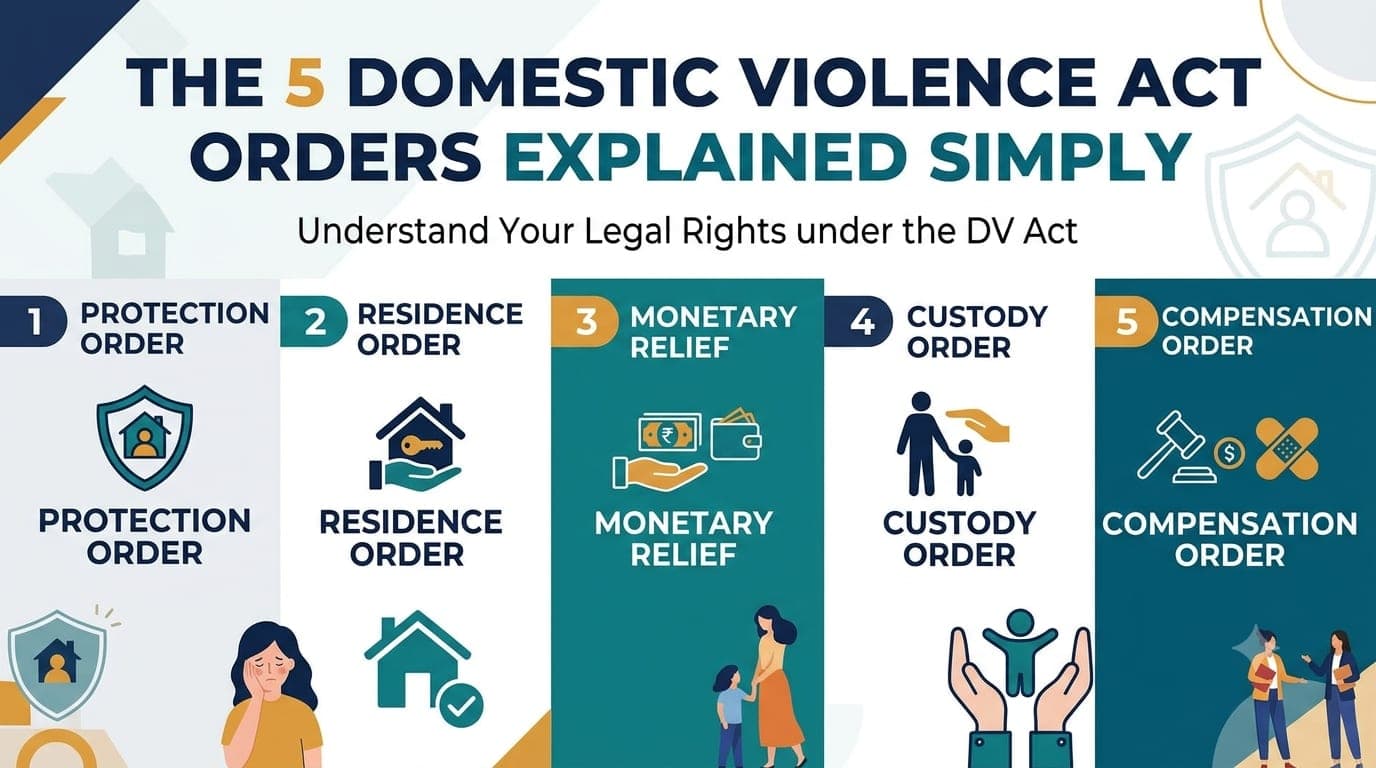
The 5 PWDVA Orders Explained Simply: Protection, Residence, Monetary Relief and More
A plain-English breakdown of the five orders a court can pass under the Protection of Women from Domestic Violence Act, 2005, and how they sit alongside Section 498A of the IPC (now Section 85 of the BNS).