
The 5 PWDVA Orders Explained Simply: Protection, Residence, Monetary Relief and More
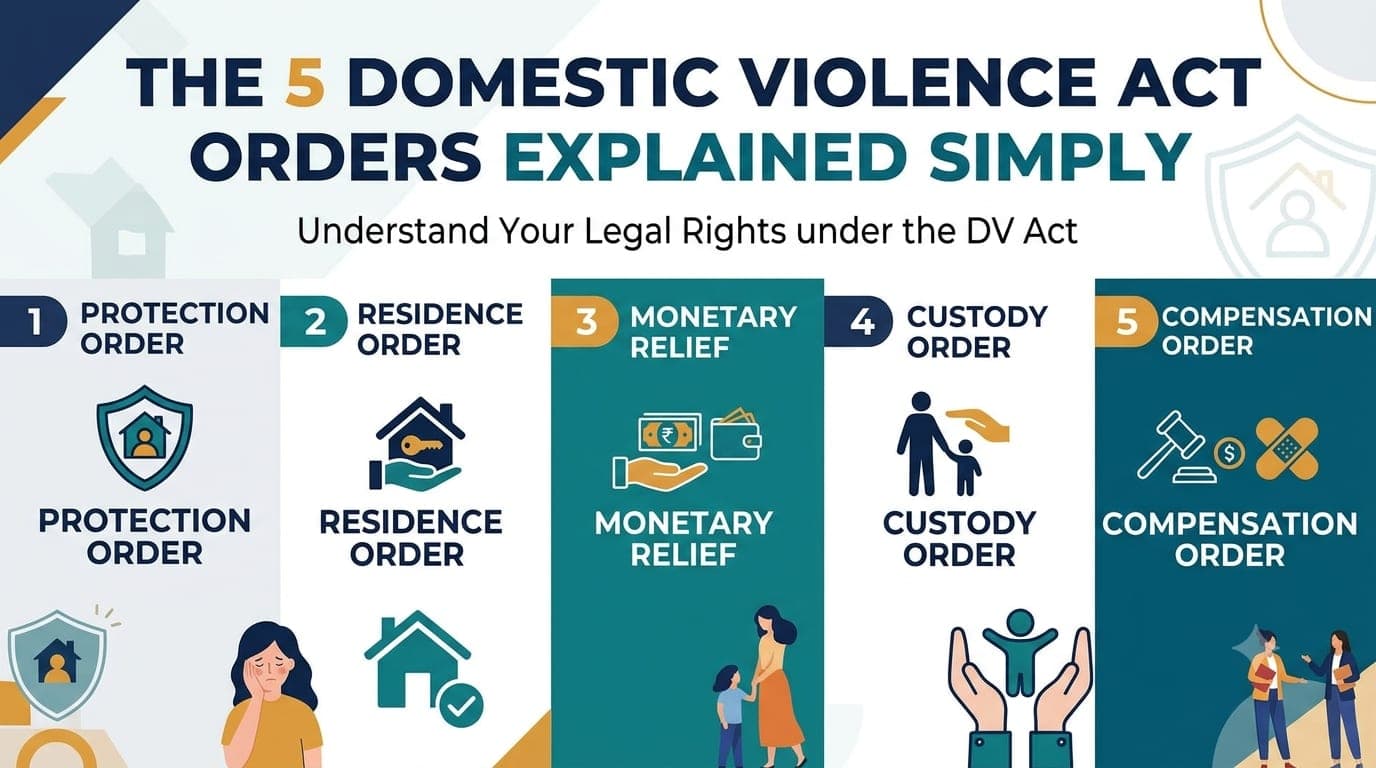
The Protection of Women from Domestic Violence Act, 2005 is not a criminal punishment law. It is a civil remedy. That single distinction explains most of the confusion around it. A woman who approaches a court under the PWDVA is not asking for the husband to be sent to jail. She is asking for protection, for a roof over her head, and for money to live on. The court responds with one or more of five statutory orders.
Criminal prosecution for cruelty is a separate track entirely, under Section 498A of the Indian Penal Code, 1860 (now Section 85 of the Bharatiya Nyaya Sanhita, 2023). The two can run together, but they do different jobs. Confusing them is the most common error I see in pleadings.
What the PWDVA Covers — and What Makes It Different
The Act defines domestic violence to include physical, sexual, verbal, emotional and economic abuse. That last category matters. Stopping a wife's access to her own bank account, refusing to pay for household expenses despite having income, or disposing of assets she uses — all of this can be economic abuse.
Crucially, the PWDVA covers women in "domestic relationships" — not only wives. Mothers, sisters, daughters and live-in partners who share a household fall within the definition. A woman who has been in a relationship in the nature of marriage is covered, regardless of whether a marriage certificate exists.
Proceedings are ordinarily initiated before the Judicial Magistrate First Class in the district where the woman resides or where the violence occurred. Interim orders can be passed quickly, often within weeks of the application.
The Five Orders at a Glance
The Act provides five distinct reliefs. A single application can seek all of them, and courts routinely pass a combination.
- Protection Order — restraining further violence.
- Residence Order — preventing the woman from being evicted from the shared household.
- Monetary Relief — maintenance and compensation.
- Custody Order — temporary custody of children.
- Compensation Order — damages for the injury suffered.
Each is examined below.
Protection Order: Stopping the Violence
A Protection Order is the most commonly sought relief. It directs the respondent — usually the husband or partner — to stop committing domestic violence, and may restrain him from contacting the woman, entering her workplace, or attempting to communicate through others.
What courts actually look at is not the severity of a single incident but the pattern. A medical record of one injury may support a case; a series of messages, complaints to a Protection Officer, or entries in a diary maintained by the woman often carry more weight because they show repetition.
A typical mistake: a woman files for a Protection Order but does not seek a Residence Order or Monetary Relief in the same application. Courts can only grant what is asked for. Relief not sought is relief not granted. At an interim stage, the court looks at whether the application discloses a prima facie case of domestic violence.
Breach of a Protection Order is itself an offence under Section 31 of the PWDVA, punishable with imprisonment which may extend to one year, or a fine, or both.
Residence Order: The Right to Stay in the Shared Household
A Residence Order under Section 19 of the PWDVA prevents the respondent from evicting or excluding the woman from the shared household, and can also restrain him from entering the portion of the house she occupies.
The concept of a "shared household" has generated significant litigation. The Supreme Court has clarified that a woman's right to reside in a shared household is not dependent on ownership — she cannot be thrown out merely because the house belongs to her husband's parents or is jointly owned. However, the exact scope of this right has been refined by subsequent decisions, and lower courts sometimes take a narrower view than the statute suggests.
This is the order that affects family arrangements most directly. If a husband's parents own the house and the wife has lived there, a Residence Order can allow her to remain while proceedings are pending. In practice, courts are cautious about ordering a woman to remain in a house occupied by in-laws against whom allegations exist — protection measures are often passed alongside to keep the parties apart within the same property, or alternate accommodation is directed.
Monetary Relief: Maintenance During and After Proceedings
Monetary Relief under Section 20 of the PWDVA covers three things:
- Maintenance for the woman and her children.
- Compensation for material losses — medical expenses, loss of earnings, damage to property.
- Expenses incurred in the legal proceedings themselves.
The court looks at the standard of living enjoyed in the shared household, the respondent's income and assets, and the woman's own means. An interim monetary order can be passed during the pendency of the case, and it is enforceable like a maintenance order under Section 125 of the Code of Criminal Procedure, 1973 (now Section 144 of the Bharatiya Nagarik Suraksha Sanhita, 2023).
A practical point: the burden of disclosing income lies on the respondent. If he claims to earn very little but lives in an expensive house and drives a new car, courts draw adverse inferences. Affidavits of assets are filed in many jurisdictions, though enforcement of disclosure orders remains uneven.
Custody Order: Children in the Interim
A Custody Order under Section 21 of the PWDVA allows the court to grant temporary custody of children to the woman. It can also direct the respondent to produce the children before the court if they have been removed from her care.
This is an interim arrangement, not a final custody determination. Final custody is decided in guardianship proceedings under the Guardians and Wards Act, 1890 or the Hindu Minority and Guardianship Act, 1956. But the PWDVA interim order often sets the factual stage for the longer custody battle. Courts generally favour continuity — which parent the child has been living with, and who has been handling schooling and medical care.
Compensation Order: Damages for the Injury Suffered
A Compensation Order under Section 22 of the PWDVA is distinct from Monetary Relief. It is damages — compensation for the mental torture and emotional distress caused by the domestic violence. It is awarded after the court records a finding that domestic violence occurred, and the amount is decided on the facts of the case.
In practice, Compensation Orders are less frequently awarded than Protection or Residence Orders, largely because they require a full trial and a positive finding. A woman who has suffered years of abuse may be awarded a lump sum, but collecting it is a separate challenge. A compensation order is executable like a money decree, and proceedings for recovery can follow.
How the Five Orders Work Together
A common error in drafting is to treat the five orders as alternatives. They are not. An application can seek protection, residence, monetary relief and custody in a single petition, and courts routinely grant an interim combination while the case proceeds.
A typical sequence: an application filed in the Magistrate's court; notice issued; an interim Protection Order and interim Monetary Relief granted within weeks; the matter then proceeds for evidence on the remaining reliefs. The entire process can take one to three years depending on the court's docket and the parties' conduct.
Section 498A proceedings, by contrast, follow the criminal procedure — investigation, charge sheet, trial. The standard of proof is higher. The two should not be conflated in the pleadings, and the reliefs sought in each forum should be tracked separately.
What to Gather Before Filing
Before approaching the court or a Protection Officer, collect whatever exists: medical records, photographs, message screenshots, bank statements, rent receipts, school records of children, and details of the respondent's employment and income. There is no fixed limitation period for filing a PWDVA application, but delay weakens interim relief applications because urgency is part of the case.
An application can be filed directly before the Magistrate; a Domestic Incident Report from a Protection Officer is helpful but not mandatory. If the woman is unsure of the correct court, the District Legal Services Authority can guide her to the right forum.
Facing a similar situation? Talk to a BKA advocate before you act.
Chat on WhatsAppNeed help with this?
Our Family Law services
Frequently Asked Questions
What is the difference between a Protection Order and a Residence Order under the PWDVA?
A Protection Order restrains the respondent from committing further domestic violence or contacting the woman. A Residence Order prevents the woman from being evicted from the shared household and can bar the respondent from entering her portion of it. They are separate reliefs and courts frequently pass both together.
Wife ko ghar se kaise nahi nikala ja sakta? (How can a wife be prevented from being thrown out of the house?)
She can apply for a Residence Order under Section 19 of the PWDVA. This prevents the husband or in-laws from evicting her from the shared household, regardless of who owns the property. The court can also restrain them from entering the portion of the house she occupies.
Can I get maintenance under the PWDVA if I already have a maintenance order under Section 125 CrPC?
Yes, but the court will consider the amounts already being received to avoid duplication. Monetary Relief under Section 20 PWDVA covers maintenance, medical expenses, loss of earnings and litigation costs. You should disclose any existing maintenance order in your PWDVA application.
Is the Domestic Violence Act applicable to live-in relationships?
Yes. The PWDVA covers women in a domestic relationship, which includes a relationship in the nature of marriage. A live-in partner who shares a household can seek protection, residence and monetary relief under the Act, even without a registered marriage.
How long does it take to get an interim order under the PWDVA?
An interim Protection Order or interim Monetary Relief can be granted within weeks of filing, depending on the court's docket. The full trial and final orders on all reliefs typically take one to three years. Delay in filing can weaken an application for urgent interim relief.
Can a woman claim the house if it belongs to her husband's parents?
A Residence Order does not give her ownership of the property. It protects her right to reside in the shared household, which the Supreme Court has held is not dependent on ownership. However, courts are cautious about ordering residence in a house occupied by in-laws against whom allegations exist, and may direct alternate accommodation instead.

About the author
Vidhanshi Kamalia
Advocate · Divorce & Matrimonial Disputes
Vidhanshi Kamalia is an Advocate practising before the Supreme Court of India and courts across Delhi, specialising in divorce, matrimonial disputes, and family law matters. She represents clients in divorce proceedings, maintenance, alimony, child custody, domestic violence, and other matrimonial disputes, providing strategic and personalised legal guidance with a client-focused approach.
More about our team →Related Articles
Supreme Court and High Court Rulings on Maintenance When the Wife Has Her Own Income
A wife's salary, flat or car does not automatically shut down her maintenance claim. What the Supreme Court and High Courts have actually held on maintenance where the wife earns, and how the courts decide.
Interim vs Permanent Maintenance: When Can a Husband Legally Reduce or Stop Payments?
Maintenance cannot be stopped at will. This explainer sets out when a husband can lawfully seek reduction or cancellation, and when non-payment is simply illegal.

Wife's Rights in a Matrimonial Dispute: Maintenance, Residence, Custody and Streedhan
A plain-English guide to a wife's core legal rights in a matrimonial dispute in India — maintenance under Section 144 BNSS and Section 125 CrPC, residence under the Domestic Violence Act, child custody, and ownership of streedhan.