
Wife's Rights in a Matrimonial Dispute: Maintenance, Residence, Custody and Streedhan

When a marriage breaks down, the practical questions arrive fast: where will she live, who pays the bills, who keeps the jewellery, who has the children tonight. Indian law answers all four. What it does not do is answer them automatically — almost every right below has to be asked for, in the right forum, with the right evidence.
Here is how the four core rights actually work, and where a wife's claim is strongest.
Maintenance Is a Right, Not Charity — and It Can Be Claimed in More Than One Forum
A wife who cannot maintain herself can seek maintenance from her husband under Section 144 of the Bharatiya Nagarik Suraksha Sanhita, 2023, which replaced Section 125 of the CrPC. This is a criminal-procedure remedy but it is not a punishment — it is a fast, relatively cheap monthly payment order available even if she has not filed for divorce.
Running parallel to it are the civil routes: Section 24 of the Hindu Marriage Act, 1955 for interim maintenance and litigation expenses during a pending divorce or restitution case, and Section 25 for permanent alimony at the end. Muslims may proceed under the Muslim Women (Protection of Rights on Marriage) Act, 2019 or the Muslim Women (Protection of Rights on Divorce) Act, 1986, and Christian and Parsi wives under their own personal laws — all of which now read maintenance in line with the Supreme Court's reasoning in Rajnesh v. Neha (2020), which pushed courts toward uniform standards and mandatory financial disclosure affidavits from both sides.
The factors a court weighs are consistent: the husband's actual income and assets, the wife's own earning capacity, the standard of living during the marriage, and the needs of any dependent children. A wife who has never worked, or who left a career for the marriage, is not expected to start from zero before she can claim. Courts routinely impute income where a husband shows a suspiciously low salary while living well.
One caution that catches people out: the obligation ends if the wife is genuinely able to maintain herself, or if she is living in adultery, or if she remarries. "Able to maintain herself" means able to meet her own reasonable needs, not matching her husband's lifestyle.
The Right to Stay in the Matrimonial Home Survives the Marriage Breaking Down
This is the right most often misunderstood. Under Section 17 of the Protection of Women from Domestic Violence Act, 2005, every woman in a domestic relationship has the right to reside in the shared household — the house where she lived with her husband in a domestic relationship, whether he owns it, rents it, or it belongs to his parents. The Act defines "shared household" broadly enough to cover joint family property, and the Supreme Court's decision in Satish Chander Ahuja v. Sneha Ahuja (2021) confirmed that a wife cannot simply be shown the door from a house in which she has lived, merely because the husband does not own it.
What the right does not do is make her a co-owner. She cannot sell the flat or stop the husband from dealing with his own property. But she can seek a residence order from a Magistrate under Section 19, barring her husband or in-laws from evicting, dispossessing or excluding her from the household, and if living together has become unsafe, a protection order restraining further violence under Section 18, or a restraint on communication under Section 19 itself.
In practice, a residence order is the single most valuable interim relief in a domestic violence case. It buys a woman time and stability while the divorce, maintenance and custody battles run in the background.
Streedhan Belongs to the Wife — It Was Never Family Property
Streedhan is property a woman receives before, during or after marriage — jewellery given at the wedding, cash gifts from her parents and relatives, household articles, and in some cases immovable property. The Supreme Court has been blunt about it: in Pratibha Rani v. Suraj Kumar (1985), it held that a wife's streedhan is her absolute property, and a husband who refuses to return it can face criminal breach of trust under Section 316 of the Bharatiya Nyaya Sanhita, 2023 (formerly Section 406 IPC). Custody of streedhan is not a favour the husband grants — it is a return of what was never his.
The 2023 replacement of the IPC did not change the principle, and courts continue to treat streedhan as distinct from dowry. That distinction matters: dowry is what is demanded from the wife's side, streedhan is what she owns personally. In a divorce or restitution proceeding, a wife can seek a decree for return of streedhan in addition to maintenance, and the value of what she brought into the marriage is often a relevant factor when a court fixes permanent alimony.
If you are documenting a streedhan claim, do it early: photographs, gift receipts, bank statements showing transfers, and any list prepared at the time of the wedding. Recollecting it five years later is far harder.
Custody Is Decided by the Child's Welfare — but the Mother's Role Carries Real Weight
The governing statute depends on the religion and the forum. Hindus approach the court under Section 26 of the Hindu Marriage Act, 1955 and the Guardians and Wards Act, 1890; the secular framework for all communities comes from the same Guardians and Wards Act. The overriding test is the welfare of the child — not the parents' rights, not the mother's gender, not who earns more.
What does matter, heavily, is the practical reality: who has been the primary caregiver, where the child goes to school, what routine the child knows. Courts are wary of uprooting a child for the sake of a legal argument. A mother who has been the day-to-day caregiver from birth starts with a strong factual position, and courts have repeatedly recognised that the welfare of a young child is ordinarily served by the mother's care unless there is a specific reason to think otherwise.
Custody can take several forms — physical custody with one parent and visitation for the other, joint custody with a defined schedule, or in some cases custody with a grandparent or relative. Interim custody is usually decided on affidavits and a counselling report rather than a full trial, and courts increasingly expect both parents to demonstrate willingness to cooperate rather than litigate every school pickup. If you are the mother and your child is currently with you, do not disrupt the arrangement without legal advice — the existing living situation carries weight in every interim application.
Practical Takeaways
None of these rights are self-executing. A wife who is out of the matrimonial home without a residence order, or who has left her jewellery behind without documenting it, is fighting from a weaker position than the law actually gives her. File the domestic violence application and the maintenance petition early, keep a financial trail, and treat streedhan and custody as evidence-based claims rather than moral ones. Which forum fits — Magistrate, family court, or both together — depends on your facts, and in Delhi NCR the Family Courts and the Magistrate's DV Court often run in parallel. Speaking to a family lawyer before you vacate the house, or before you respond to a notice, is usually the cheapest legal step you will take.
Facing a similar situation? Talk to a BKA advocate before you act.
Chat on WhatsAppNeed help with this?
Our Family Law services
Frequently Asked Questions
Can a wife claim maintenance if she is still living with her husband?
Yes. There is nothing in Section 144 of the BNSS or Section 24 of the Hindu Marriage Act that requires a wife to have separated before claiming maintenance. What matters is that she is unable to maintain herself from her own income. In practice, however, courts are more likely to order interim maintenance once there is a pending proceeding, so most claims are filed alongside a divorce, restitution or domestic violence case.
Can my husband legally throw me out of the house if it is in his mother's name?
No. Under Section 17 of the Protection of Women from Domestic Violence Act, 2005, a wife's right of residence applies to the shared household regardless of who owns it, including cases where it belongs to her husband's parents. She can apply for a residence order under Section 19 restraining any person from evicting or excluding her. The right makes her a resident, not a co-owner, so she cannot sell or transfer the property.
How do I prove what my streedhan was if I have no receipts?
You can build the claim through other evidence — wedding photographs showing jewellery, statements from your parents and relatives who gave the items, bank or UPI records of cash transfers, and any list or inventory prepared at or around the wedding. Courts have accepted testimonial evidence in streedhan claims. The stronger the documentary trail, the less the case depends on the husband's word.
Does the mother automatically get custody of a young child?
No, there is no automatic rule, but the practical position is close. Courts decide custody on the welfare of the child, and for very young children the primary caregiver's role usually decides the outcome. Since mothers are more often the primary caregiver, they tend to get physical custody unless there is a specific concern about their care. Fathers are routinely granted visitation or, increasingly, shared custody arrangements.
Can I file a domestic violence case and a maintenance case at the same time?
Yes, and you often should. A domestic violence application before the Magistrate deals with protection, residence and monetary relief under the DV Act, while a separate petition for maintenance under Section 144 BNSS or Section 24 HMA can run before the family court. The two proceedings overlap, so courts usually coordinate them, and a maintenance order is adjusted to avoid double payment.
What happens to my maintenance if I start earning after separation?
Maintenance is not automatically cancelled. The court considers your actual income and your reasonable needs against your husband's capacity, and maintenance may be reduced or, in genuine cases where a wife can comfortably meet her own needs, stopped. Courts generally do not expect a wife who has been out of the workforce for years to immediately match her earlier standard of living. Any change in circumstances should be brought to the court's notice rather than assumed.

About the author
Ujjwal Agrawal
Advocate · Commercial & Money Recovery Cases
Ujjwal Agrawal focuses on commercial litigation and money recovery, including cheque bounce cases under the Negotiable Instruments Act and recovery suits for individuals and businesses.
More about our team →Related Articles
Supreme Court and High Court Rulings on Maintenance When the Wife Has Her Own Income
A wife's salary, flat or car does not automatically shut down her maintenance claim. What the Supreme Court and High Courts have actually held on maintenance where the wife earns, and how the courts decide.
Interim vs Permanent Maintenance: When Can a Husband Legally Reduce or Stop Payments?
Maintenance cannot be stopped at will. This explainer sets out when a husband can lawfully seek reduction or cancellation, and when non-payment is simply illegal.
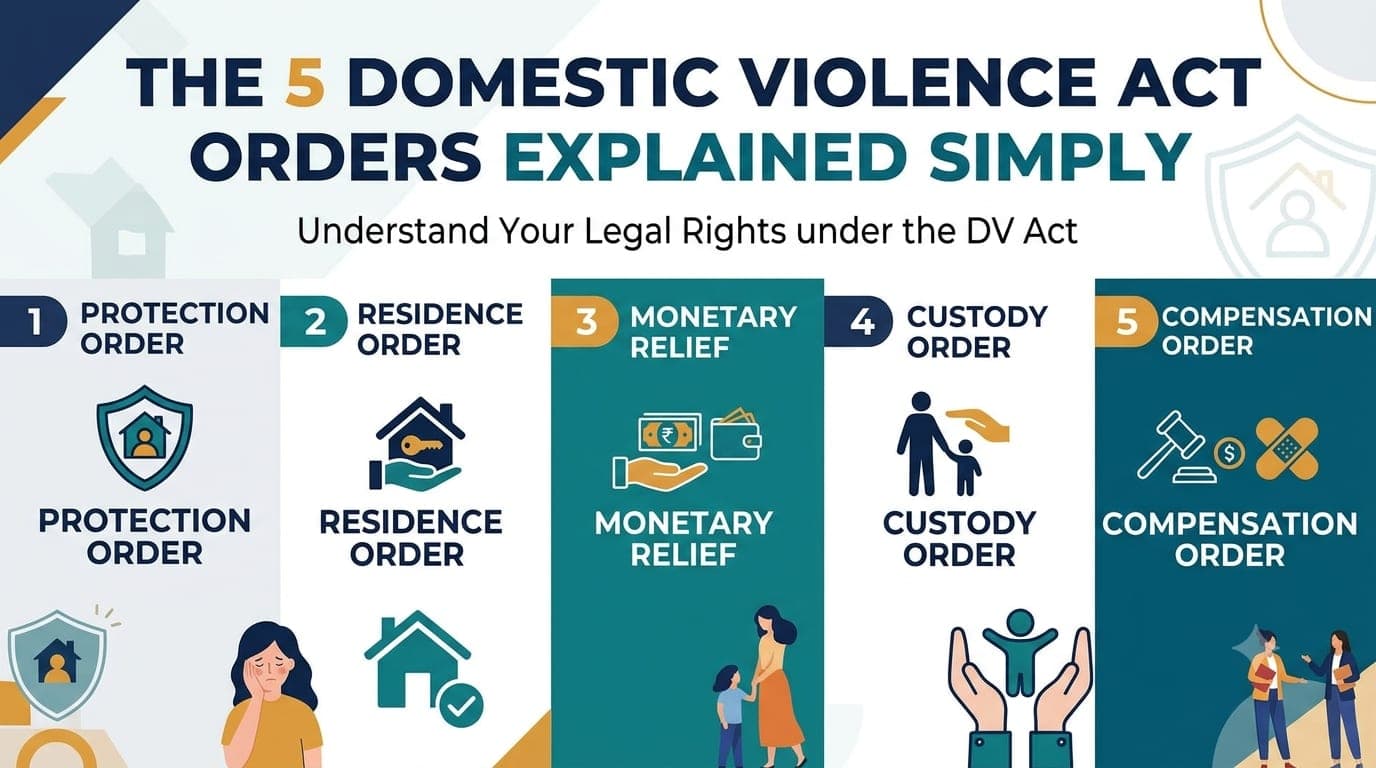
The 5 PWDVA Orders Explained Simply: Protection, Residence, Monetary Relief and More
A plain-English breakdown of the five orders a court can pass under the Protection of Women from Domestic Violence Act, 2005, and how they sit alongside Section 498A of the IPC (now Section 85 of the BNS).