Engaging a Divorce Lawyer in Divorce Lawyer in Rohini
A divorce is a statutory proceeding. The forum chosen and the ground pleaded determine both the length and the cost of the matter. BKA Lawyers advises clients from Rohini, Pitampura, Prashant Vihar, Narela and the wider North-West Delhi district on the correct route at the outset, whether that is a joint petition or a contested one.
Clients usually approach the firm at three stages: before the petition is filed, after a petition has been served, and where an earlier settlement has broken down. In each case the firm reviews the marriage record, the assets and any pending proceedings before advising on the next step.
For clients whose matter is listed at Rohini Courts, the chamber is inside the complex. A consultation can therefore be held on the day of the hearing.
Court Procedure for Divorce Lawyer in Rohini Matters
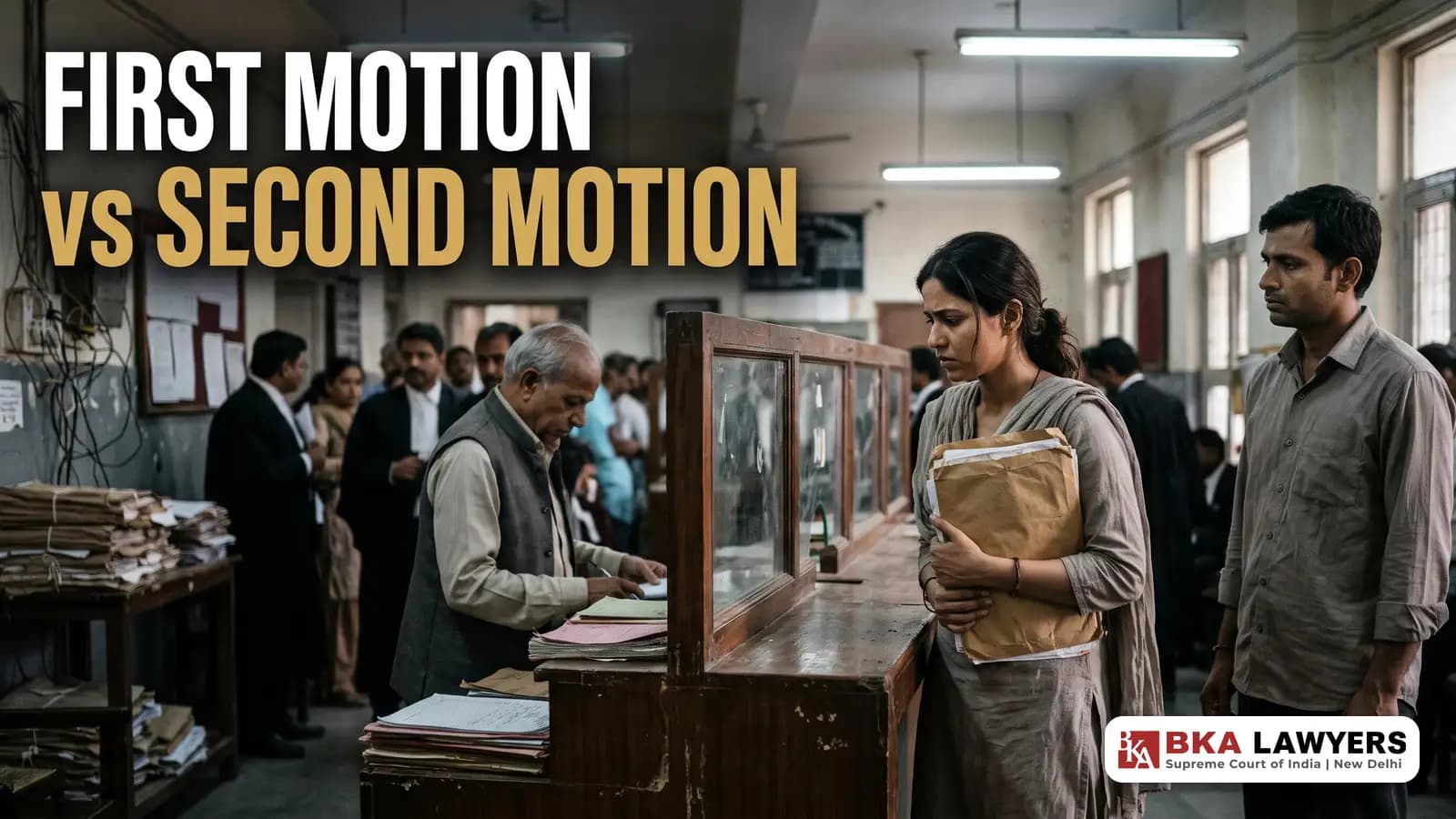
A divorce under the Hindu Marriage Act, 1955 begins with a petition presented before the family court. A joint petition under Section 13B follows a fixed sequence. The parties appear for their statements, the court records the first motion, a cooling-off period of six months follows, and a second motion is recorded before the decree of divorce is passed. The court may waive the waiting period in appropriate circumstances where the statutory conditions are satisfied.
A contested petition under Section 13 is tried like any other civil suit. Notice issues to the respondent, a written statement is filed, issues are framed, and evidence is led by affidavit and cross-examination. Interim applications for maintenance, custody or injunctions are heard alongside the main petition. Matters at Rohini are heard by the family courts sitting within the Rohini Court Complex.
Under the Family Courts Act, 1984, the court first attempts reconciliation and may refer the parties to mediation. Where a settlement is reached, its terms are recorded and the decree follows those terms.
Documents Required
- Marriage certificate or proof of solemnisation, and wedding photographs where the certificate is unavailable
- Address proof and identity documents of both parties
- Photographs of the parties and of any children
- Details of joint and separate assets, bank accounts, investments and liabilities
- Income proof, such as salary slips or income tax returns, where maintenance or alimony is in issue
- Particulars of any previous or pending litigation between the parties
- Passport, visa and overseas address details in NRI matrimonial matters
- Original petition and court records where a matter is already pending
Expected Timelines and Costs
A mutual consent divorce at Rohini ordinarily concludes after the first motion, the cooling-off period and the second motion, provided both parties remain consistent. Where the court is satisfied that the statutory waiting period should be dispensed with, the timeline shortens. A contested divorce depends on the number of witnesses, interim applications and adjournments, and typically runs considerably longer than a joint petition.
Costs are driven by the nature of the matter rather than by the place of filing. A joint petition involves drafting, filing and two appearances. A contested matter involves pleadings, interim applications, evidence and arguments, and the professional fee reflects that work. Court fees and incidental expenses are separate. BKA Lawyers sets out the basis of the fee at the first consultation and confirms it in writing before work begins.
Common Pitfalls
- Filing a joint petition before the parties have agreed on all terms, including permanent alimony and the return of streedhan.
- Omitting assets or income particulars, which later weakens a claim for maintenance or a defence to it.
- Treating a compromise reached in mediation as final without having it recorded in the court's order.
- Allowing a contested matter to proceed without addressing interim maintenance, which can lead to arrears.
- In NRI matters, ignoring overseas proceedings or failing to place the foreign marriage record before the court.
Why Choose BKA Lawyers in Divorce Lawyer in Rohini
BKA Lawyers has been in practice for over 35 years. The firm appears before the Supreme Court of India, the High Court of Delhi, the High Court of Punjab & Haryana at Chandigarh, the Rajasthan High Court at Jaipur and Jodhpur, and the district and sessions courts across Delhi, including Rohini, Tis Hazari, Karkardooma, Saket, Dwarka, Patiala House and Rouse Avenue, as well as the district courts of Gurugram, Noida, Ghaziabad and Faridabad.
The firm's chamber at Rohini is Chamber No. 1032 Lawyer's, Rohini Court Complex, Block D, Sector 14, Rohini, New Delhi, Delhi 110085. Clients also meet the firm at the Pitampura office at NP-39/C, Maurya Enclave, Pitampura, New Delhi - 110088, the Tis Hazari chamber at Chamber No. A-15, Western Wing, Tis Hazari Courts, New Delhi - 110054, and the Narela office at Pocket IV, Sector G2&G6, 1109, Eleventh Floor, Tower C, Narela, Delhi 110040.
Rohini is served by the Rohini West, Rohini East and Rithala stations on the Red Line and Rohini Sector 18-19 on the Yellow Line. The principal landmarks are Madhuban Chowk, Japanese Park and the Rohini Court Complex, Sector 14. The local police stations are Prashant Vihar, Rohini North and Rohini South. Urgent bail and arrest assistance is available 24x7.