When Treatment Becomes Negligence
A medical negligence claim arises where a doctor or hospital owes a duty of care to a patient, breaches that duty by falling below the standard expected of a reasonably competent practitioner in the same field, and the breach causes injury or death. A poor result alone does not establish negligence; the law distinguishes an adverse outcome from careless conduct.
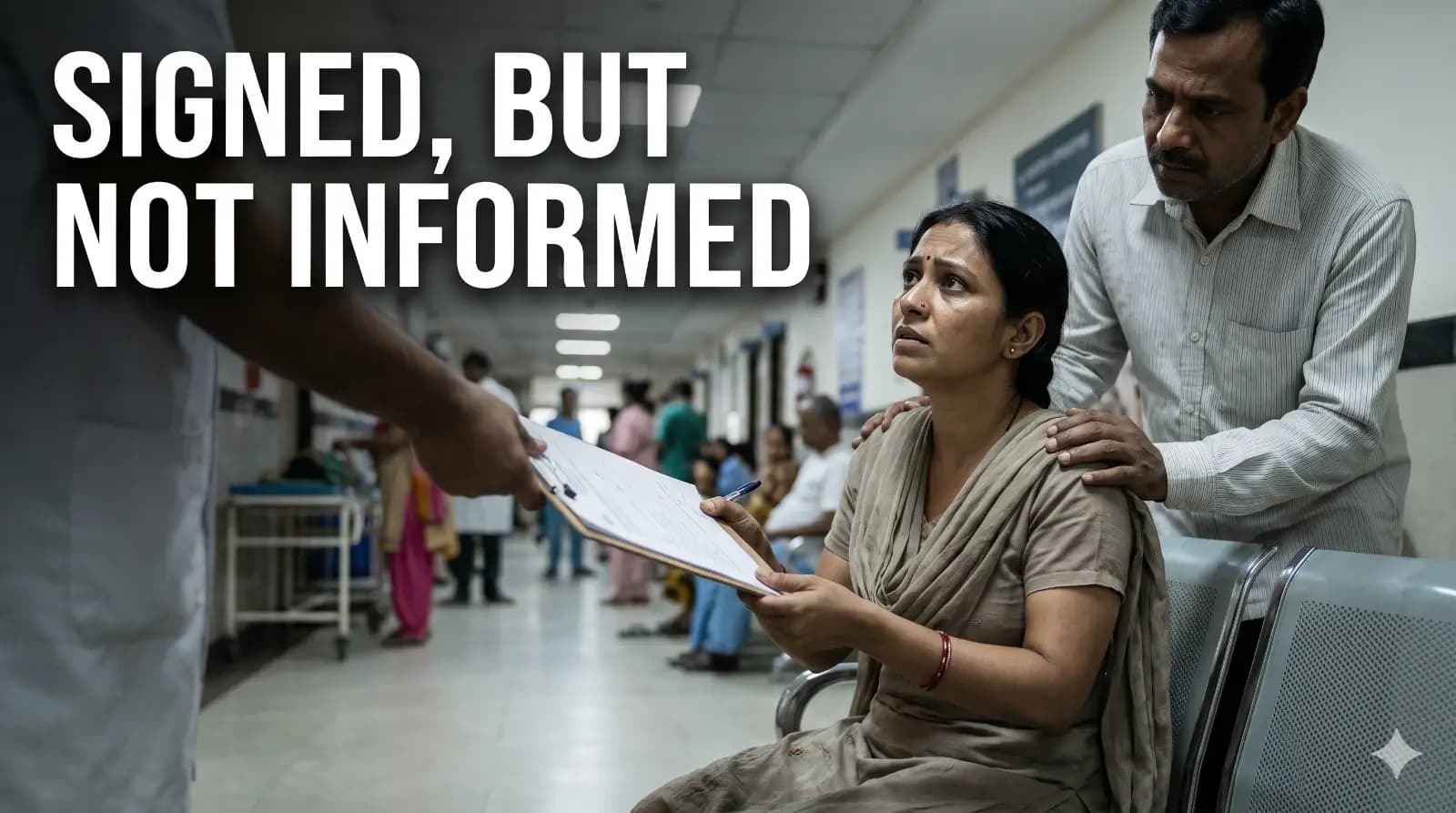
Negligence may take several forms: failure to diagnose or a delayed diagnosis, surgical error, wrong-site surgery, medication and dosage errors, failure to obtain informed consent, inadequate post-operative monitoring, hospital-acquired infection caused by deficient hygiene, and birth injury arising from mismanaged labour. Maternal negligence and the mismanagement of pregnancy are treated as serious categories.
BKA Lawyers assesses each case against the treatment records, so that a claim rests on clinical evidence rather than on dissatisfaction with the outcome.
Where to File a Claim
A claim may be pursued in more than one forum, and the choice depends on the nature of the grievance and the relief sought.
- Consumer Commissions. Medical services fall within the Consumer Protection Act, 2019. A complaint may be filed before the District, State or National Commission according to the value of the compensation claimed. BKA Lawyers appears before the Consumer Commissions in Delhi NCR.
- Civil courts. A suit for damages for negligence may be filed before the civil court, generally where the claim does not fall within the consumer fora or where a civil remedy is otherwise appropriate.
- Criminal complaint. Where negligence is of a gross nature, a complaint may be made before the police or the magistrate. The firm handles criminal matters under the Bharatiya Nyaya Sanhita, 2023 (BNS), the Bharatiya Nagarik Suraksha Sanhita, 2023 (BNSS) and the Bharatiya Sakshya Adhiniyam, 2023 (BSA).
- State Medical Council. A complaint may be made to the State Medical Council for professional misconduct, which may result in disciplinary action against the practitioner.
Proving Medical Negligence
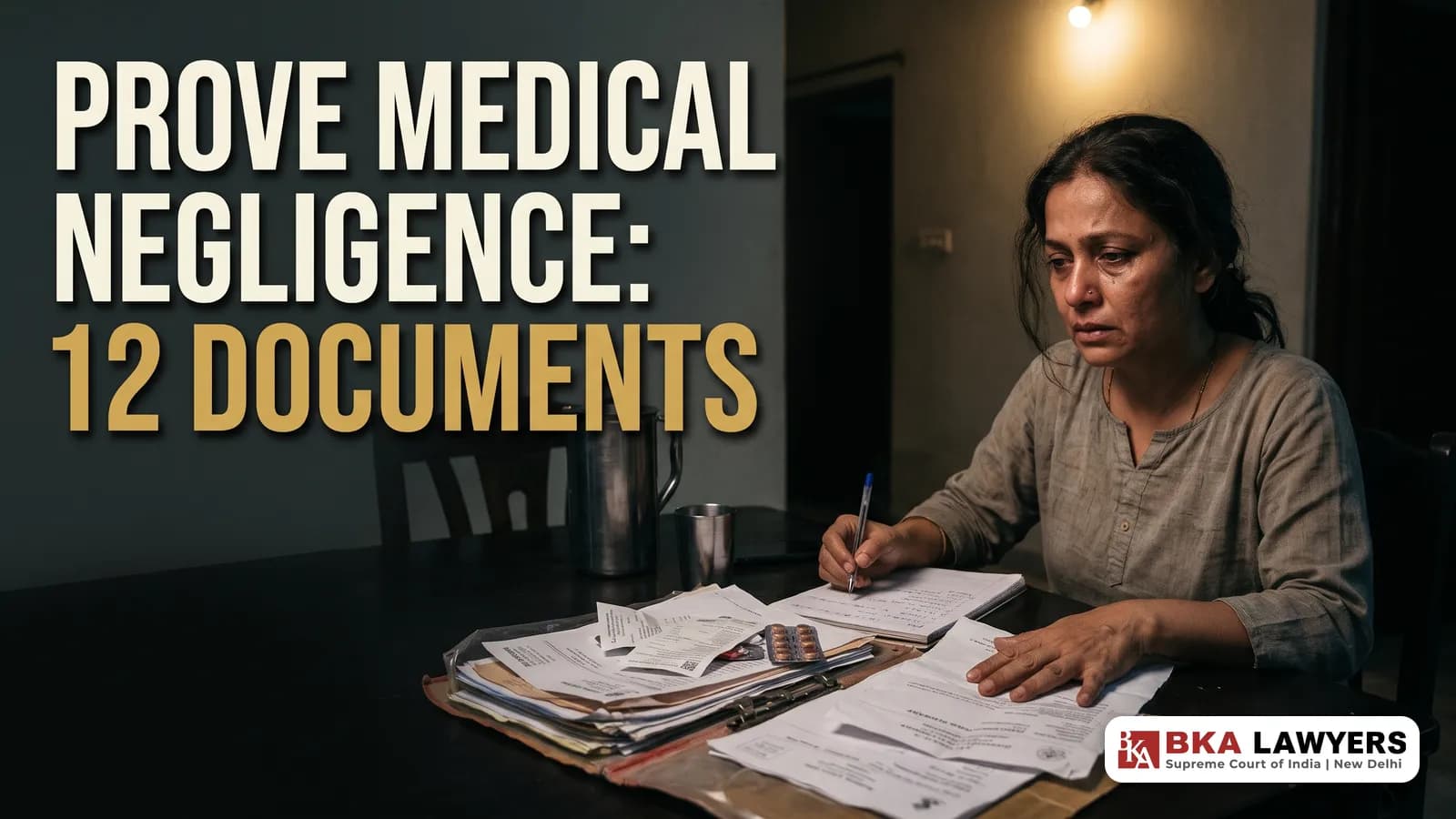
The burden lies on the patient or the family to establish the standard of care, its breach and the causal link to the injury. The following material is central:
- Complete medical records — admission notes, case sheets, investigation reports, operation notes, discharge summaries and prescriptions.
- Expert opinion from a qualified practitioner in the relevant speciality, addressing the standard of care and the deviation from it.
- Evidence of causation, connecting the deviation to the harm suffered.
- In appropriate cases, the opinion of a medical board.
Evidence must be preserved early. Hospitals are obliged to maintain records, and an application for their production may be made where records are withheld. BKA Lawyers coordinates the collection of records and the obtaining of expert opinion.
When to File
Time limits differ by forum. Under the Consumer Protection Act, 2019, a complaint must ordinarily be filed within two years from the date of the cause of action, and delay may be condoned on sufficient cause being shown. Civil suits for damages are governed by the Limitation Act, 1963, with a three-year period generally applying to claims in tort. Criminal complaints are subject to the limitation prescribed under the BNSS.
Delay weakens a claim because records are lost and witnesses become unavailable. Patients and families should obtain a legal opinion as soon as the harm is identified.
Compensation
The compensation awarded depends on the facts of each case and the evidence led. Broadly, the heads of claim include:
- Medical and hospital expenses already incurred and expected in future.
- Loss of income, present and future, where the patient is unable to work.
- Pain, suffering and loss of amenities of life.
- In fatal cases, loss of dependency and funeral expenses.
- In appropriate cases, compensation for mental agony.
No amount can be stated in advance. The quantum is determined by the commission or court on the evidence, and past decisions of the Consumer Commissions and the Supreme Court illustrate the range of awards in comparable matters.
Our Approach to Medical Negligence Cases
BKA Lawyers has over 35 years in practice and appears before the Supreme Court of India, the High Court of Delhi, the High Court of Punjab & Haryana at Chandigarh, the Rajasthan High Court at Jaipur and Jodhpur, the District and Sessions Courts across Delhi and NCR, and the Consumer Commissions in Delhi NCR. The firm also appears before the NCLT and NCLAT, the DRT and DRAT, the RERA authorities, MACT, Labour Courts, CAT and SDM Courts.
The firm's work in a medical negligence matter proceeds in stages: a preliminary review of the treatment records; advice on the appropriate forum; drafting and filing of the complaint or suit; collection of records and expert opinion; and representation through hearings and arguments. Urgent bail and arrest assistance is available 24x7 where a criminal complaint is made.
Clients are informed of the strengths and weaknesses of a claim before it is filed. The firm does not promise any particular outcome; the result depends on the evidence and the decision of the adjudicating authority.