Medical Negligence Under Indian Law
Medical negligence arises when a doctor or hospital fails to exercise the degree of care expected of a reasonably competent practitioner in the same field. The standard is that of an ordinary skilled professional, not the highest expert. A claim requires proof of a duty of care, a breach of that duty, and injury caused by the breach.
In Jacob Mathew v. State of Punjab (2005), the Supreme Court held that criminal negligence requires gross negligence, not a mere error of judgment. In civil and consumer matters, the test is whether the practitioner acted with reasonable skill and care. The principle of res ipsa loquitur (the thing speaks for itself) may apply where the injury would not ordinarily occur without negligence.
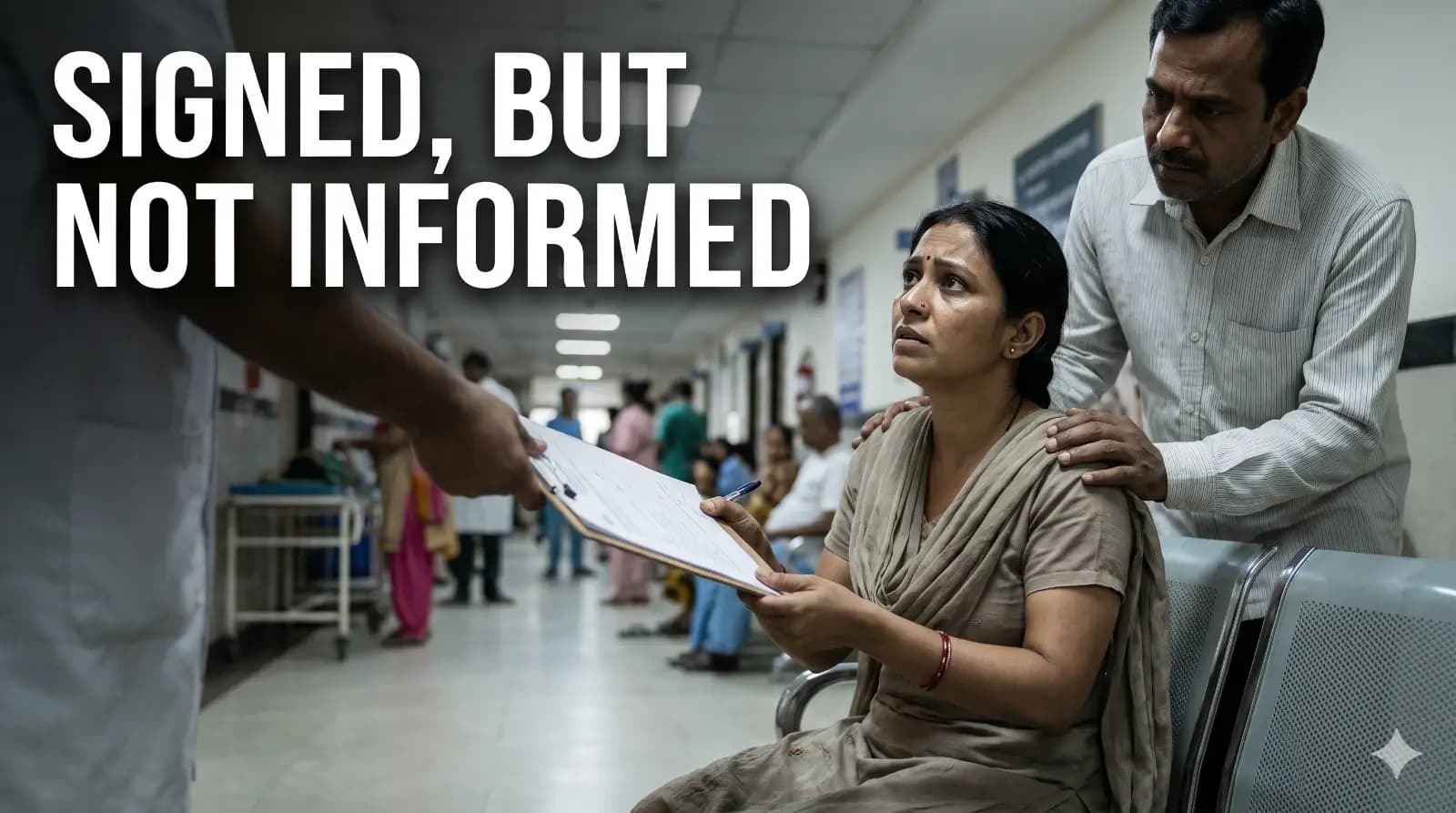
Claims commonly concern surgical errors, wrong-site surgery, retained surgical items, anaesthesia mishaps, misdiagnosis, delayed diagnosis, birth injuries, maternal negligence and failure to obtain informed consent.
Consumer, Civil and Criminal Remedies
A patient may complain to the appropriate Consumer Commission under the Consumer Protection Act, 2019, seeking compensation for deficiency in service. The pecuniary limits are fixed by the Act: the District Commission up to ₹50 lakh, the State Commission up to ₹2 crore, and the National Commission above that. Medical services fall within the definition of "service" under the Act.
A civil suit for damages may be filed where the compensation claimed exceeds the consumer forum limits or where the matter is unsuitable for summary consumer proceedings. Criminal complaints for gross negligence may be filed under sections 304A, 336, 337 and 338 of the Bharatiya Nyaya Sanhita, 2023, which replaced the Indian Penal Code. A complaint for professional misconduct may also be made to the State Medical Council.
Evidence and Expert Opinion
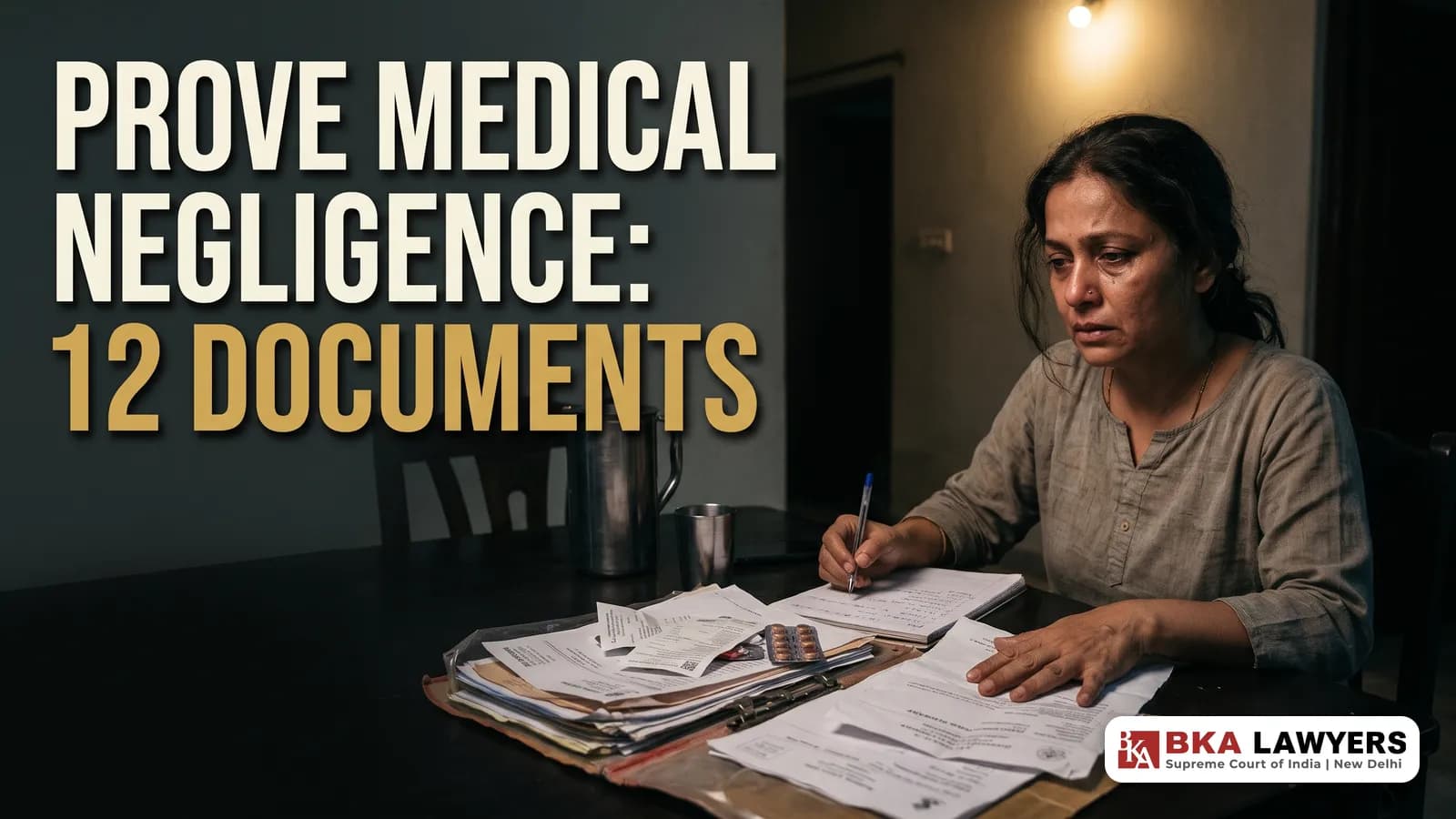
The complainant bears the burden of proving negligence. Medical records — case sheets, discharge summaries, operation notes, investigation reports and prescriptions — form the primary evidence. Patients and families are entitled to copies under the Clinical Establishments (Central Government) Rules, 2012 and the Consumer Protection Act.
Expert opinion is usually necessary to establish the standard of care and any deviation from it. In Jacob Mathew, the Supreme Court held that a doctor should not be prosecuted without a credible opinion from another competent doctor. In consumer and civil proceedings, the commission or court may rely on expert testimony, medical literature and the evidence of treating doctors. The firm assists in obtaining and presenting expert evidence.
Limitation Period for Claims
Under the Consumer Protection Act, 2019, a complaint must be filed within two years from the date of the cause of action. Delay may be condoned on sufficient cause being shown. For civil suits, the Limitation Act, 1963 prescribes three years from the date of the injury or from the date the negligence becomes known.
Criminal complaints are governed by the Bharatiya Nagarik Suraksha Sanhita, 2023. Where negligence is continuing or the injury is discovered later, limitation may run from the date of discovery. Claimants should seek legal advice promptly.
Compensation and Damages
Compensation is intended to restore the claimant to the position they would have occupied but for the negligence. It may cover medical expenses, loss of income, pain and suffering, loss of amenities and, in fatal cases, loss of dependency and funeral expenses. The Supreme Court discussed the governing principles in Malay Kumar Ganguly v. Dr. Sukumar Mukherjee (2009) and Balram Prasad v. Kunal Saha (2014).
India has no fixed formula or calculator for compensation. The amount depends on the facts, the nature of the injury, the patient's age and the evidence. The firm assesses each claim and presents it before the appropriate forum.
How BKA Lawyers Assists Patients and Families
BKA Lawyers has over 35 years of experience in compensation claims, including medical negligence matters, before consumer commissions, civil courts and medical councils. The firm's Rohini office is at Chamber No. 1032, Lawyer's Chambers, Rohini Court Complex, Block D, Sector 14, Rohini, New Delhi, Delhi 110085. Clients may also meet at the Pitampura office at NP-39/C, Maurya Enclave, Pitampura, New Delhi 110088, or at Chamber No. A-15, Western Wing, Tis Hazari Courts, New Delhi 110054.
The firm assists in obtaining medical records, arranging expert opinions, drafting and filing complaints, and representing clients before the District and State Consumer Commissions, civil courts and the Delhi Medical Council. It also appears before the High Court of Delhi and the Supreme Court of India in appropriate matters. Urgent assistance is available 24x7 for bail and arrest-related matters.
BKA Lawyers takes matters from any area to any court. The firm appears before all District and Sessions Courts in Delhi, including Tis Hazari, Rohini, Karkardooma, Saket, Dwarka, Patiala House and Rouse Avenue, and before the District Courts in Gurugram, Noida, Ghaziabad and Faridabad. For Rohini matters, the nearest court complex is the Rohini Court Complex, where the firm maintains a chamber.