
Civil Suit and Injunction in India: Procedure, Reliefs and Enforcement
A civil suit is used to enforce a private right—such as ownership, possession, payment, contractual performance or protection from interference. When waiting for the final judgment may allow serious harm, the claimant can also seek an injunction. The injunction may preserve the existing position temporarily or form part of the final relief granted by the court.
Step 1: Identify the right and the correct relief
The first question is not simply whether the defendant has acted unfairly. The plaintiff must identify a legally enforceable right and show how it has been violated or threatened.
Common civil remedies include:
- recovery of money or possession;
- declaration of title or legal status under Section 34 of the Specific Relief Act, 1963;
- specific performance of a contract;
- cancellation or rectification of an instrument; and
- permanent or mandatory injunction.
An injunction can be prohibitory, preventing an act such as construction, dispossession or misuse of confidential information. It can also be mandatory, requiring a person to undo an unlawful act. A mandatory injunction is governed by Section 39 of the Specific Relief Act.
The relief must match the dispute. For example, a person whose ownership is seriously disputed may need a suit for declaration and possession, not merely a bare injunction suit.
Step 2: Check jurisdiction, limitation and maintainability
Under Section 9 of the Code of Civil Procedure, 1908 (CPC), civil courts can hear suits of a civil nature unless jurisdiction is expressly or impliedly barred. Some disputes must instead go before specialised forums such as consumer commissions, family courts, tribunals or authorities created by particular statutes.
The correct court is determined by:
- territorial jurisdiction, including where the defendant resides or the cause of action arose;
- pecuniary jurisdiction, based on the suit’s valuation;
- the location of immovable property, where relevant; and
- any statutory or contractual jurisdiction requirements.
The suit must also be filed within the applicable period under the Limitation Act, 1963. The deadline varies with the relief claimed and the date on which the right to sue arose. Delay can defeat the main suit and also weaken a request for urgent equitable relief.
If the suit concerns a commercial dispute of the specified value, Section 12A of the Commercial Courts Act, 2015 may require pre-institution mediation. The statutory exception applies where the suit genuinely contemplates urgent interim relief.
Step 3: Prepare and file the plaint
A civil suit begins with a plaint prepared under Order VII CPC. It should clearly state the parties, material facts, cause of action, jurisdiction, valuation and exact relief requested.
The plaintiff should file the documents on which the claim relies. In a property dispute, these may include title deeds, revenue or municipal records, site plans, photographs, correspondence and proof of possession. In a contractual dispute, the agreement, invoices, notices and payment records may be central.
Material facts must be pleaded with precision. An injunction is an equitable remedy, so concealment or a misleading statement can result in refusal or later vacation of the order.
Court fees are payable according to the nature and valuation of the relief under the applicable court-fee legislation. If notice is required before suing the Government or a public officer, Section 80 CPC must also be examined.
Step 4: Apply for a temporary injunction
A temporary injunction protects the subject matter while the suit is pending. Section 37 of the Specific Relief Act recognises temporary injunctions, while the procedure is principally contained in Order XXXIX Rules 1 and 2 CPC.
The application should be supported by an affidavit and documents showing urgency. Courts ordinarily examine three requirements:
- Prima facie case: there is a serious issue requiring trial.
- Balance of convenience: refusing protection would cause greater hardship than granting it.
- Irreparable injury: damages alone would not adequately remedy the threatened harm.
These requirements operate together. Filing a suit does not create an automatic right to an injunction.
The court may impose conditions or require an undertaking. It can also grant a limited status quo order rather than the wider restraint requested by the plaintiff.
Step 5: Understand ex parte injunctions and the defendant’s remedies
An ex parte injunction may be granted without first hearing the defendant where delay would defeat the purpose of the application. Under Order XXXIX Rule 3 CPC, the court must record why prior notice is being dispensed with. The applicant must then promptly provide the opposite party with the application, plaint, supporting affidavit and relied-upon documents.
Order XXXIX Rule 3A CPC requires the court to endeavour to decide the injunction application within 30 days of granting an ex parte order. If that is not possible, reasons should be recorded.
A defendant can apply under Order XXXIX Rule 4 CPC to discharge, vary or set aside the injunction. Anyone anticipating an urgent application may lodge a caveat under Section 148A CPC. A caveat remains effective for 90 days unless the expected application is filed earlier.
An order granting or refusing an injunction is ordinarily appealable under Order XLIII Rule 1(r) CPC. In commercial litigation, the appellate route is also affected by Section 13 of the Commercial Courts Act.
Step 6: Proceed through the civil trial
After filing, the court issues summons under Order V CPC. The defendant files a written statement under Order VIII CPC, after which the court identifies the disputed issues. The parties then lead documentary and oral evidence, cross-examine witnesses and make final submissions.
Interim protection does not determine the suit. A party may secure a temporary injunction at the beginning but still lose after evidence is tested. Conversely, refusal of interim relief does not always mean that the final claim must fail.
Commercial suits follow stricter timelines and case-management requirements. In an ordinary civil suit, delay remains possible, making careful pleadings, complete documents and focused issues particularly important.
Step 7: Obtain and enforce the final injunction
A perpetual injunction is granted through the final decree and is governed principally by Section 38 of the Specific Relief Act. The court may also grant a mandatory injunction under Section 39 and damages in addition to, or instead of, an injunction under Section 40, provided the relief is properly claimed.
An injunction may be refused in circumstances listed in Section 41 of the Specific Relief Act. These include cases where an equally effective remedy is available through another usual mode of proceeding, the plaintiff has acquiesced in the conduct, or the plaintiff’s own conduct disentitles them to equitable relief.
Breach of a temporary injunction can invite action under Order XXXIX Rule 2A CPC, including attachment of property and civil detention. A final injunction decree may be enforced under Order XXI Rule 32 CPC. Courts may also exercise inherent powers under Section 151 CPC where necessary to protect their process and ensure meaningful implementation, subject to the limits of the CPC.
A civil suit should be framed around the final remedy actually required, while an injunction application should address the immediate risk with evidence rather than broad allegations. Early review of jurisdiction, limitation, documents and the correct combination of declaration, possession, damages and injunctive relief can prevent avoidable objections later.
Facing a similar situation? Talk to a BKA advocate before you act.
Chat on WhatsAppNeed help with this?
Our Civil Law services
Frequently Asked Questions
Can I obtain an injunction to stop the sale or construction of disputed property?
A temporary injunction may be sought under Order XXXIX Rules 1 and 2 CPC when property is in danger of being transferred, damaged or wrongfully interfered with during the suit. You must establish a prima facie case, balance of convenience and a risk of irreparable injury; urgency alone is not enough.
Can a civil court grant an injunction without hearing the defendant?
Yes, but only where delay would defeat the purpose of the application. Under Order XXXIX Rule 3 CPC, the court must record reasons for proceeding without notice, and the applicant must promptly supply the pleadings, application, affidavit and relied-upon documents to the defendant.
What can I do if an ex parte injunction has been passed against me?
You can apply under Order XXXIX Rule 4 CPC to have the injunction discharged, varied or set aside. An appeal against an order granting or refusing an injunction ordinarily lies under Order XLIII Rule 1(r) CPC, subject to the applicable forum and any special law governing the dispute.
Do I need a declaration of ownership along with a property injunction?
A bare injunction suit may be sufficient where lawful possession is threatened and title is not genuinely disputed. If ownership is under a serious cloud, the plaintiff may need to seek a declaration of title, possession and consequential injunction instead of asking only for an injunction.
How long does an injunction remain in force during a civil suit?
The main civil suit can continue until trial and final judgment unless it is settled or disposed of earlier. An ex parte injunction application should be addressed promptly, and Order XXXIX Rule 3A CPC requires the court to endeavour to decide it within 30 days of the ex parte order.
What happens if someone disobeys a civil court injunction?
Breach of a temporary injunction can lead to proceedings under Order XXXIX Rule 2A CPC, including attachment of property and civil detention. A final injunction decree can be enforced under Order XXI Rule 32 CPC through the executing court.

About the author
Binod K. Agrawal
Founding Advocate · Civil Cases & Property Disputes
Binod K. Agrawal is the founding advocate of BKA Lawyers, with extensive experience handling high-stakes litigation across civil, criminal, and commercial matters before the Delhi High Court, District Courts, and Supreme Court of India.
More about our team →Related Articles
Hiding a Live-In Relationship or a Child From a Prospective Bride: What the Kerala High Court Has Now Said
The Kerala High Court has held that concealing a live-in relationship or an existing child from a prospective bride can amount to obtaining consent to sex by deceitful means. Here is what the ruling means, in plain English, and what both sides should know before a marriage is arranged.
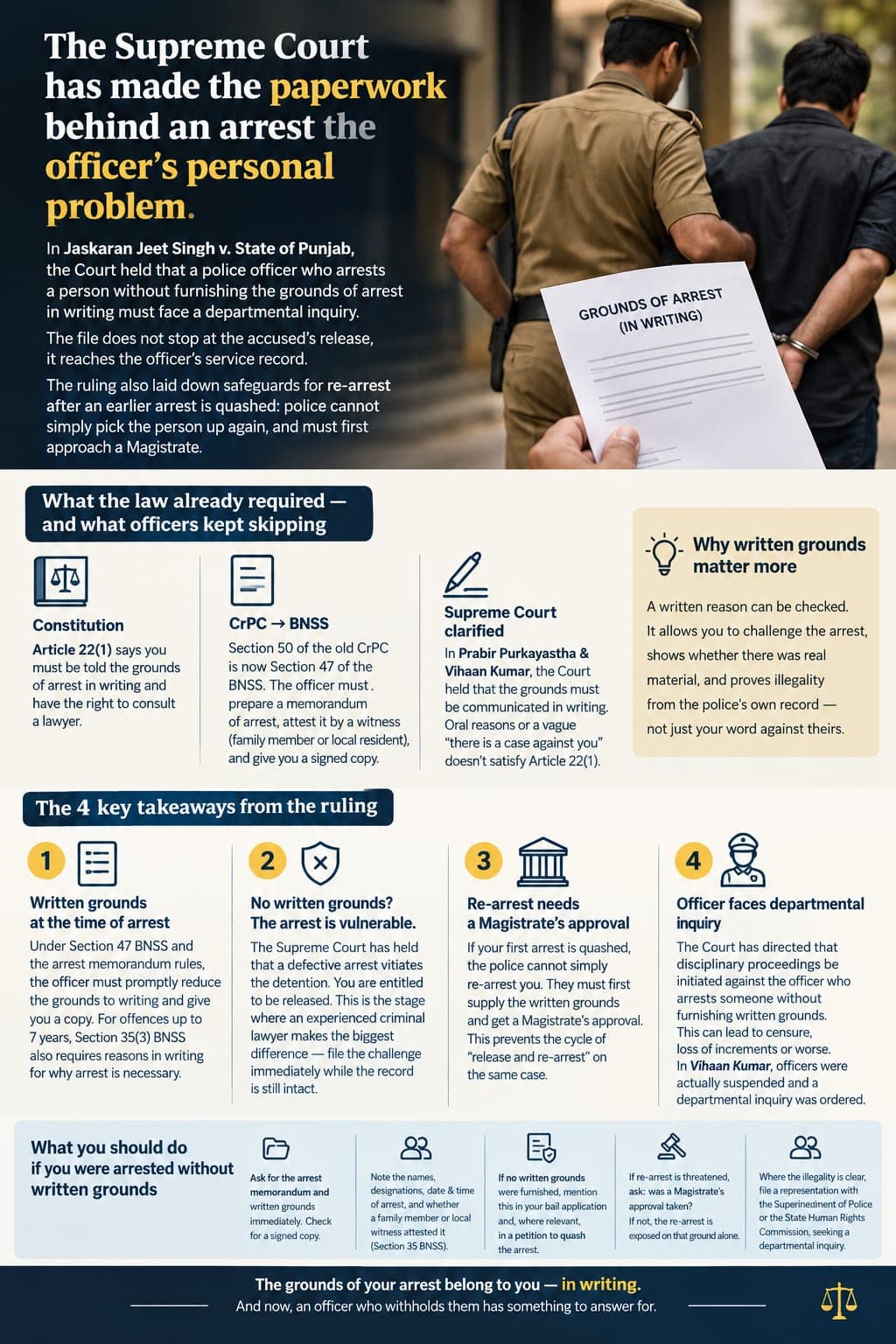
Arrest Without Written Grounds: Why the Supreme Court Says the Officer Must Face a Departmental Inquiry
A police officer who arrests you without handing over written grounds of arrest now faces a departmental inquiry. Here is what the Supreme Court's ruling means for your rights under Article 22(1), Section 35 BNSS and Section 58 BNSS.
Arbitration and Settlement in India: A Practical Guide
Understand how arbitration works in India under the Arbitration and Conciliation Act, 1996, including settlement options, enforceability, and practical steps for resolving disputes outside court.