
Bought a Defective Product in Delhi? How to File a Consumer Complaint Under the Consumer Protection Act, 2019

A defective product is not a matter of bad luck you must absorb. Under the Consumer Protection Act, 2019 (CPA 2019), a buyer in Delhi can seek repair, replacement, refund or compensation — and since 2020, the process can begin online through the e-Daakhil portal. What follows is how the process actually runs, in the order it runs.
The Act defines a "defect" as any fault, imperfection or shortcoming in the quality, quantity, potency, purity or standard of goods. A phone that stops charging in week two, a pressure cooker whose lid fails, a car with a recurring braking fault — each is a potential defect. So is a product that is unsafe when used as intended.
Step 1: Send a written notice to the seller or manufacturer
Before filing, put the grievance in writing. A short letter or email to the seller (and, where the defect appears serious, to the manufacturer) should identify the product, the invoice number and date, the defect, what you want (repair, replacement or refund) and a reasonable deadline — two to four weeks is usual.
This notice matters for two reasons. First, a significant number of disputes are settled at this stage because the seller would rather replace a ₹30,000 appliance than defend a complaint. Second, the notice and the reply (or the silence) become part of your record. Keep proof of dispatch — email sent, courier receipt, or acknowledgement.
A common mistake: sending an angry WhatsApp message and treating it as notice. It is evidence, but it is not a notice. Write a proper one.
Step 2: Gather the documents that prove the defect
A consumer commission decides on documents. Assemble, in one folder:
- Invoice or bill in your name, showing date, product and price.
- Warranty or guarantee card, with the terms.
- Proof of payment — card statement, UPI record or bank entry.
- Photographs and videos of the defect, taken early and dated.
- Repair records — job sheets from service centres, emails with customer care, ticket numbers.
- The notice you sent and any reply.
- An expert report, where the defect is technical and not obvious. For a faulty electrical appliance or a vehicle, a report from a qualified technician carries weight; the commission is not equipped to test the product itself.
Courts look closely at whether the product was used as intended. A claim that a device "caught fire" weakens sharply if the service record shows it was opened by an unauthorised repairer or run on the wrong voltage.
Step 3: Decide which commission has jurisdiction
Consumer commissions sit at three levels: District, State and National. Which one hears your complaint depends on the value of the goods or services paid as consideration — that is, the price you paid, not the compensation you claim.
As the law stands, pecuniary limits are prescribed under Section 34 of the Act. The figures have been revised since 2019, so check the current threshold on the National Consumer Helpline portal or the e-Daakhil site before filing rather than relying on an old figure. For most household purchases — appliances, phones, furniture, clothing — the District Commission is the forum.
Territorially, you may file where you reside or work, or where the seller or manufacturer has an office. For a Delhi buyer, that usually means the district commission for your address.
Step 4: File the complaint — online or on paper
Since 2020, complaints can be filed electronically through the e-Daakhil portal, which is linked from the National Consumer Helpline (consumerhelpline.gov.in). The portal allows registration, upload of the complaint and documents, payment of the fee and tracking of the case.
A complaint should contain:
- Your name and address, and the opposite party's name and address.
- Facts: what you bought, when, for how much, and what went wrong.
- The defect and how it was caused — manufacturing flaw, design flaw, or failure to warn.
- The relief sought: replacement, refund, compensation for loss, litigation costs.
- A verification and signature.
The complaint must be accompanied by the documents in Step 2 and the prescribed fee. If the defect has caused personal injury, say so clearly and quantify the medical expenses.
Step 5: Admission, notice and the other side's reply
The commission first examines whether the complaint is maintainable — whether you are a "consumer" (you bought for personal use, not for resale or commercial purpose), whether the complaint is within limitation (two years from the date the cause of action arose under Section 69), and whether the correct opposite party has been named. If it is admitted, notice goes to the seller or manufacturer.
The opposite party files a written reply, usually within 30 days, extendable by another 15 on sufficient cause. They will typically argue: the product was used wrongly; the defect is not covered by warranty; the complaint is time-barred; or you are not a consumer because you bought for business.
A frequent error at this stage: naming only the retailer when the defect is a manufacturing flaw. The retailer can point to the manufacturer; better to implead both where the defect is not a simple handling issue.
Step 6: Hearing and evidence
The commission then hears the parties. Evidence is by affidavit and documents; cross-examination is rare in consumer matters and the process is deliberately summary. Where the defect is technical, the commission may direct an expert opinion or a laboratory test.
Judges tend to find these arguments unconvincing: a manufacturer blaming the buyer without any service record to support it; a seller relying on a warranty clause that excludes liability for a defect the law itself treats as actionable; a complainant claiming a large compensation figure with no receipts.
Step 7: The order and relief
If the commission finds a defect, Section 39 of the Act empowers it to direct the opposite party to:
- remove the defect;
- replace the goods with new goods of similar description free from defect;
- return the price paid, with interest;
- pay compensation for loss or injury suffered;
- discontinue an unfair trade practice, and pay costs.
Orders are enforceable; non-compliance can attract penalties. An appeal lies to the State Commission within 30 days, and from there to the National Commission.
What to do next
Start with the invoice and the warranty card, because without them the complaint is hard to sustain. Write a formal notice to the seller and manufacturer and keep proof of sending it. Photograph the defect now, before the product is repaired or discarded. If the purchase was recent and the seller is unresponsive, file through e-Daakhil at the District Commission for your Delhi address, keeping in mind the two-year limitation period. If the defect has caused injury, preserve medical records and bills from the first visit.
A well-documented complaint filed early is usually resolved faster than a strong claim filed late.
Facing a similar situation? Talk to a BKA advocate before you act.
Chat on WhatsAppNeed help with this?
Our Consumer Protection services
Frequently Asked Questions
How long do I have to file a consumer complaint for a defective product in Delhi?
Under Section 69 of the Consumer Protection Act, 2019, the limitation period is two years from the date the cause of action arose — usually when the defect appeared or when the seller refused to remedy it. Delay beyond that requires an application for condonation with reasons. File within the period; do not wait for the warranty to expire.
Can I file a consumer complaint online in Delhi without going to court?
Yes. Complaints can be filed electronically through the e-Daakhil portal, accessible via the National Consumer Helpline. You register, upload the complaint and supporting documents, pay the prescribed fee and track the matter online. Physical filing at the commission remains available, but the online route is now the standard first step.
Defective product mila hai, complaint kahan file karun? (Where do I file a complaint for a defective product?)
File at the District Consumer Disputes Redressal Commission for the district in Delhi where you reside or where the seller has an office. For most household purchases, the District Commission is the correct forum. The pecuniary threshold is set under Section 34 — check the current figure on the e-Daakhil portal before filing.
Do I need a lawyer to file a consumer complaint?
No. The consumer commission process is designed to be used without a lawyer, and you can appear in person. That said, where the defect is technical or the compensation claimed is substantial, drafting the complaint carefully and presenting the evidence in the right order materially affects the outcome.
What can the consumer commission order if it finds the product defective?
Under Section 39, the commission can direct repair of the defect, replacement with a defect-free product, refund of the price with interest, compensation for loss or injury, and costs. It can also order the opposite party to stop an unfair trade practice. The relief is chosen based on what the facts support — a refund is not automatic if repair is feasible.
I bought the product for my business. Can I still claim as a consumer?
Possibly not. The Act excludes purchases made for a commercial purpose — for resale or for use in a profit-making activity — from the definition of "consumer". A product bought for personal or household use qualifies; one bought for your shop or factory generally does not, unless it falls within the narrow exception for self-employment.
Related Articles

Seller Not Refunding Your Money After Online Shopping? A Step-by-Step Legal Roadmap Under the Consumer Protection Act, 2019
An online seller that refuses a refund breaks the E-Commerce Rules, 2020. Here is what you can demand and where to file when it ignores you.
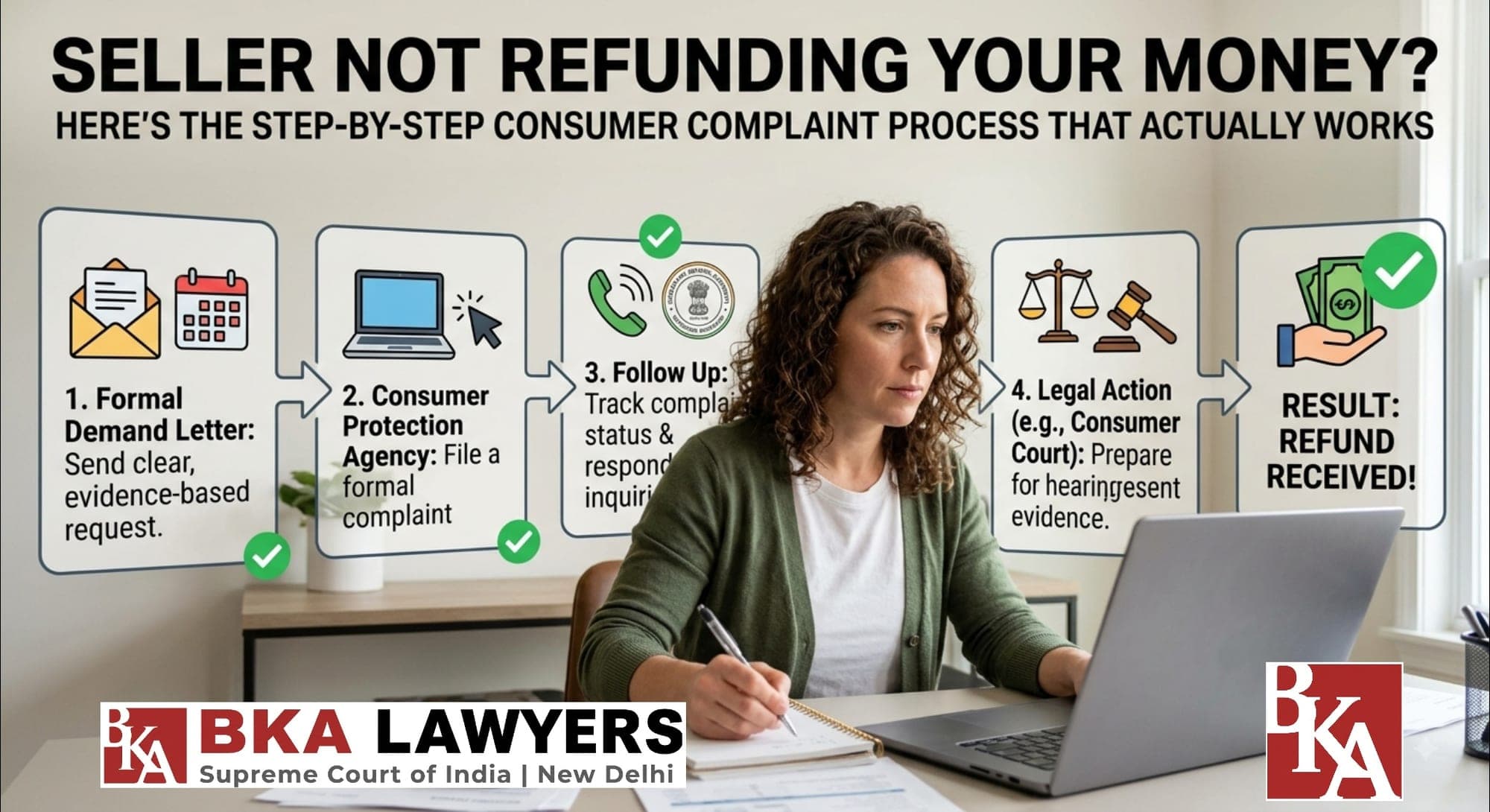
Seller Not Refunding Your Money? Here's the Step-by-Step Consumer Complaint Process That Actually Works
When an online seller keeps your money, the Consumer Protection Act, 2019 lets you file on e-Daakhil or go to the District Commission.

Health Insurance Claim Rejected in India? A Step-by-Step Guide to Filing a Consumer Complaint
A rejected health insurance claim can be challenged. The repudiation letter, the IRDAI and the consumer commission each give you a way to push back.