
Licence Suspended for Challans? Why 'Just Paying the Fine' Can Make It Worse
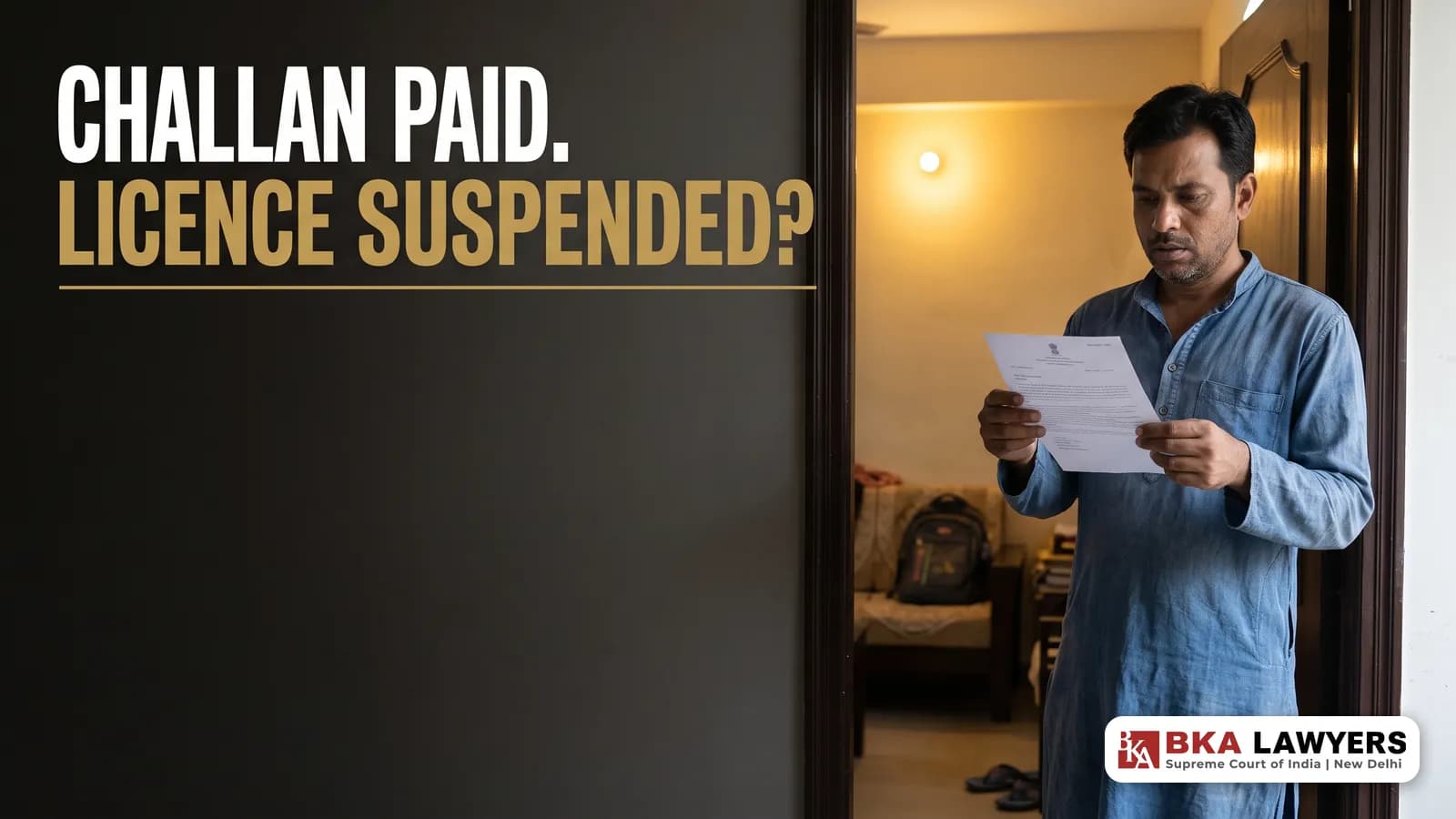
Paying a challan clears the payment. It does not clear the violation from your record. That distinction matters because licence suspension under the Motor Vehicles Act is triggered by the number of violations on record, not by whether the fines were paid.
This is the point most drivers miss. A challan has two separate lives — the money and the record. The moment it is issued, an entry is created against your vehicle and, where the driver is identified, against your licence. Paying settles the first. The second stays, and it accumulates.
What happens first: the record builds quietly
When an e-challan is generated by a camera or issued on the spot, it enters the transport department's enforcement data. Pay within the window allowed and you avoid late fees and court referral. But the fact of the violation remains.
This is where the practical difficulty begins. Most drivers treat the payment receipt as proof that the matter is closed. It is proof of payment, nothing more. A second challan two months later, and a third after that, and you now have a pattern on record that you were never tracking.
In Delhi, this is not theoretical. The Traffic Police have, in the recent past, flagged well over a thousand vehicles — a majority of them private cars and commercial vehicles — with more than a hundred pending challans each to the Transport Department, which then began issuing notices to registered owners. A hundred pending challans on one vehicle tells you something about how records behave when nobody is watching them.
What follows if it continues: action against the licence
The Motor Vehicles Act allows the licensing authority to take action against a driver whose record shows repeated traffic offences. The precise trigger varies: police advisories in different NCR districts have at times fixed their own thresholds — Noida, for instance, has publicly indicated a lower count in the past — while broader state-level policy discussions have pointed to a higher figure across a year. Because these thresholds shift with administrative policy, do not rely on a number you read somewhere. Check what your licensing authority currently applies.
What is consistent, though, is the mechanism. Action is taken against the driving licence, not merely the vehicle. The licensing authority issues a show cause notice — a formal written demand that you explain why your licence should not be suspended or disqualified. If you do not respond, or respond without addressing the record, an order follows. Driving after that order is itself an offence.
For a commercial driver, the consequence is immediate: livelihood stops. For a private car owner, the vehicle may also be flagged, making transfer, renewal or even insurance claims difficult.
What makes it better or worse
What makes it worse is silence. An unanswered show cause notice is treated as an admission that you have nothing to say. The authority proceeds on the record before it, which — because you have not contested anything — consists only of the challans.
What also makes it worse is paying without checking. Before paying, confirm on the official e-challan portal that the violation is genuinely yours: correct registration number, correct location, correct time. Camera errors, cloned plates and misread characters do occur. Paying a challan that was never yours converts a contestable entry into an admitted one.
What makes it better is responding on time, in writing, to the show cause notice, and where the challans are disputed, raising that dispute through the proper forum rather than assuming payment has settled it. Where a challan has already been referred to a magistrate's court, the payment route alone may not dispose of it.
What the person can still do
Gather the full record first: a printout of all challans against the vehicle and licence, the show cause notice, and proof of payment for each challan that was settled. Where a notice has already been received, note the date of receipt — the response window runs from there, not from the date printed on the notice.
The forum matters. For a show cause notice from the licensing authority, the reply goes to that authority. Where the suspension order has already been passed, a statutory appeal or representation to the appellate authority under the Motor Vehicles Act is generally the route, and it is time-bound. Where a challan has been sent to court, the magistrate's court is the forum.
A short, dated reply that deals with each challan individually — paid, disputed, or not attributable to the licence holder — will do more than a letter of apology. If you are unsure which stage you are at, that is the first thing to establish, because the forum and the deadline change with it.
Facing a similar situation? Talk to a BKA advocate before you act.
Chat on WhatsAppFrequently Asked Questions
Will my driving licence get suspended if I have unpaid challans in Delhi?
Unpaid challans alone do not automatically suspend a licence. What triggers action is the number of violations on record, and the licensing authority must first issue a show cause notice giving you a chance to respond. If you do not reply, the authority can proceed on the record before it. The thresholds applied vary by district and change with administrative policy, so check the current position with the licensing authority rather than relying on a figure you have read.
Challan pay kar diya, phir bhi licence suspend ho sakta hai? (I paid the challan, can my licence still be suspended?)
Yes, it can. Payment settles the fine but does not remove the violation from your enforcement record. If the record shows repeated violations, the licensing authority can still initiate action against the licence. This is why it is important to dispute a challan that is not yours before paying it, rather than after.
What should I do if I receive a show cause notice for licence suspension?
Note the date you received it, because your response window runs from receipt, not from the date printed on the notice. Then gather the challan history, payment receipts, and any evidence that a particular challan was wrongly issued. Reply in writing to the licensing authority, dealing with each challan separately rather than sending a general apology. If a suspension order has already been passed, a time-bound appeal or representation is generally the next step.
I never received the challans — can the licence still be suspended?
Notices are sent to the address on the vehicle registration record, so an outdated address is a common reason for missed challans. That does not erase the entries. You can still raise it in your reply to the show cause notice — that notices were not served and that the record is therefore incomplete — but you must do so before an order is passed.
Related Articles
How to Legally Block a Co-Owner from Selling the Family Home
Learn the legal steps to stop a co-owner from selling joint property in India, including filing a partition suit and obtaining a stay order under Order 39 Rule 1 and 2 of the CPC.
Will vs. Succession Certificate: Which One Do You Need?
Understand the key differences between a Will and a Succession Certificate in India, when each is required, and how they affect inheritance claims.
Is Probate Mandatory in Delhi? What the Indian Succession Act Really Says (2025 Update)
Understand the mandatory probate rules in Delhi under the Indian Succession Act, including when probate is required, how to obtain it, and the impact of recent court rulings. Updated for 2025.