
Will vs. Succession Certificate: Which One Do You Need?
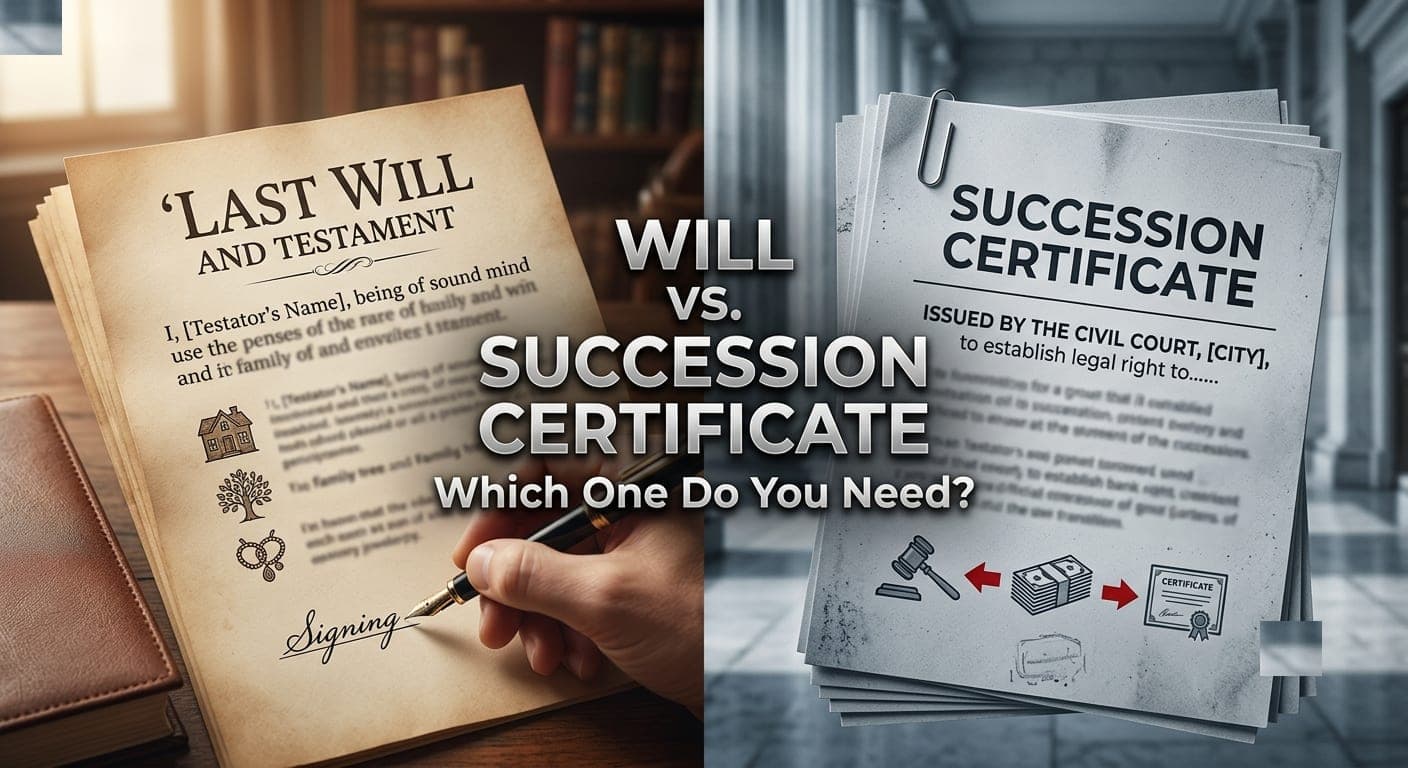
When a person passes away, settling their estate often requires legal documentation. Two common tools are a Will and a Succession Certificate. They serve different purposes, and knowing which one applies can save time, money, and court battles. This article breaks down the differences in plain language.
What is a Will?
A Will is a legal document that declares how a person wants their property distributed after death. It takes effect only upon death and can be changed or revoked anytime during the testator's lifetime. In India, Wills are governed by the Indian Succession Act, 1925, though personal laws may apply to certain communities. A Will must be signed by the testator and witnessed by at least two people to be valid. It does not need to be registered, but registration adds authenticity.
What is a Succession Certificate?
A Succession Certificate is a court-issued document that grants authority to the legal heirs to collect debts, securities, and other assets of the deceased. It is typically needed when there is no Will and the assets are moveable (like bank balances, shares, or mutual funds). The certificate is issued under Section 370 of the Indian Succession Act, 1925. It does not determine who inherits; it simply authorizes the holder to receive the assets from institutions.
Key Differences: Will vs. Succession Certificate
The core distinction is that a Will expresses the deceased's wishes, while a Succession Certificate is a tool to claim assets when there is no Will. A Will requires probate (court validation) in certain cases, especially in metropolitan cities like Kolkata and Chennai. A Succession Certificate is a standalone court order. A Will can cover immovable property, but a Succession Certificate only covers debts and securities. Also, a Will needs witnesses, while a Succession Certificate does not.
When to Use a Will
Use a Will if you want to control who gets what, including naming guardians for minor children. It is essential for transferring immovable property to chosen heirs. Without a Will, intestate succession laws determine the heirs, which may not match your wishes.
When to Use a Succession Certificate
Use a Succession Certificate when the deceased died without a Will, and you need to collect bank balances, shares, or insurance claims. It is also useful when there is a dispute among heirs; the court will hear all claimants before issuing the certificate. The certificate acts as a shield for institutions that release assets to the holder.
Legal Processes: Probate vs. Succession Certificate
Probate is the court process that validates a Will. It is mandatory in certain jurisdictions and for certain assets. Succession Certificate is a simpler process filed before a civil court. For a Will, you may also file letters of administration if there is no executor. The time and cost vary, with probate being more expensive and time-consuming.
Recent Updates and Practical Tips
- RBI and SEBI have simplified claim processes for deceased investors, often allowing claim settlement without a Succession Certificate for smaller amounts, if a nominee is named.
- A Legal Heir Certificate is different; it lists all legal heirs and is often used for government benefits. It does not authorize collection of assets.
- Always name a nominee for bank accounts and investments to avoid the need for a Succession Certificate.
- If there is a Will, probate may be avoided if all heirs agree and the asset value is below a threshold, but this is not guaranteed.
How BKA Lawyers Can Help
We assist clients in drafting Wills, obtaining Probate, and applying for Succession Certificates across Delhi NCR. Whether you are planning your estate or settling a loved one's affairs, our team ensures the process is smooth and legally sound.
Planning your estate or need to claim a loved one's assets? Contact BKA Lawyers for clear, practical advice.
Facing a similar situation? Talk to a BKA advocate before you act.
Chat on WhatsAppNeed help with this?
Our Wills, Succession & Probate services
Frequently Asked Questions
Can a Succession Certificate be used to transfer immovable property?
No. A Succession Certificate only covers moveable assets like bank balances, shares, and securities. For immovable property, you need a Will and possibly probate, or you may have to file a suit for partition if there's no Will.
Is a Will compulsory if I want to leave assets to a charity?
Yes. Intestate succession laws only distribute assets to legal heirs. If you want to leave anything to a charity or a non-family member, a Will is essential.
How long does it take to get a Succession Certificate in Delhi?
It typically takes 3-6 months, depending on court workload and whether any objections are filed. If there are disputes, it can take longer.
What happens if there is a Will but no probate?
Without probate, the executor may face difficulty in transferring title to immovable property, especially in cities like Kolkata and Chennai where probate is mandatory. For banks, they may still accept the Will with a letter of administration or indemnity.
Can a Succession Certificate be challenged in court?
Yes. Any interested party can object to the issuance. The court will hear all parties and decide who should get the certificate, often listing all heirs.

About the author
Ujjwal Agrawal
Advocate · Commercial & Money Recovery Cases
Ujjwal Agrawal focuses on commercial litigation and money recovery, including cheque bounce cases under the Negotiable Instruments Act and recovery suits for individuals and businesses.
More about our team →Related Articles
Is Probate Mandatory in Delhi? What the Indian Succession Act Really Says (2025 Update)
Understand the mandatory probate rules in Delhi under the Indian Succession Act, including when probate is required, how to obtain it, and the impact of recent court rulings. Updated for 2025.
Property Dispute — 10 Costly Mistakes That Sink Property Dispute Cases in Delhi NCR Courts
A senior advocate's plain-English guide to the ten mistakes that quietly destroy property disputes in Delhi NCR — from missing limitation to weak documentation — and what to do instead.
Supreme Court and High Court Rulings on Maintenance When the Wife Has Her Own Income
A wife's salary, flat or car does not automatically shut down her maintenance claim. What the Supreme Court and High Courts have actually held on maintenance where the wife earns, and how the courts decide.