
NEET SS 2025 Counselling: What the Supreme Court Verdict and Revised Round 2 Schedule Mean
The uncertainty surrounding NEET SS 2025 Round 2 counselling has eased after the Supreme Court’s verdict cleared the way for the Medical Counselling Committee (MCC) to issue a revised schedule. For candidates, however, the practical position will become certain only when MCC publishes the official dates, eligibility conditions and reporting instructions on its portal.
What the Supreme Court verdict changes
The immediate effect of the verdict is that the administrative deadlock affecting Round 2 can now be resolved. MCC may proceed in accordance with the Supreme Court’s operative directions and publish a revised counselling timetable.
Candidates should distinguish between a news report about the judgment and the actual order. The order determines what MCC must do, while the revised MCC notice will translate those directions into registration, choice-filling, allotment and reporting dates.
Under Article 141 of the Constitution, the law declared by the Supreme Court binds all courts in India. Article 144 also requires civil and judicial authorities to act in aid of the Supreme Court. The precise consequences nevertheless depend on the wording of the operative order; every admissions order does not automatically create a broad rule for future counselling cycles.
MCC’s revised Round 2 schedule is now the key document
The revised schedule should clarify the dates for activities such as fresh registration, payment, choice submission, choice locking, seat allotment and reporting to the allotted institution. It may also address whether candidates’ earlier choices remain valid or must be submitted again.
Candidates should not assume that a previous registration, payment or saved preference will automatically carry forward. The controlling document will be the fresh notice published on the official MCC website. Social-media posts, coaching-group messages and screenshots of unofficial schedules have no legal authority.
The revised notice should be read together with the applicable counselling scheme and information bulletin. Rules concerning eligibility, security deposits, resignation, forfeiture and participation in later rounds may continue to apply unless MCC expressly modifies them.
Why counselling schedules can become a legal issue
Medical counselling is an administrative process, but it must comply with constitutional standards. Article 14 of the Constitution requires public authorities to act fairly, consistently and without arbitrariness. A sudden rule change, unequal treatment of similarly placed candidates or inadequate notice may therefore be challenged.
At the same time, qualifying NEET SS does not by itself create an unconditional right to a particular seat or institution. Admission depends on rank, eligibility, available seats, submitted preferences and compliance with the notified procedure.
Courts also treat medical admission timelines seriously. Delayed or open-ended counselling can disrupt academic schedules, hospital staffing and training. Judicial relief is therefore usually shaped around the stage of counselling and the practical consequences for other candidates, rather than only the grievance of one applicant.
What NEET SS candidates should do now
Candidates should monitor the official MCC portal closely and keep copies of every relevant document. This includes the revised notice, payment receipts, submitted choices, locked-choice confirmation, allotment letters and correspondence with MCC or the allotted institution.
Once the portal reopens, candidates should:
- verify whether fresh registration is required;
- check whether earlier choices have been retained;
- confirm payment and security-deposit status;
- lock choices before the revised deadline;
- download the final choice list and allotment result; and
- verify the institution’s reporting requirements directly.
If the portal shows an error, take a time-stamped screenshot and send a written complaint through the official channel before the deadline. A contemporaneous record is far more useful than an unsupported claim made after counselling closes.
Can an affected candidate approach the court?
A candidate affected by non-compliance with the Supreme Court’s order, an arbitrary exclusion or a serious portal failure may seek judicial review. A petition can be filed before the appropriate High Court under Article 226 of the Constitution. Direct proceedings before the Supreme Court under Article 32 are reserved for the enforcement of fundamental rights and are not the routine remedy for every counselling dispute.
Court action should not be treated as a substitute for following the revised schedule. Admissions cases are highly time-sensitive, and delay can weaken a claim—particularly once seats have been allotted and third-party rights have arisen.
Before filing, the candidate should preserve the relevant notices, application details, transaction records, emails, screenshots and any response from MCC. The legal challenge must identify a specific violation, not merely dissatisfaction with the allotted seat.
What happens to vacant or unallotted seats?
The revised Round 2 process is expected to determine how available super-speciality seats are allotted after the interruption. The exact seat matrix, however, must come from MCC. Candidates should check the matrix published for the revised round instead of relying on an older vacancy list.
A seat shown as available at one stage may change because of reporting, resignation, category conversion or institutional updates permitted under the counselling scheme. MCC’s final allotment result and the candidate’s allotment letter remain decisive.
The practical position
The Supreme Court verdict has enabled the counselling process to move forward, but candidates must wait for MCC’s formal revised Round 2 notification before acting on dates or assumptions. Prompt portal checks, careful compliance and a complete documentary record will be essential once the updated schedule is released.
Facing a similar situation? Talk to a BKA advocate before you act.
Chat on WhatsAppNeed help with this?
Our Civil Law services
Frequently Asked Questions
Can I rely on the reported NEET SS Round 2 dates before MCC issues a notice?
No. Candidates should wait for the revised notice on MCC’s official website and verify every deadline there. A media report may confirm that counselling will resume, but it does not replace the formal schedule or counselling instructions.
Will my earlier NEET SS Round 2 choices remain valid?
Do not assume that earlier preferences will carry forward. Check the revised MCC notice and your candidate dashboard to see whether choices have been retained, reopened or cancelled. If choice filling is reopened, submit and lock the preferences within the new deadline.
What should I do if the MCC portal fails before the revised deadline?
Take time-stamped screenshots, note the exact error and immediately complain through MCC’s official email or grievance channel. Preserve the complaint and any response. If the problem is not corrected and affects your eligibility or allotment, obtain legal advice without waiting for the counselling round to finish.
Can I challenge the revised NEET SS counselling process in court?
A candidate may approach the appropriate High Court under Article 226 of the Constitution where MCC acts arbitrarily, disobeys the operative court directions or wrongly excludes an eligible candidate. The challenge should be filed promptly and supported by notices, receipts, screenshots and written complaints.
Does qualifying NEET SS create a legal right to a super-speciality seat?
No. Qualifying the examination makes a candidate eligible to participate subject to the applicable rules; it does not guarantee admission to a particular course or institution. Allotment depends on rank, eligibility, available seats, preferences and timely compliance with MCC requirements.
What happens if I do not report after receiving a Round 2 allotment?
The revised MCC schedule and counselling scheme will control the consequences. Depending on the applicable rules, failure to report can lead to cancellation of the allotment, loss of the security deposit or restrictions affecting later rounds. Candidates should check the reporting and resignation provisions before making a decision.

About the author
Binod K. Agrawal
Founding Advocate · Civil Cases & Property Disputes
Binod K. Agrawal is the founding advocate of BKA Lawyers, with extensive experience handling high-stakes litigation across civil, criminal, and commercial matters before the Delhi High Court, District Courts, and Supreme Court of India.
More about our team →Related Articles
Hiding a Live-In Relationship or a Child From a Prospective Bride: What the Kerala High Court Has Now Said
The Kerala High Court has held that concealing a live-in relationship or an existing child from a prospective bride can amount to obtaining consent to sex by deceitful means. Here is what the ruling means, in plain English, and what both sides should know before a marriage is arranged.
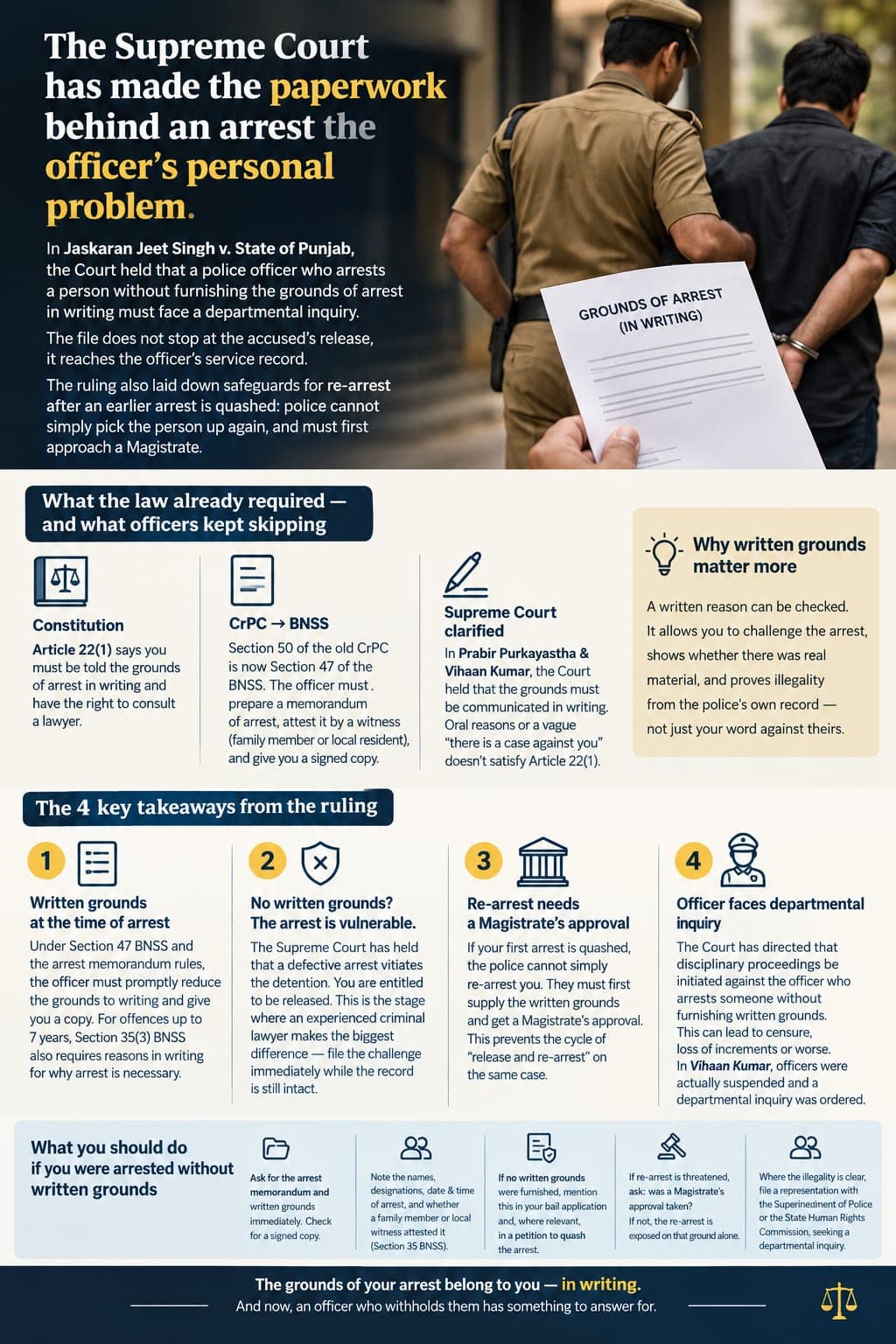
Arrest Without Written Grounds: Why the Supreme Court Says the Officer Must Face a Departmental Inquiry
A police officer who arrests you without handing over written grounds of arrest now faces a departmental inquiry. Here is what the Supreme Court's ruling means for your rights under Article 22(1), Section 35 BNSS and Section 58 BNSS.
Arbitration and Settlement in India: A Practical Guide
Understand how arbitration works in India under the Arbitration and Conciliation Act, 1996, including settlement options, enforceability, and practical steps for resolving disputes outside court.