
No Evidence? No Problem: Why Police Must Register Your FIR in Sexual Harassment Cases
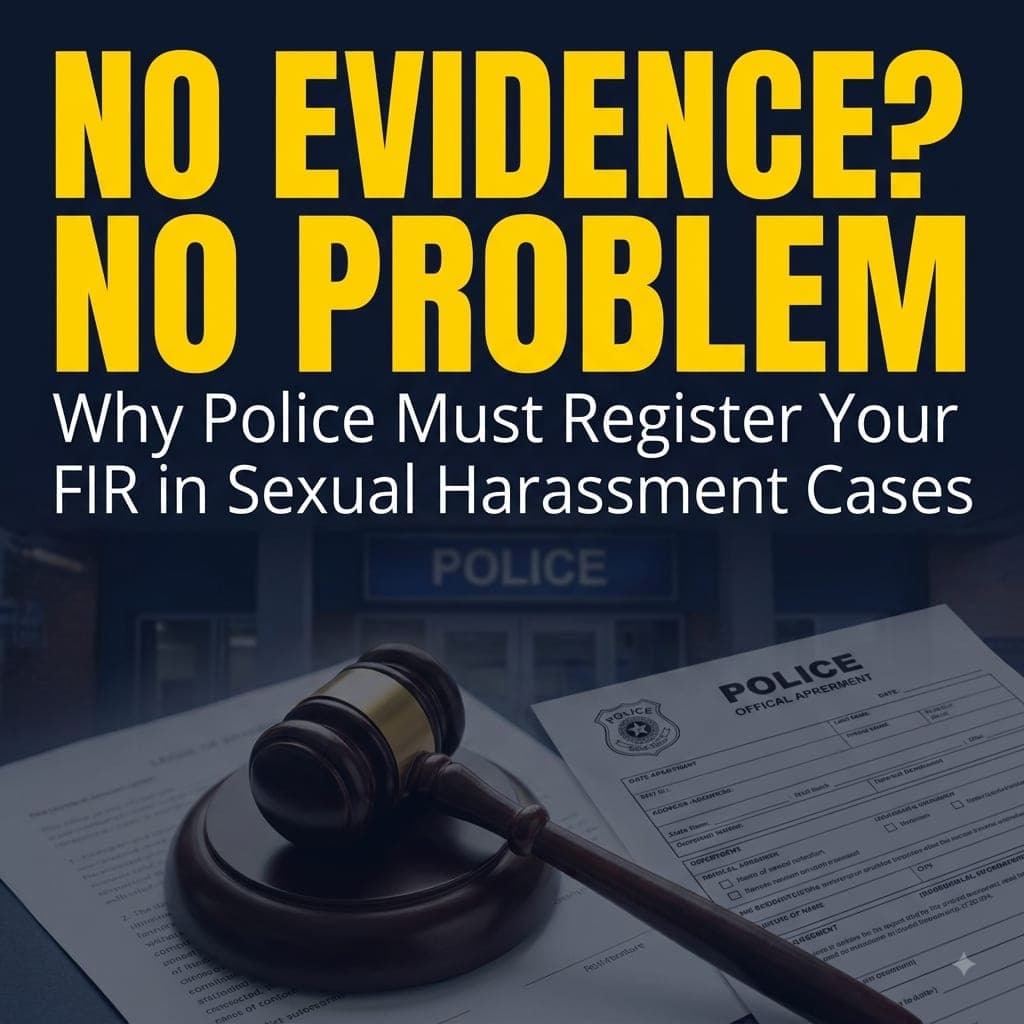
If you've been sexually harassed, you might worry that without WhatsApp chats, call recordings, or other proof, the police will turn you away. A recent Allahabad High Court decision makes clear that such a refusal is illegal. The court held that police cannot refuse to register a First Information Report (FIR) in a sexual harassment complaint merely because the complainant has not produced evidence at the time of filing. This ruling reinforces a fundamental principle of criminal law: an FIR is the starting point of an investigation, not the end. This article explains why evidence isn't required at the FIR stage, what the law demands, and what you can do if the police still refuse to register your complaint.
The FIR Registration Duty: What the Law Says
Under Section 173 of the Bharatiya Nagarik Suraksha Sanhita (BNSS), 2023 (which replaced the old CrPC), the police have a mandatory duty to register an FIR when a complaint discloses the commission of a cognizable offence. Sexual harassment under Section 354A of the Indian Penal Code, 1860 (now covered under Section 75 of the Bharatiya Nyaya Sanhita, 2023) is a cognizable offence. This means the police cannot wait for proof before registering the FIR. The Allahabad High Court, in its recent ruling, emphasized that insisting on evidence at the registration stage is a misreading of the law. The FIR is merely a first information to set the machinery of investigation into motion.
What Does "No Evidence" Really Mean?
The court's ruling addresses a practical reality: many sexual harassment incidents occur in private, without witnesses or independent documentation. Victims often come forward without a trove of WhatsApp chats, call recordings, or other digital trails. The High Court clarified that at the FIR stage, the complainant's statement itself is sufficient. The burden of gathering evidence lies on the police during investigation, not on the victim at the time of filing. As the court noted, asking a traumatized person to produce proof upfront defeats the very purpose of the criminal justice system, which is designed to investigate allegations, not to pre-judge them.
What Happens After the FIR is Registered?
Once the FIR is lodged, the police must investigate under Section 179 of BNSS. This includes recording statements, collecting documents, seizing devices, and examining witnesses. If during investigation the officer finds insufficient evidence, they can file a closure report, but that is a decision made after a full inquiry, not a reason to refuse registering the FIR in the first place. Importantly, if the police refuse to register the FIR or conduct a fair investigation, the victim has remedies: they can approach the Superintendent of Police under Section 176(3) of BNSS, or file a complaint before a Magistrate under Section 175 of BNSS, who can order the police to register the case. These legal avenues exist to ensure that no complaint is brushed aside.
Delayed Complaints: Not a Ground for Refusal
The Allahabad High Court also reiterated that a delay in filing the complaint does not justify refusal to register an FIR. Victims often take time to process trauma, fear retaliation, or seek advice before coming forward. The law recognizes this reality, and courts have consistently held that unexplained delay may be a factor in evaluation, but it cannot be a reason to deny registration. In cases of sexual harassment, especially where a power dynamic is involved, delayed reporting is common and understandable.
Practical Steps If Police Refuse to Register Your FIR
If you face a refusal, here's what you can do:
- Get a written acknowledgment of your complaint, even if the police write "not received" – this becomes evidence of your attempt.
- Approach the Superintendent of Police or the Deputy Commissioner of Police with a written representation, citing the Allahabad High Court ruling.
- File a complaint under Section 175 of BNSS before the local Magistrate, who can direct the police to investigate or take cognizance directly.
- Keep records of all communications with the police, including dates, names, and responses. This documentation is crucial if you need to escalate.
Conclusion
The recent Allahabad High Court decision is a powerful reminder that the police cannot act as gatekeepers of justice by demanding evidence before registering an FIR. The law clearly places the duty to investigate on the police, not on the victim. If you or someone you know has faced sexual harassment, know that you have the right to file an FIR without producing evidence. If the police refuse, don't give up – escalate through legal channels or consult a lawyer who can guide you through the process. At BKA Lawyers, we're here to help you assert your rights and navigate the legal system with confidence.
Facing a similar situation? Talk to a BKA advocate before you act.
Chat on WhatsAppNeed help with this?
Our Criminal Defence services
Frequently Asked Questions
I have no WhatsApp chats or call recordings. Can the police still register my FIR for sexual harassment?
Yes. The Allahabad High Court recently held that police cannot refuse to register an FIR in a sexual harassment case merely because you haven't produced evidence. Your statement is enough to trigger an investigation; gathering evidence is the police's job.
The police station refused to lodge my FIR, saying I need proof. What should I do?
First, get a written acknowledgment of your complaint. Then approach the Superintendent of Police or Deputy Commissioner with a written representation. If that fails, file a complaint before a Magistrate under Section 175 of the BNSS, who can order the police to register the FIR.
Is there a time limit for filing an FIR in sexual harassment cases?
No, there is no strict time limit. A delayed complaint can be filed, and courts have held that delay alone is not a ground to refuse registration. However, the delay may be explained during the investigation, so it's best to file as soon as you are able.
What is a cognizable offence, and why does it matter for my FIR?
A cognizable offence is one where the police can arrest without a warrant and must register an FIR without prior permission. Sexual harassment under Section 354A IPC (now Section 75 BNS) is a cognizable offence, so the police have a mandatory duty to register your FIR.
Can the police file a closure report later if no evidence is found?
Yes, after investigation, if the police find insufficient evidence, they can file a closure report. But that is a decision made after a full inquiry, not a reason to refuse registration initially. You have the right to challenge a closure report before a Magistrate.
What if the incident happened long ago? Will the police refuse?
No. The Allahabad High Court reiterated that delay is not a ground for refusal. You can still file your FIR, though you may need to explain the delay. Courts often consider the trauma and power dynamics in harassment cases to justify delay.

About the author
Ujjwal Agrawal
Advocate · Commercial & Money Recovery Cases
Ujjwal Agrawal focuses on commercial litigation and money recovery, including cheque bounce cases under the Negotiable Instruments Act and recovery suits for individuals and businesses.
More about our team →Related Articles
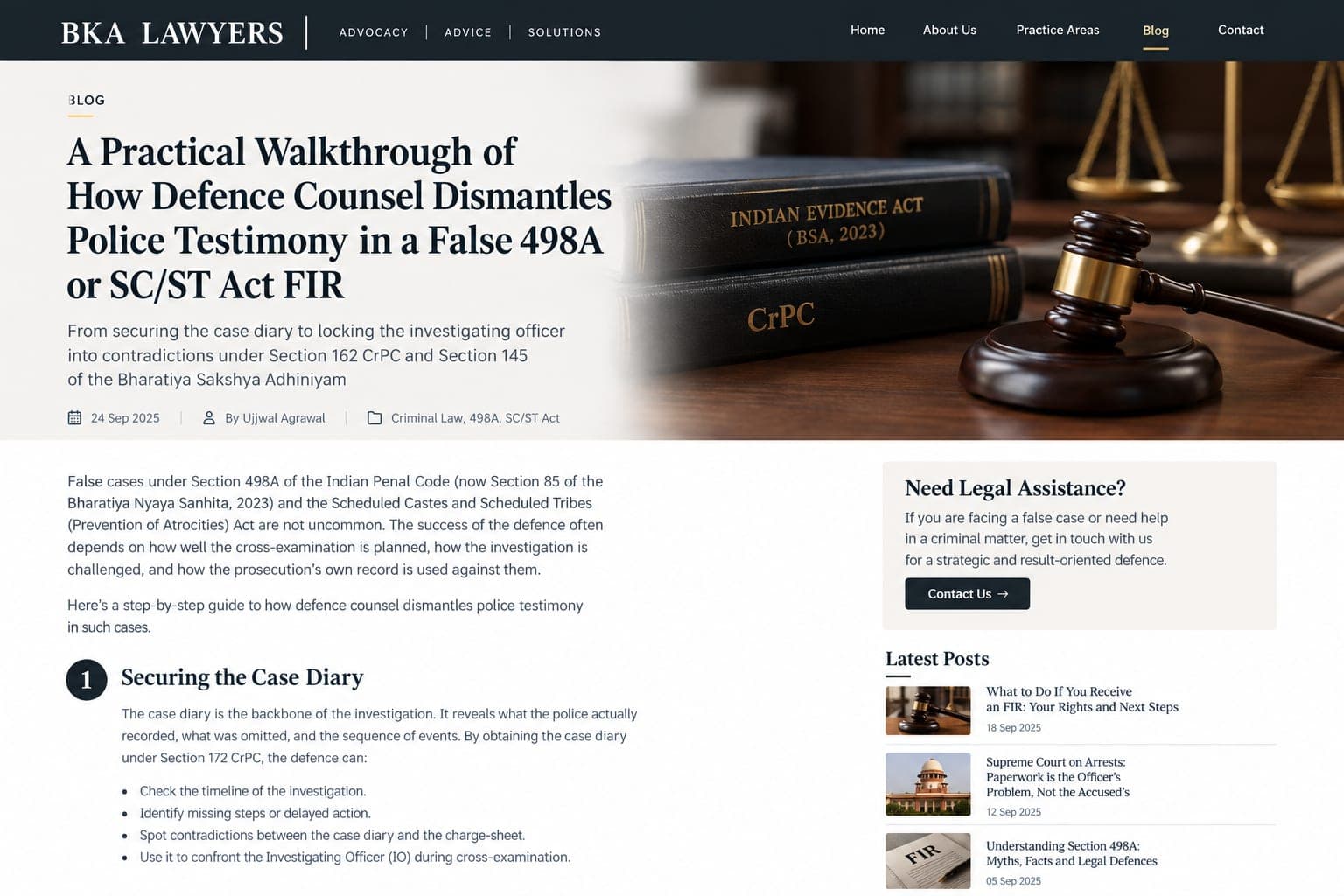
Cross-Examining Police Witnesses in a False FIR: A Step-by-Step Defence Guide
A practical walkthrough of how defence counsel dismantles police testimony in a false 498A or SC/ST Act FIR — from securing the case diary to locking the investigating officer into contradictions under Section 162 CrPC and Section 145 of the Bharatiya Sakshya Adhiniyam.

Can Police Still Register an FIR After Your Section 156(3) Application Is Rejected? Here's What the Supreme Court Just Clarified
The Supreme Court recently held that police can register an FIR even if a Magistrate has rejected a complaint's application under Section 156(3) CrPC. Learn what this means for your case, the legal reasoning, and practical steps for complainants.

Samay Raina and Criminal Liability for Offensive Online Content: What Creators Need to Know
The FIR against Samay Raina over 'India's Got Latent' highlights the real criminal risks of offensive online content. This article breaks down the laws, the legal process, and practical steps for creators.