
Property Dispute — 10 Costly Mistakes That Sink Property Dispute Cases in Delhi NCR Courts
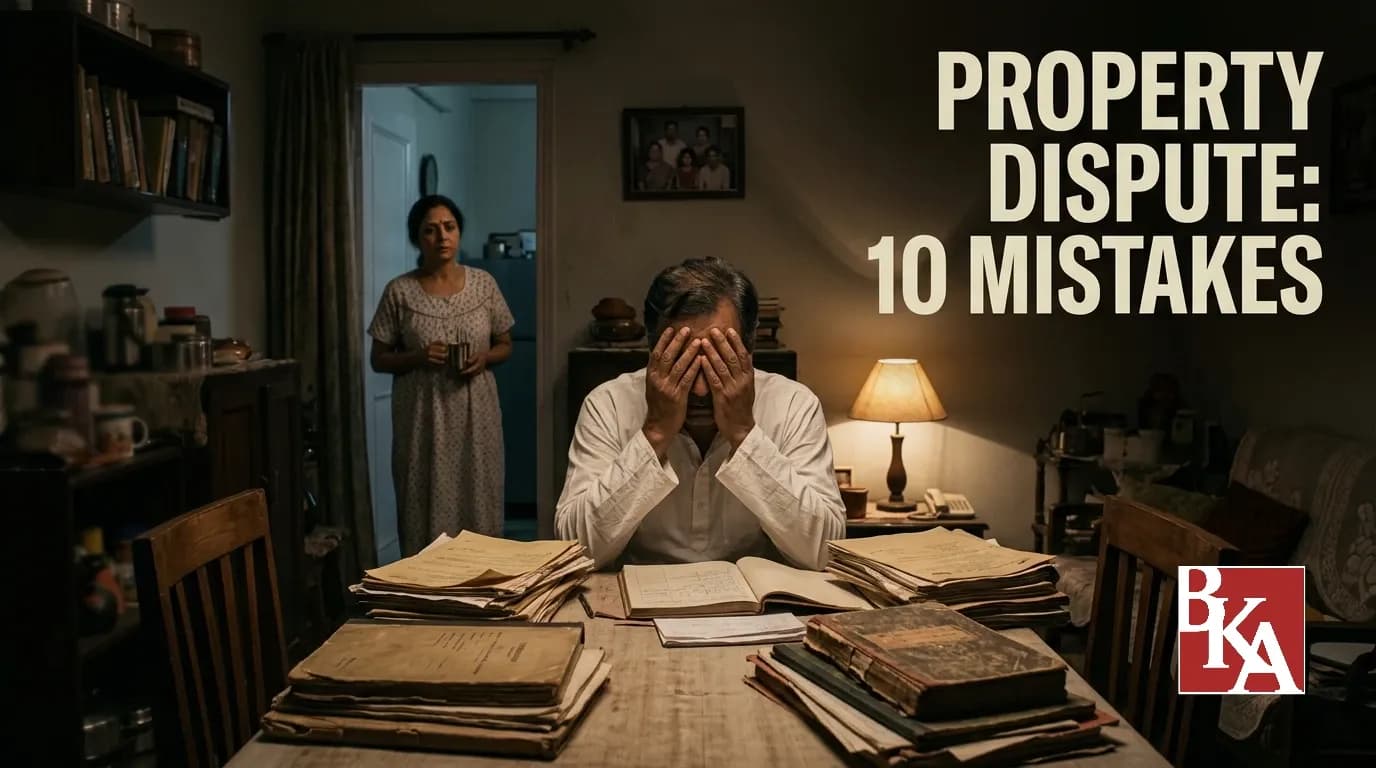
Property litigation in Delhi NCR rarely turns on who is morally right. It turns on who preserved the right evidence, filed in the right forum, and respected the clock. Across the district courts, the Delhi High Court and the tribunals, the same avoidable errors sink otherwise strong claims. Here are ten that come up again and again.
1. Waiting Too Long — Ignoring Limitation
Every property claim has an expiry date. A suit for possession of immovable property based on title must ordinarily be filed within twelve years of the right to sue arising; a suit to enforce a contract, within three years. For a declaration of ownership, the period is three years from when the right is denied. Once limitation runs out, the Limitation Act, 1963 bars the suit — the judge cannot revive it, however genuine the grievance. The mistake is often not deliberate; people wait for a family settlement that never comes, or for a tenant to vacate "next month", and lose years in the meantime.
What to check first: the exact date your right was first denied — a sale deed executed by someone else, a mutation order, a written refusal. That date starts the clock.
2. Filing in the Wrong Forum
Delhi NCR property disputes do not all go to the civil court. A dispute between a landlord and tenant over an unauthorised structure or non-payment of rent may belong before the Rent Controller. A consumer complaint about a builder's delay goes to the consumer commission. A dispute over a project registered under RERA goes to the RERA authority before the civil court. A partition suit among co-owners, however, is a civil suit.
Choosing wrongly is not fatal if corrected quickly, but the return of the plaint and a fresh filing can cost a year or more, and in the meantime the other side may transfer the property. The forum is decided by the nature of the relief you seek, not by the value of the property.
3. Treating Oral Family Arrangements as Binding
A common situation: three brothers divide ancestral land orally, each takes possession of a portion, and everyone lives peacefully for fifteen years. Then one sells "his" share to an outsider, and the buyer claims the whole parcel. Oral partitions are recognised in law, but proving one is another matter. Without a written memorandum, a mutation entry, or long, uninterrupted possession that is open and hostile to the other co-owners, the oral arrangement may be treated as never having happened.
Courts look for conduct consistent with the division — separate tax receipts, separate electricity connections, separate cultivation or construction. If none of that exists, the claim of an oral partition usually fails.
4. Relying on a Power of Attorney as a Sale
An irrevocable power of attorney is not a sale deed. It transfers authority to act, not ownership. Many buyers in Delhi NCR — and many NRIs — have purchased property through a General Power of Attorney and a Will, without a registered conveyance. When the attorney-holder later claims ownership, or when a third party challenges the title, the purchaser has no registered title to fall back on.
The Supreme Court has repeatedly held that a power of attorney transaction does not convey title. If you are buying, insist on a registered sale deed. If you already hold only a power of attorney, get the conveyance completed now, while the original owner is alive and cooperating.
5. A Vague or Unregistered Agreement to Sell
An agreement to sell creates a right to enforce the sale; it does not itself transfer ownership. Two errors are common. First, leaving it unregistered when possession is handed over — under the Registration Act, 1908, an unregistered document that purports to transfer immovable property cannot be received as evidence of that transfer. Second, drafting it so loosely that the property is described only by a khasra number and a rough area, with no boundaries, no chain of title and no timeline for completion.
What courts ask first: does the agreement identify the property beyond doubt, and does it fix a date for performance? If either is missing, the buyer is left arguing equity with no clear starting point.
6. Losing the Chain of Title
Title is proved by an unbroken sequence: the original allotment or sale, every subsequent transfer, the mutation in the revenue records, and the current ownership. A single missing link invites the other side to argue that the person who sold to you had nothing to sell.
The documents that matter most are the sale deed, the mother deed (the deed by which your seller acquired the property), the revenue records and the encumbrance certificate. If a prior transfer was never registered, or a probate was never obtained where a Will was involved, that gap will be exploited.
7. Ignoring Possession While the Title Suit Crawls
Possession is nine-tenths of the practical battle. A person in settled possession cannot be removed except by due process of law, even if the title is against him. Conversely, a title-holder who has never taken possession may spend years in court only to find the property occupied, built upon, or alienated to a third party.
Interim relief matters. An application for an injunction or for appointment of a receiver, filed early, can freeze the situation. Delay it, and the court may say the balance of convenience lies with the occupant.
8. Filing a Criminal Complaint Where the Remedy Is Civil
A dispute over title, boundaries, or a delayed sale is civil. Registration of an FIR for cheating or forgery is only appropriate where there is a genuine allegation of a forged document or dishonest inducement — not where a seller has simply refused to perform an agreement. Filing a criminal case to pressure the other side often backfires: the police may close it, and the civil court may view the conduct as an abuse of process.
Let the criminal and civil tracks run separately, and only where each is independently justified.
9. Poor Pleadings and Weak Documents
A plaint that does not plead the source of title, the date of the cause of action and the exact relief sought will be attacked at the first hearing. So will a written statement that pleads conclusions without documents. Under Order VI Rule 2 of the Code of Civil Procedure, 1908, pleadings must contain a concise statement of material facts, not evidence and not law. Every fact you intend to prove must appear there.
What judges find unconvincing: broad claims of "ancestral right" without a pedigree, assertions of payment without receipts, and documents produced for the first time at the evidence stage without explanation for the delay.
10. Treating Mutation as Ownership
Revenue mutation — the entry of a name in the land records — is for fiscal purposes. It is evidence of possession or of who pays land revenue; it does not create or extinguish title. Many parties believe that a mutation in their favour settles the matter. It does not, and a civil court can and often does look behind it.
If you are buying on the strength of a mutation entry alone, stop and verify the title deed. If you are defending, remember that a mutation entry favourable to the other side is not the end of the case.
What to Do Next
Gather three sets of documents before you do anything else: the chain of title from the original owner to you, the revenue records and mutation entries, and every written communication in which the other side denied your right or demanded something from you. Fix the date of the cause of action from those communications — that date determines your limitation period and, often, the forum. If possession is at risk, move for interim protection promptly. And if a family settlement is being discussed, put it in writing and register it where the law requires.
A property dispute is won or lost long before the final arguments. Most of it happens in the first few months, in the documents you keep and the steps you take.
Facing a similar situation? Talk to a BKA advocate before you act.
Chat on WhatsAppNeed help with this?
Our Property Disputes services
Frequently Asked Questions
Mere paas registered sale deed nahi hai, sirf power of attorney aur will hai. Kya main property ka owner hoon? [I only have a power of attorney and a will, not a registered sale deed. Am I the owner?]
No. A power of attorney gives you authority to act on the owner's behalf; it does not transfer ownership. A Will operates only on the owner's death. To become the legal owner, you need a registered sale deed or other registered conveyance. If the original owner is alive and cooperating, complete the conveyance now — delay only increases the risk of a challenge.
How long do I have to file a property suit in Delhi?
It depends on the relief. A suit for possession based on title ordinarily has a twelve-year limitation period from when the right to sue arose. A suit for declaration of ownership or to enforce a contract is usually three years. The clock generally starts when your right is first denied — for example, when someone else executes a sale deed or a written refusal is issued.
Can I file an FIR against a seller who took my money but did not transfer the property?
Only if there was dishonest inducement from the beginning or a forged document is involved. A mere refusal to perform an agreement to sell is a civil breach, not cheating. Filing an FIR to pressure the seller often fails and can weaken your civil case. The proper remedy is usually a suit for specific performance or for recovery of the advance paid.
What is the difference between mutation and ownership?
Mutation is an entry in the revenue records showing who is liable to pay land revenue. It is evidence of possession or fiscal responsibility, not proof of title. A civil court can look behind a mutation entry and decide ownership on the basis of the registered documents. Buying property only on the strength of a mutation entry is risky.
Should I go to RERA or the civil court for a builder delay dispute in Noida or Gurugram?
If the project is registered under RERA, the authority has jurisdiction over delay, defective construction and refund claims. You can also approach the consumer commission for deficiency of service. A civil suit is generally not the first choice where a specialised forum exists. The correct forum depends on the nature of your claim and the relief you seek.
Our family divided ancestral property orally years ago. Is that valid?
An oral partition is recognised in law, but proving it is difficult. Courts look for conduct consistent with the division — separate possession, separate tax payments, separate utility connections, and mutation entries in each person's name. Without such evidence, the oral arrangement may be treated as never having taken place. It is far safer to record the partition in a written, registered document.

About the author
Ujjwal Agrawal
Advocate · Commercial & Money Recovery Cases
Ujjwal Agrawal focuses on commercial litigation and money recovery, including cheque bounce cases under the Negotiable Instruments Act and recovery suits for individuals and businesses.
More about our team →Related Articles

How to Evict a Tenant in Delhi: A Step-by-Step Guide Under the Delhi Rent Control Act, 1958
A practical, plain-English walkthrough of the legal eviction process in Delhi — the grounds, the notice, the Rent Controller petition, and the execution stage — explained under the Delhi Rent Control Act, 1958.

How to Legally Block a Co-Owner from Selling the Family Home
Learn the legal steps to stop a co-owner from selling joint property in India, including filing a partition suit and obtaining a stay order under Order 39 Rule 1 and 2 of the CPC.
Supreme Court and High Court Rulings on Maintenance When the Wife Has Her Own Income
A wife's salary, flat or car does not automatically shut down her maintenance claim. What the Supreme Court and High Courts have actually held on maintenance where the wife earns, and how the courts decide.