
Contested Divorce Proceedings in India: A Step-by-Step Guide
A contested divorce begins when one spouse seeks dissolution of the marriage and the other spouse opposes either the divorce itself or the grounds and related claims. Unlike mutual consent divorce, the petitioner must establish a legally recognised ground through pleadings and evidence. The following process describes proceedings primarily under the Hindu Marriage Act, 1955 (HMA); the governing grounds may differ for marriages under other personal laws or the Special Marriage Act, 1954.
Step 1: Identify the legal ground for divorce
A Family Court cannot grant a contested divorce merely because the spouses no longer wish to live together. For marriages governed by the HMA, the petition must rely on a ground stated in Section 13, such as cruelty, adultery, desertion for a continuous period of at least two years, conversion, or specified mental disorder grounds.
The ground determines what must be proved. Cruelty may arise from a sustained course of conduct rather than one isolated disagreement. Adultery is often established through surrounding circumstances because direct evidence is uncommon. Desertion requires proof of both separation and an intention to bring marital cohabitation to an end, without reasonable cause and without the petitioner's consent.
Irretrievable breakdown of marriage is not, by itself, a statutory ground that an ordinary Family Court can apply under the HMA. The Supreme Court may dissolve a marriage on that basis using its exceptional power under Article 142 of the Constitution, but parties cannot treat that constitutional remedy as a routine substitute for proving a ground before the trial court.
A divorce petition ordinarily cannot be presented within one year of marriage. Under Section 14 of the HMA, the court may permit an earlier petition only in exceptional circumstances involving extraordinary hardship to the petitioner or extraordinary depravity by the respondent.
Step 2: Choose the proper Family Court and prepare the petition
Territorial jurisdiction is governed by Section 19 of the HMA. Depending on the facts, proceedings may be filed where the marriage was solemnised, where the respondent resides, where the spouses last lived together, or where the wife resides when she is the petitioner. Special jurisdictional rules apply where the respondent is outside India or has not been heard from for seven years.
The petition should set out specific facts rather than broad accusations. Dates, places, communications, periods of separation and earlier proceedings should be pleaded clearly. Relevant material may include messages, emails, medical records, bank documents, travel records, photographs, police complaints and details of witnesses. Electronic records must be preserved in their original form and produced in accordance with the Bharatiya Sakshya Adhiniyam, 2023.
Material facts and existing litigation must be disclosed. Concealing maintenance, domestic violence, child custody or criminal proceedings can damage credibility and complicate interim orders.
Step 3: Filing, scrutiny and service of notice
After filing, the court registry checks the petition for procedural defects, court fees, supporting affidavits and required documents. Once the case is registered, the Family Court issues notice to the respondent.
Proper service is essential. Notice may be served through the recognised modes directed by the court, including personal service, registered post or approved electronic means. If the respondent deliberately avoids service, the court may permit substituted service. When a properly served respondent still fails to appear, the case may proceed ex parte—but the petitioner must still prove the asserted ground.
Step 4: Reply, counterclaim and framing of disputed issues
The respondent files a written statement admitting or denying the allegations and stating their defence. The court may also allow a counterclaim under Section 23A of the HMA where the respondent seeks matrimonial relief based on the petitioner's adultery, cruelty or desertion.
The respondent should answer factual allegations specifically. A bare denial may be inadequate where the petition gives dates, incidents and supporting records. Documents relied upon by either side should be produced at the proper stage rather than introduced unexpectedly during evidence.
After reviewing the pleadings, the court identifies the questions requiring adjudication. These issues may concern whether cruelty occurred, whether desertion continued for the statutory period, whether a party is entitled to maintenance, or what custody arrangement serves the child's welfare.
Step 5: Reconciliation and mediation
Family Courts have a statutory duty to explore settlement. Section 9 of the Family Courts Act, 1984 and Section 23(2) of the HMA require genuine efforts at reconciliation where the circumstances permit. The matter may be referred to a mediator or counsellor, and settlement discussions ordinarily remain confidential.
Mediation is not limited to restoring the marriage. It may resolve permanent alimony, return of belongings, custody, visitation and pending cases. If both spouses ultimately choose divorce by mutual consent, they must follow Section 13B of the HMA, file the appropriate joint petition and maintain free consent through the required stages. A Family Court cannot simply label two opposed divorce cases as a mutual consent petition.
If mediation fails, the contested case returns to the court and proceeds on evidence. A last-minute offer to resume cohabitation does not automatically defeat an otherwise proved divorce claim; the court examines whether the offer is genuine in light of the parties' conduct and earlier reconciliation attempts.
Step 6: Decide interim maintenance, expenses and child arrangements
Several urgent questions may be addressed before the final trial. Under Section 24 of the HMA, either spouse who lacks sufficient independent income may seek interim maintenance and litigation expenses. The court examines actual income, earning capacity, reasonable needs, dependants and financial disclosures; maintenance is not fixed by a universal percentage.
Section 26 of the HMA permits interim orders concerning the custody, maintenance and education of minor children. The controlling consideration is the child's welfare, not an automatic parental entitlement. Courts may create a temporary visitation schedule while evidence on final custody is pending.
Other remedies may run alongside the divorce case. These include monetary relief and residence orders under the Protection of Women from Domestic Violence Act, 2005, or maintenance proceedings under Section 144 of the Bharatiya Nagarik Suraksha Sanhita, 2023, which replaced Section 125 of the Code of Criminal Procedure, 1973. Courts account for overlapping awards to prevent an undisclosed double recovery, although one proceeding does not automatically cancel another.
Step 7: Evidence, cross-examination and final arguments
The petitioner normally leads evidence first because that spouse carries the burden of proving the pleaded ground. Witness affidavits are filed, documents are exhibited and witnesses face cross-examination. The respondent then presents their evidence and may also be cross-examined.
The standard in a matrimonial case is the preponderance of probabilities, not proof beyond reasonable doubt. The judge assesses whether the alleged ground is more likely than not, considering the complete course of conduct. Allegations unsupported by records, consistent testimony or surrounding circumstances may fail.
Matrimonial proceedings are conducted in camera under Section 22 of the HMA. Publication of material relating to such proceedings is restricted, protecting the parties and children from unnecessary public exposure.
After evidence closes, both sides address the legal grounds, credibility of witnesses, documentary record and related reliefs. The Family Court then delivers its judgment.
Step 8: Final decree, permanent alimony and appeal
If a ground is proved and no legal bar applies, the court may grant a decree of divorce. It may also determine permanent alimony under Section 25 of the HMA and make or continue child-related orders under Section 26. If the evidence does not establish the pleaded ground, the petition may be dismissed even where the marriage has effectively broken down.
An appeal from a decree or appealable order under the HMA is governed by Section 28. The statutory period under Section 28(4) is 90 days from the date of the decree or order, subject to the law governing exclusion or condonation of delay.
A divorced person should not remarry immediately after the decree. Under Section 15 of the HMA, remarriage is lawful only when there is no right of appeal, the appeal period has expired without an appeal, or a filed appeal has been dismissed.
Contested divorce litigation is decided on precise pleadings, admissible evidence and consistent conduct—not the number or intensity of allegations. Early organisation of financial records, communications, child-related documents and connected case details can prevent avoidable delay and keep the dispute focused on issues the Family Court can legally decide.
Facing a similar situation? Talk to a BKA advocate before you act.
Chat on WhatsAppNeed help with this?
Our Divorce Matters services
Frequently Asked Questions
Can my spouse obtain a contested divorce if I do not consent?
For marriages governed by the Hindu Marriage Act, one spouse may file without the other's consent only by relying on a statutory ground under Section 13, such as cruelty, adultery or desertion. The court will grant divorce only if that ground is proved on a preponderance of probabilities.
How long does a contested divorce usually take in Delhi NCR?
There is no fixed completion period. The timeline depends on service of notice, interim applications, court workload, evidence, cross-examination and whether connected maintenance or custody disputes are pending. Missed hearings and incomplete financial disclosure commonly extend the case.
Can a Family Court grant divorce only because we have lived separately for years?
No. Irretrievable breakdown is not an independent statutory ground available to a Family Court under the Hindu Marriage Act. The Supreme Court can use Article 142 of the Constitution in an appropriate case, but a trial court ordinarily requires proof of a ground listed in Section 13.
Can a husband claim interim maintenance during a contested divorce?
Yes. Either spouse without sufficient independent income may apply for interim maintenance and litigation expenses under Section 24 of the Hindu Marriage Act. The court considers income, earning capacity, reasonable expenses, dependants and maintenance already ordered in other proceedings.
What happens if the respondent ignores the divorce notice?
The case may proceed ex parte after the court is satisfied that notice was properly served. The petitioner does not win automatically and must still present evidence proving a lawful ground for divorce. An ex parte decree may also be challenged on legally recognised grounds.
Can a contested divorce later become a mutual consent divorce?
Yes. The parties may settle during mediation or at any later stage and choose mutual consent divorce. They must file the proper joint petition under Section 13B and continue to consent; the Family Court cannot convert opposed petitions into mutual consent divorce without that process.

About the author
Neha Sharma
Advocate · Divorce & Matrimonial Disputes
Neha Sharma represents clients in divorce and matrimonial disputes, bringing a sensitive and thorough approach to family law matters including custody, maintenance, and domestic violence cases.
More about our team →Related Articles
Proving Mental Cruelty in Indian Divorce: 5 Evidence Types Courts Actually Accept
Learn the five types of evidence Indian courts accept to prove mental cruelty in divorce cases, including WhatsApp messages, witness testimony, and more. Essential guide for spouses seeking divorce on grounds of cruelty.
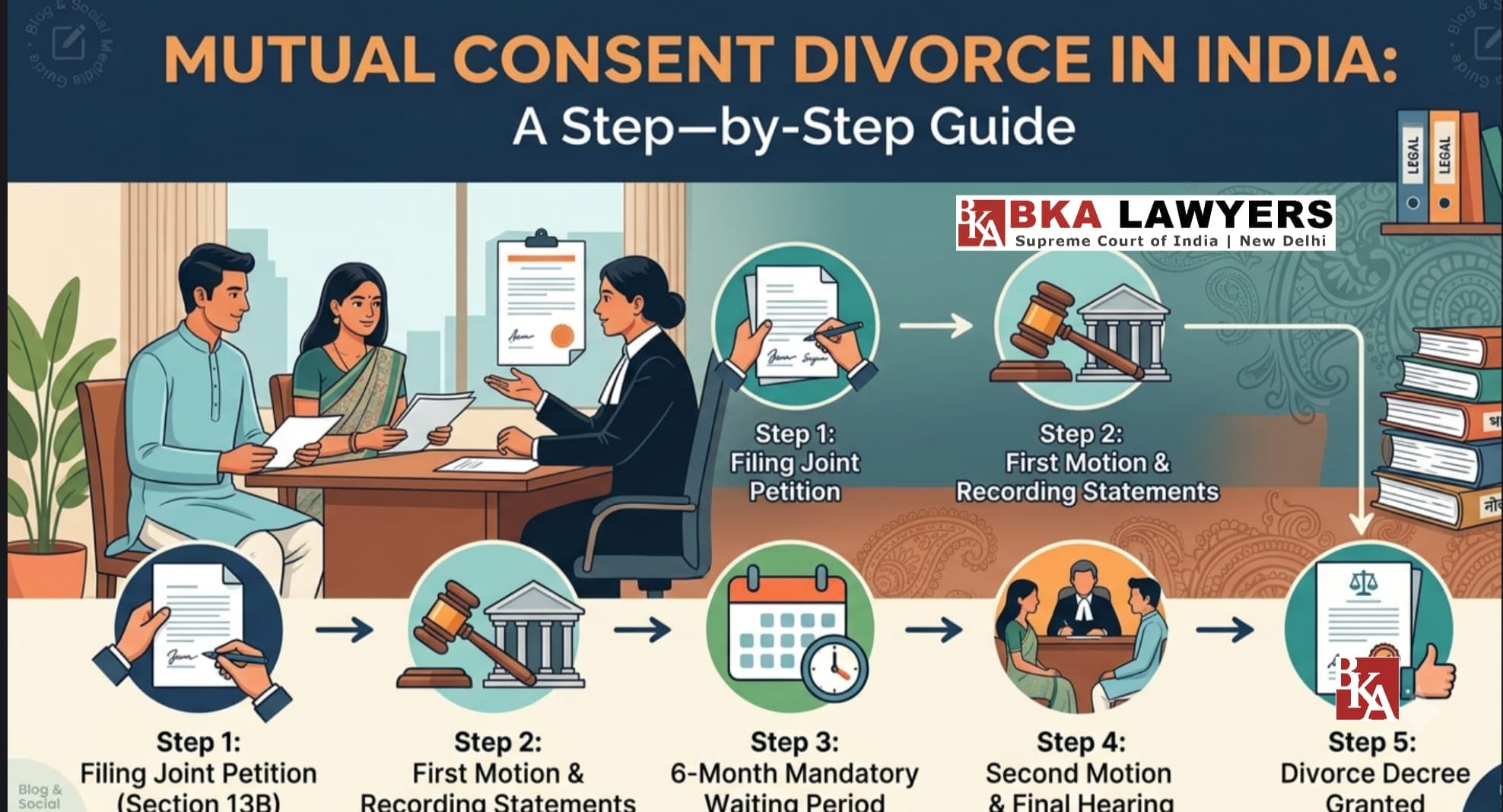
Mutual Consent Divorce in India: A Step-by-Step Guide (2026)
Learn how mutual consent divorce works in India under Section 13B of the Hindu Marriage Act, including the cooling-off period, the role of the family court, and key considerations for alimony, child custody, and the second motion.
Judicial Separation Lawyer in Delhi: Grounds, Rights and Court Process
Understand judicial separation in Delhi, including legal grounds, Family Court procedure, maintenance, child custody and the difference from divorce.