
Judicial Separation Lawyer in Delhi: Grounds, Rights and Court Process
Judicial separation allows spouses to live apart under a court decree without ending the marriage. For couples who are not ready for divorce—or who want legal protection while deciding their future—it can clarify obligations relating to cohabitation, maintenance, children and pending matrimonial disputes. A judicial separation lawyer in Delhi can assess whether this remedy fits the facts and present the case before the appropriate Family Court.
What Judicial Separation Means Under Indian Law
For marriages governed by the Hindu Marriage Act, 1955, judicial separation is available under Section 10. Once the court passes a decree, the spouses are no longer required to live together. The marriage, however, remains legally valid.
This distinction has practical consequences:
- Neither spouse can remarry while the marriage continues.
- The decree does not automatically divide jointly owned property.
- Questions of maintenance, child custody and visitation may still require separate or interim orders.
- Either spouse may later seek rescission of the decree if the court considers it just and reasonable.
Judicial separation is also recognised under Section 23 of the Special Marriage Act, 1954. Other communities may be governed by provisions such as Section 22 of the Divorce Act, 1869 or Section 34 of the Parsi Marriage and Divorce Act, 1936. The correct legal route therefore depends on how the marriage was solemnised and the personal law applicable to the parties.
Grounds for Judicial Separation
Under Section 10 of the Hindu Marriage Act, a spouse may seek judicial separation on the grounds available for divorce under Sections 13(1) and 13(2). Common grounds include:
- Cruelty, whether physical or mental;
- Adultery;
- Desertion for a continuous period of at least two years immediately before filing;
- Conversion to another religion;
- Serious mental disorder meeting the statutory requirements;
- Renunciation of the world by entering a religious order; or
- The spouse not being heard of as alive for seven years or more.
A wife may also rely on the additional grounds provided by Section 13(2), where applicable.
Merely stating that the marriage has become unhappy is not enough. The petition must identify a recognised legal ground and set out specific incidents, dates and supporting material. In a cruelty case, for example, contemporaneous messages, medical records, police complaints, financial documents and witness testimony may be relevant.
Judicial Separation Versus Divorce
The key difference is that divorce dissolves the marriage, while judicial separation does not. A divorced person may remarry after the decree becomes final and any applicable appeal period has passed. A judicially separated spouse cannot.
Judicial separation may be suitable where:
- A spouse wants formal permission to live separately but does not presently want divorce;
- Religious, personal or family considerations make immediate divorce difficult;
- Reconciliation remains possible, but living together is unsafe or unworkable; or
- A spouse needs court orders concerning maintenance or children while the marriage continues.
Judicial separation should not be treated as an informal trial divorce. It is a substantive decree passed after the court examines the pleaded ground and evidence.
How a Judicial Separation Case Proceeds in Delhi
A petition is filed before the Family Court having territorial jurisdiction. For Hindu marriages, Section 19 of the Hindu Marriage Act permits filing, among other places, where the marriage was solemnised, where the respondent resides, or where the spouses last lived together. A wife filing the petition may also rely on the jurisdiction of the place where she resides on the filing date.
After filing, the usual stages include scrutiny of the petition, issuance of notice, the respondent’s written statement, counselling or mediation, framing of disputed issues, evidence and final arguments. Under Section 9 of the Family Courts Act, 1984, the Family Court must make appropriate efforts toward settlement where possible.
Settlement discussions do not require a person to return to an abusive or unsafe household. Where there is domestic violence or an immediate threat, urgent protective remedies may be pursued separately.
There is no single statutory period within which every judicial separation case must finish. The duration depends on service of notice, interim applications, the volume of evidence, settlement prospects and whether the case is contested.
Maintenance, Children and Residence During Separation
A petition for judicial separation does not prevent either spouse from requesting financial or child-related relief.
Under Section 24 of the Hindu Marriage Act, a spouse without sufficient independent income may seek interim maintenance and litigation expenses. Section 25 permits permanent alimony, while Section 26 empowers the court to pass orders concerning the custody, maintenance and education of minor children.
Depending on the facts, a wife may also claim maintenance under Section 144 of the Bharatiya Nagarik Suraksha Sanhita, 2023, which replaced Section 125 of the Code of Criminal Procedure, 1973. Relief under the Protection of Women from Domestic Violence Act, 2005 may include protection orders, residence orders, monetary relief, temporary custody and compensation under Sections 18 to 22.
Child custody is decided according to the child’s welfare, not as a reward or punishment for either parent. The court may regulate visitation, schooling, travel and day-to-day expenses while the main petition remains pending.
Can Judicial Separation Later Lead to Divorce?
Yes, but divorce is not automatic. Under Section 13(1A)(i) of the Hindu Marriage Act, either spouse may seek divorce if there has been no resumption of cohabitation for at least one year after the judicial separation decree.
A fresh divorce petition must still be filed and decided by the court. Conversely, if the spouses reconcile, either may ask the court to rescind the judicial separation decree under Section 10(2).
This flexibility is one reason some couples choose judicial separation: it creates legal distance without immediately and permanently dissolving the marital relationship.
Documents Commonly Required
The documents needed depend on the ground and the relief claimed, but a judicial separation lawyer in Delhi will commonly review:
- Marriage certificate, wedding photographs or other proof of marriage;
- Identity and address documents;
- Details of the place where the parties last lived together;
- Messages, emails, call records or complaints relevant to cruelty or desertion;
- Medical records, where legally relevant;
- Salary slips, bank statements, income-tax returns and details of assets and liabilities;
- Children’s birth certificates, school records and expense statements; and
- Copies of any pending domestic violence, maintenance, criminal or custody proceedings.
Evidence should be preserved in its original form. Selectively edited screenshots or recordings obtained through questionable means can create evidentiary and privacy disputes.
How a Judicial Separation Lawyer in Delhi Can Help
A lawyer’s role begins with choosing the correct remedy. In some situations, judicial separation is appropriate; in others, divorce, restitution of conjugal rights, domestic violence relief or a negotiated settlement may better address the client’s objective.
Counsel can also identify the proper Delhi Family Court, draft fact-specific pleadings, organise electronic and financial evidence, seek interim maintenance or child-related orders, respond to counterclaims and conduct settlement discussions without compromising essential rights.
The initial legal strategy matters because allegations made in one matrimonial proceeding can affect connected maintenance, custody, domestic violence or criminal cases. Consistency across pleadings is therefore essential.
Judicial separation provides legal recognition to living apart while keeping the marriage intact. Before filing, it is sensible to assess the applicable personal law, available evidence, financial needs, child-care arrangements and the realistic prospects of reconciliation or eventual divorce.
Facing a similar situation? Talk to a BKA advocate before you act.
Chat on WhatsAppNeed help with this?
Our Divorce Matters services
Frequently Asked Questions
Can I remarry after obtaining judicial separation in Delhi?
No. A decree of judicial separation suspends the obligation to cohabit but does not dissolve the marriage. Neither spouse can legally remarry unless the marriage is later ended by a valid divorce decree.
Can spouses obtain judicial separation by mutual consent?
Under the Hindu Marriage Act, there is no separate mutual-consent procedure for judicial separation. Even if the other spouse does not contest the case, the court must be satisfied that a statutory ground under Section 10 read with Section 13 has been established.
Can I claim maintenance while seeking judicial separation?
Yes. Under Section 24 of the Hindu Marriage Act, either spouse who lacks sufficient independent income may seek interim maintenance and litigation expenses. Permanent alimony may also be considered under Section 25, while other maintenance remedies may be available under Section 144 of the BNSS or the Domestic Violence Act.
How soon after judicial separation can I apply for divorce?
Under Section 13(1A)(i) of the Hindu Marriage Act, either spouse may file for divorce if cohabitation has not resumed for at least one year after the judicial separation decree. Divorce is not automatic; a separate petition and decree are required.
Which Family Court in Delhi will hear my judicial separation case?
Jurisdiction depends on facts such as where the marriage took place, where the respondent lives and where the spouses last lived together. Under Section 19 of the Hindu Marriage Act, a wife may also file where she resides on the date of filing, subject to the statutory requirements.
What happens to child custody during judicial separation?
The court may pass custody, maintenance and education orders under Section 26 of the Hindu Marriage Act. The child’s welfare is the controlling consideration, and the court can set temporary custody and visitation arrangements while the case is pending.

About the author
Neha Sharma
Advocate · Divorce & Matrimonial Disputes
Neha Sharma represents clients in divorce and matrimonial disputes, bringing a sensitive and thorough approach to family law matters including custody, maintenance, and domestic violence cases.
More about our team →Related Articles
Proving Mental Cruelty in Indian Divorce: 5 Evidence Types Courts Actually Accept
Learn the five types of evidence Indian courts accept to prove mental cruelty in divorce cases, including WhatsApp messages, witness testimony, and more. Essential guide for spouses seeking divorce on grounds of cruelty.
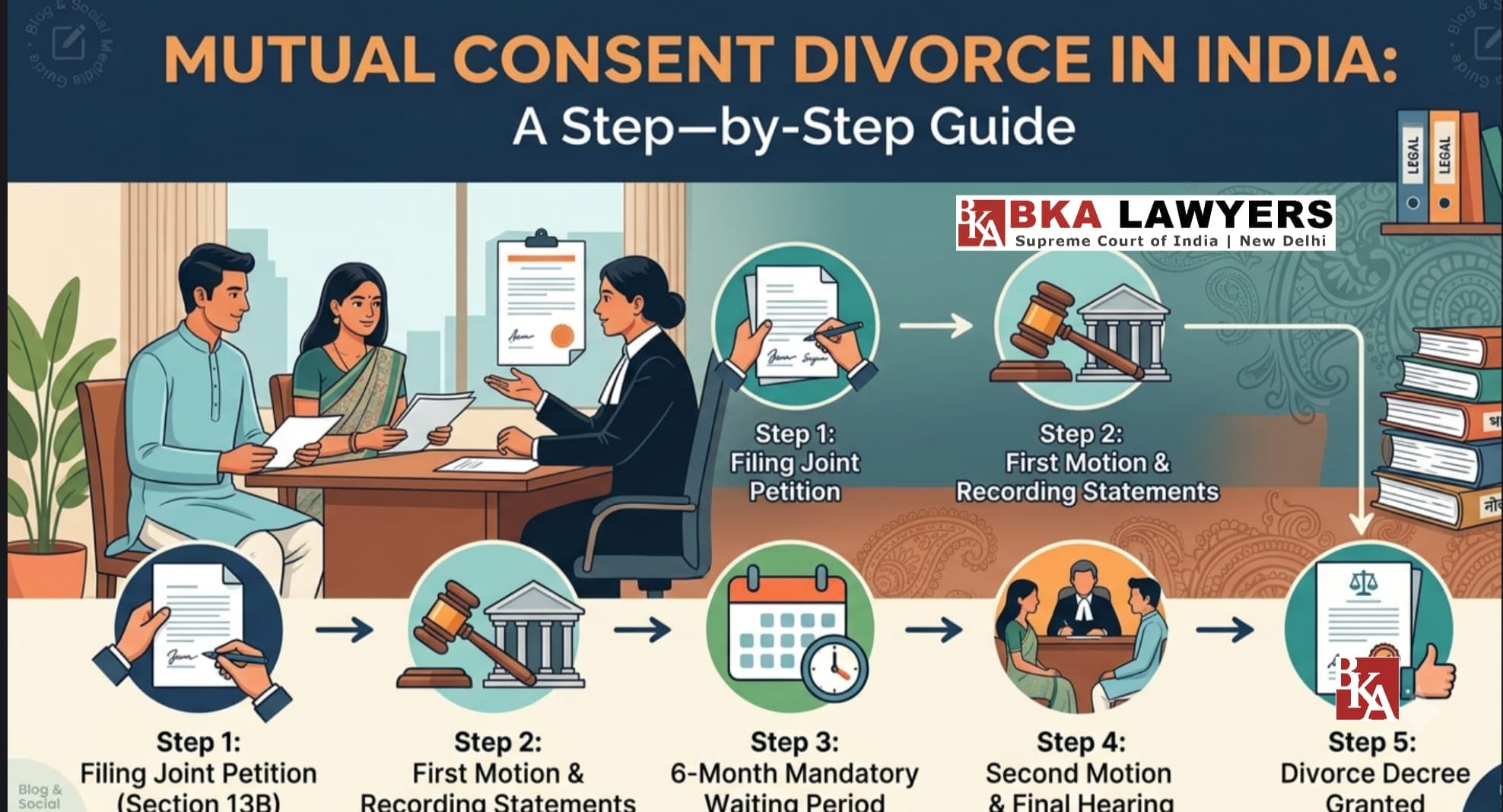
Mutual Consent Divorce in India: A Step-by-Step Guide (2026)
Learn how mutual consent divorce works in India under Section 13B of the Hindu Marriage Act, including the cooling-off period, the role of the family court, and key considerations for alimony, child custody, and the second motion.
Contested Divorce Proceedings in India: A Step-by-Step Guide
A practical guide to contested divorce proceedings in India, covering legal grounds, Family Court filing, mediation, evidence, maintenance, custody, decree and appeal.