
SARFAESI Notice Received: Your 60-Day Action Plan to Protect Your Property
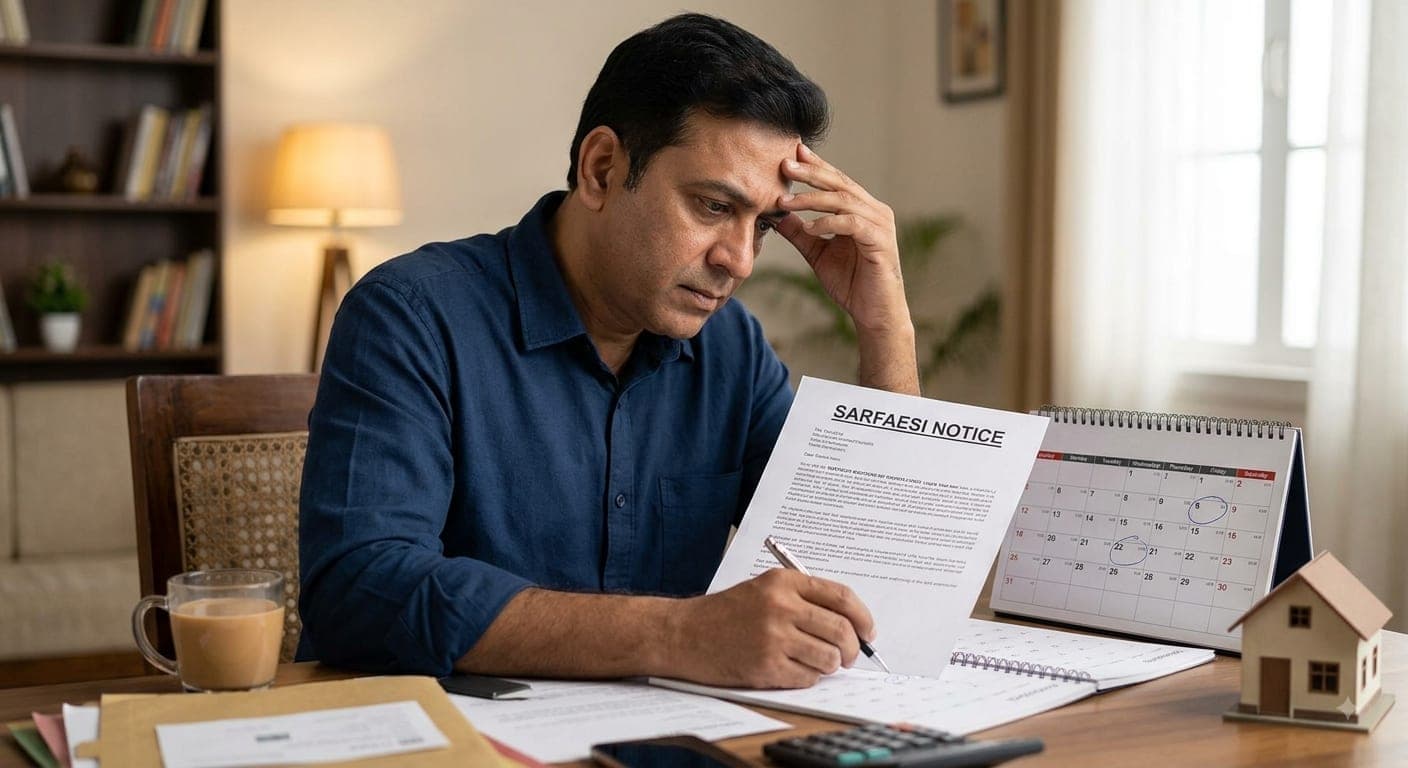
A SARFAESI notice is not a eviction order — it's a warning shot. Under the Securitisation and Reconstruction of Financial Assets and Enforcement of Security Interest Act, 2002 (SARFAESI Act), a bank or NBFC must give you at least 60 days to repay the outstanding dues before it can take possession of your property. Most borrowers panic and either ignore the notice or surrender. The smarter move is to treat those 60 days as a structured negotiation and legal window. Here's your action plan.
Step 1: Verify the Notice's Legality and Timeline
Not every notice is valid. Check whether the bank has complied with Section 13(2) of the SARFAESI Act — the demand notice must state the amount due, the asset secured, and give you 60 days from receipt to pay. It must be served personally or by registered post. If the bank fails to prove proper service, the entire subsequent action can be challenged. A recent DRAT order set aside a possession order because the bank couldn't prove personal service of the 13(2) notice. So, note the date you actually received the notice — that's when your 60-day clock starts ticking.
Step 2: Don't Sit Silent — File a Representation Under Section 13(3A)
Within those 60 days, you can file a written representation or objection with the bank. The bank is legally bound to consider it and pass a reasoned order. This is not a formality. If the bank dismisses your objection without proper reasoning, you can use that as a ground to challenge the entire action later. Keep a copy of your representation and proof of delivery. This step often gets overlooked, but it's a powerful tool that can force the bank to pause and review.
Step 3: Consider Regularising the Loan or One-Time Settlement
The 60-day window is also your best chance to negotiate. Use this time to approach the bank with a concrete plan: either clear the overdue EMIs and regularization charges, or propose a one-time settlement (OTS). Banks are often open to OTS because it avoids the cost and delay of auction. If you can arrange funds, an OTS can save your property and your credit score. Even if you can't pay in full, a partial payment might buy you more time — some banks will accept a payment and extend the timeline informally.
Step 4: If the Bank Moves to Possession, File a Securitisation Application Under Section 17
If you fail to pay and the bank issues a Section 13(4) notice (symbolic possession) or takes physical possession under Section 14, you have the right to file a Securitisation Application (SA) with the Debt Recovery Tribunal (DRT). The SA must be filed within 45 days of the bank's possession notice. The DRT can stay the bank's action and even restore possession if it finds the bank violated procedure. Delay is fatal — missing the 45-day deadline can leave you without a remedy. So, the moment you get a 13(4) notice, start preparing your SA.
Step 5: Appeal to the Debt Recovery Appellate Tribunal (DRAT)
If the DRT rules against you, you have a further appeal to the DRAT within 30 days. The DRAT has set aside bank actions where notices were not properly served or where the bank failed to follow the rules. This second tier gives you another chance, but it's increasingly technical — you'll need strong legal representation and a clear procedural error to succeed.
When a Court Can Still Protect You
Courts have refused to interfere when the bank followed the process correctly. For example, the Calcutta High Court recently refused to protect a wife's property under the Domestic Violence Act because the SARFAESI action was independent and the bank had complied with the law. The takeaway: don't expect courts to rescue you just because you're facing hardship. Your protection lies in the SARFAESI process itself — use it correctly.
The 60-day clock is precious, but it's also a deadline, not a doom. Start by verifying the notice, file a representation, negotiate if you can, and keep your options open for a DRT challenge. The worst thing you can do is ignore the notice and hope it goes away — it won't. Consult a lawyer who specialises in banking disputes before the 60 days expire. Acting early gives you leverage; acting late leaves you with a legal battle that's harder to win.
Facing a similar situation? Talk to a BKA advocate before you act.
Chat on WhatsAppNeed help with this?
Our Banking & NBFC Disputes services
Frequently Asked Questions
I received a SARFAESI notice from my bank. How many days do I have to respond?
You have 60 days from the date of receipt of the notice under Section 13(2) to repay the dues or file a representation with the bank. The bank cannot take possession before this period ends. After that, if you still haven't resolved it, the bank may issue a possession notice, and you'll have 45 days to file a Securitisation Application with the DRT.
Can I negotiate with the bank after receiving a SARFAESI notice?
Yes, absolutely. Within the 60-day window, you can approach the bank with a repayment proposal or a one-time settlement (OTS). Banks often prefer OTS to avoid the time and cost of auction. Filing a formal representation under Section 13(3A) makes your negotiation part of the legal record, which can help if you later need to challenge the bank's action.
What happens if I ignore the SARFAESI notice?
If you ignore it, the 60 days will pass, and the bank will proceed to issue a possession notice under Section 13(4). At that stage, you have only 45 days to file a Securitisation Application with the DRT. If you miss that deadline too, the bank can take physical possession and auction your property. Ignoring the notice is the worst strategy — it only takes away your chance to defend.
Can the bank take possession of my house even if I have a pending case in another court?
Yes, unless you have obtained a stay from the DRT or DRAT. SARFAESI actions are independent of other proceedings. For example, a court order under the Domestic Violence Act does not automatically stop the bank from enforcing its security interest. You must challenge the possession notice before the DRT specifically.
I am a guarantor for a loan, and the bank has issued a SARFAESI notice to me. Do I have the same rights as the borrower?
Yes, as a guarantor, you are entitled to the same protections. The bank must serve you a demand notice under Section 13(2), and you have the same 60-day window to respond. You can file representation, negotiate, and if the bank takes possession, you can file a Securitisation Application before the DRT. However, the bank is not required to exhaust remedies against the borrower first.
Is there a time limit to file an appeal against a DRT order in a SARFAESI case?
Yes, you can appeal to the Debt Recovery Appellate Tribunal (DRAT) within 30 days from the date of the DRT order. The DRAT is the second tier of appeal, and it has set aside bank actions where the bank failed to follow procedure, such as improper service of notice. You'll need strong legal grounds, not just hardship, to succeed.

About the author
Ujjwal Agrawal
Advocate · Commercial & Money Recovery Cases
Ujjwal Agrawal focuses on commercial litigation and money recovery, including cheque bounce cases under the Negotiable Instruments Act and recovery suits for individuals and businesses.
More about our team →Related Articles
Property Dispute — 10 Costly Mistakes That Sink Property Dispute Cases in Delhi NCR Courts
A senior advocate's plain-English guide to the ten mistakes that quietly destroy property disputes in Delhi NCR — from missing limitation to weak documentation — and what to do instead.
Supreme Court and High Court Rulings on Maintenance When the Wife Has Her Own Income
A wife's salary, flat or car does not automatically shut down her maintenance claim. What the Supreme Court and High Courts have actually held on maintenance where the wife earns, and how the courts decide.
Interim vs Permanent Maintenance: When Can a Husband Legally Reduce or Stop Payments?
Maintenance cannot be stopped at will. This explainer sets out when a husband can lawfully seek reduction or cancellation, and when non-payment is simply illegal.